Thalis H. B. da Silva, Théo Cavignac, Tiago F. T. Cerqueira, Hai-Chen Wang and Miguel A. L. Marques
{"title":"Machine-learning accelerated prediction of two-dimensional conventional superconductors†","authors":"Thalis H. B. da Silva, Théo Cavignac, Tiago F. T. Cerqueira, Hai-Chen Wang and Miguel A. L. Marques","doi":"10.1039/D4MH01753F","DOIUrl":null,"url":null,"abstract":"<p >We perform a large scale search for two-dimensional (2D) superconductors, by using electron–phonon calculations with density-functional perturbation theory combined with machine learning models. In total, we screened over 140 000 2D compounds from the Alexandria database. Our high-throughput approach revealed a multitude of 2D superconductors with diverse chemistries and crystal structures. Moreover, we find that 2D materials generally exhibit stronger electron–phonon coupling than their 3D counterparts, although their average phonon frequencies are lower, leading to an overall lower <em>T</em><small><sub>c</sub></small>. In spite of this, we discovered several out-of-distribution materials with relatively high-<em>T</em><small><sub>c</sub></small>. In total, 105 2D systems were found with <em>T</em><small><sub>c</sub></small> > 5 K. Some interesting compounds, such as CuH<small><sub>2</sub></small>, NbN, and V<small><sub>2</sub></small>NS<small><sub>2</sub></small>, demonstrate high <em>T</em><small><sub>c</sub></small> values and good thermodynamic stability, making them strong candidates for experimental synthesis and practical applications. Our findings highlight the critical role of computational databases and machine learning in accelerating the discovery of novel superconductors.</p>","PeriodicalId":87,"journal":{"name":"Materials Horizons","volume":" 10","pages":" 3408-3419"},"PeriodicalIF":10.7000,"publicationDate":"2025-02-06","publicationTypes":"Journal Article","fieldsOfStudy":null,"isOpenAccess":false,"openAccessPdf":"https://pubs.rsc.org/en/content/articlepdf/2025/mh/d4mh01753f?page=search","citationCount":"0","resultStr":null,"platform":"Semanticscholar","paperid":null,"PeriodicalName":"Materials Horizons","FirstCategoryId":"88","ListUrlMain":"https://pubs.rsc.org/en/content/articlelanding/2025/mh/d4mh01753f","RegionNum":2,"RegionCategory":"材料科学","ArticlePicture":[],"TitleCN":null,"AbstractTextCN":null,"PMCID":null,"EPubDate":"","PubModel":"","JCR":"Q1","JCRName":"CHEMISTRY, MULTIDISCIPLINARY","Score":null,"Total":0}
引用次数: 0
Abstract
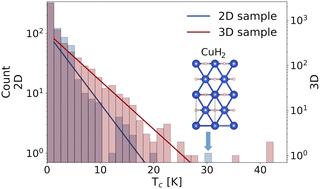
We perform a large scale search for two-dimensional (2D) superconductors, by using electron–phonon calculations with density-functional perturbation theory combined with machine learning models. In total, we screened over 140 000 2D compounds from the Alexandria database. Our high-throughput approach revealed a multitude of 2D superconductors with diverse chemistries and crystal structures. Moreover, we find that 2D materials generally exhibit stronger electron–phonon coupling than their 3D counterparts, although their average phonon frequencies are lower, leading to an overall lower Tc. In spite of this, we discovered several out-of-distribution materials with relatively high-Tc. In total, 105 2D systems were found with Tc > 5 K. Some interesting compounds, such as CuH2, NbN, and V2NS2, demonstrate high Tc values and good thermodynamic stability, making them strong candidates for experimental synthesis and practical applications. Our findings highlight the critical role of computational databases and machine learning in accelerating the discovery of novel superconductors.
我们通过使用密度泛函微扰理论结合机器学习模型的电子-声子计算,对二维(2D)超导体进行大规模搜索。总的来说,我们从亚历山大数据库中筛选了超过14万种2D化合物。我们的高通量方法揭示了多种具有不同化学和晶体结构的二维超导体。此外,我们发现2D材料通常比3D材料表现出更强的电子-声子耦合,尽管它们的平均声子频率较低,导致总体较低的Tc。尽管如此,我们还是发现了一些tc较高的out- distribution materials。共发现105个含Tc bbb5 K的二维体系。一些有趣的化合物,如CuH2、NbN和V2NS2,表现出高Tc值和良好的热力学稳定性,使它们成为实验合成和实际应用的有力候选者。我们的发现强调了计算数据库和机器学习在加速发现新型超导体方面的关键作用。




 京公网安备 11010802042870号
京ICP备2023020795号-1
京公网安备 11010802042870号
京ICP备2023020795号-1

 分享
分享
 求助内容:
求助内容: 应助结果提醒方式:
 扫码关注我们
