Anita Kaliszewicz, Agata Czyżewska, Kamil Karaban, Izabella Olejniczak, Paweł Boniecki
{"title":"Micro- and Mesoplastic Consumption Tendency of <i>Exaiptasia diaphana</i> Sea Anemones.","authors":"Anita Kaliszewicz, Agata Czyżewska, Kamil Karaban, Izabella Olejniczak, Paweł Boniecki","doi":"10.3390/ani15030405","DOIUrl":null,"url":null,"abstract":"<p><p>Microplastics are an increasingly common threat to the aquatic environment, and, due to their small size, it is easy for them to spread and enter the seas and oceans. Micro- and mesoplastic particles are often ingested by marine organisms, especially those that have the potential for successful settlement on artificial substrata, including plastic. In laboratory experiments, we tested the tendency of the sea anemone <i>Exaiptasia diaphana</i> to consume plastic fragments and fibers of various sizes and shapes; these organisms are widely distributed in coastal waters, tide pools, and coral reefs. The plastic fragments and fibers were placed either in natural food or covered with a special food in gel form, which allowed them to retain their original shape. Our studies have shown that plastic in the shape of fibers is less readily consumed than in the form of fragments. The <i>E. diaphana</i> anemones with oral discs of diameter 10-12 mm had difficulty consuming long fibers. A total of 67% of the studied animals were unable to consume fibers of 13 mm length, while those of 3 and 7 mm length were consumed by 100% of the sea anemones. We have also established that microplastics taken with food are harmful to these cnidarians: mechanical injury to the body column was caused by the ingested polypropylene microfragments, and we also observed significantly increased mortality. Injuries, combined with the possible toxicological effects of the polymers, may have been the cause of increased mortality of the <i>Exaiptasia diaphana</i>.</p>","PeriodicalId":7955,"journal":{"name":"Animals","volume":"15 3","pages":""},"PeriodicalIF":2.7000,"publicationDate":"2025-02-01","publicationTypes":"Journal Article","fieldsOfStudy":null,"isOpenAccess":false,"openAccessPdf":"https://www.ncbi.nlm.nih.gov/pmc/articles/PMC11816139/pdf/","citationCount":"0","resultStr":null,"platform":"Semanticscholar","paperid":null,"PeriodicalName":"Animals","FirstCategoryId":"97","ListUrlMain":"https://doi.org/10.3390/ani15030405","RegionNum":2,"RegionCategory":"农林科学","ArticlePicture":[],"TitleCN":null,"AbstractTextCN":null,"PMCID":null,"EPubDate":"","PubModel":"","JCR":"Q1","JCRName":"AGRICULTURE, DAIRY & ANIMAL SCIENCE","Score":null,"Total":0}
引用次数: 0
Abstract
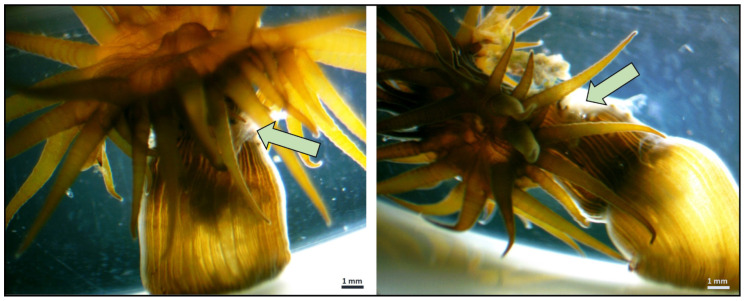
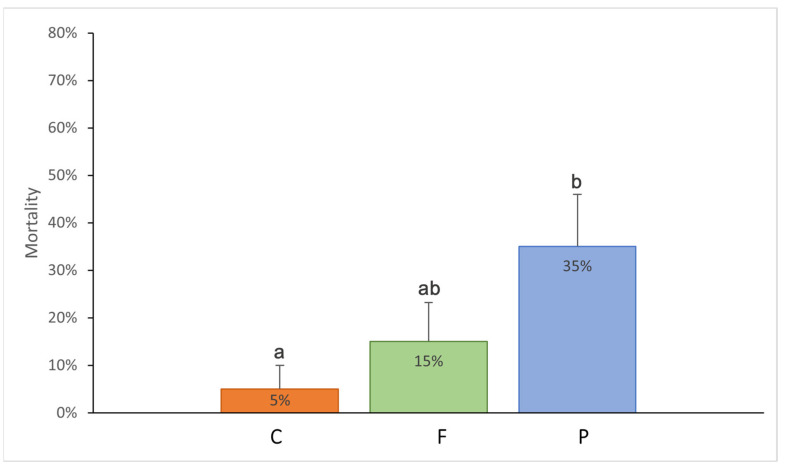
Microplastics are an increasingly common threat to the aquatic environment, and, due to their small size, it is easy for them to spread and enter the seas and oceans. Micro- and mesoplastic particles are often ingested by marine organisms, especially those that have the potential for successful settlement on artificial substrata, including plastic. In laboratory experiments, we tested the tendency of the sea anemone Exaiptasia diaphana to consume plastic fragments and fibers of various sizes and shapes; these organisms are widely distributed in coastal waters, tide pools, and coral reefs. The plastic fragments and fibers were placed either in natural food or covered with a special food in gel form, which allowed them to retain their original shape. Our studies have shown that plastic in the shape of fibers is less readily consumed than in the form of fragments. The E. diaphana anemones with oral discs of diameter 10-12 mm had difficulty consuming long fibers. A total of 67% of the studied animals were unable to consume fibers of 13 mm length, while those of 3 and 7 mm length were consumed by 100% of the sea anemones. We have also established that microplastics taken with food are harmful to these cnidarians: mechanical injury to the body column was caused by the ingested polypropylene microfragments, and we also observed significantly increased mortality. Injuries, combined with the possible toxicological effects of the polymers, may have been the cause of increased mortality of the Exaiptasia diaphana.
AnimalsAgricultural and Biological Sciences-Animal Science and Zoology
CiteScore
4.90
自引率
16.70%
发文量
3015
审稿时长
20.52 days
期刊介绍:
Animals (ISSN 2076-2615) is an international and interdisciplinary scholarly open access journal. It publishes original research articles, reviews, communications, and short notes that are relevant to any field of study that involves animals, including zoology, ethnozoology, animal science, animal ethics and animal welfare. However, preference will be given to those articles that provide an understanding of animals within a larger context (i.e., the animals'' interactions with the outside world, including humans). There is no restriction on the length of the papers. Our aim is to encourage scientists to publish their experimental and theoretical research in as much detail as possible. Full experimental details and/or method of study, must be provided for research articles. Articles submitted that involve subjecting animals to unnecessary pain or suffering will not be accepted, and all articles must be submitted with the necessary ethical approval (please refer to the Ethical Guidelines for more information).




 京公网安备 11010802042870号
京ICP备2023020795号-1
京公网安备 11010802042870号
京ICP备2023020795号-1

 分享
分享
 求助内容:
求助内容: 应助结果提醒方式:
 扫码关注我们
