Mareike Tometten, Fabian Beier, Martin Kirschner, Yannic Schumacher, Jeanette Walter, Margherita Vieri, Kim Kricheldorf, Alexander Röth, Uwe Platzbecker, Markus Radsak, Philippe Schafhausen, Selim Corbacioglu, Britta Höchsmann, Stefan Balabanov, Claas Hinze, Jörg Chromik, Michael Heuser, Michael Kreuter, Marcin W Wlodarski, Miriam Elbracht, Ingo Kurth, Steffen Koschmieder, Jens Panse, Susanne Isfort, Robert Meyer, Tim H Brümmendorf
{"title":"Late-onset telomere biology disorders in adults: clinical insights and treatment outcomes from a retrospective registry cohort.","authors":"Mareike Tometten, Fabian Beier, Martin Kirschner, Yannic Schumacher, Jeanette Walter, Margherita Vieri, Kim Kricheldorf, Alexander Röth, Uwe Platzbecker, Markus Radsak, Philippe Schafhausen, Selim Corbacioglu, Britta Höchsmann, Stefan Balabanov, Claas Hinze, Jörg Chromik, Michael Heuser, Michael Kreuter, Marcin W Wlodarski, Miriam Elbracht, Ingo Kurth, Steffen Koschmieder, Jens Panse, Susanne Isfort, Robert Meyer, Tim H Brümmendorf","doi":"10.1182/bloodadvances.2024014632","DOIUrl":null,"url":null,"abstract":"<p><strong>Abstract: </strong>Pathogenic germ line variants affecting proper telomere maintenance result in premature telomere shortening and cause telomere biology disorders (TBDs). Although classical dyskeratosis congenita in children is rather well defined, late-onset (\"cryptic\") TBDs remain underrecognized, resulting in underdiagnosis and inadequate treatment in affected adults. Here, we present a series of adult TBD cases collected through the German TBD reference center between 2014 and 2024. Patients aged ≥18 years with an age-matched telomere length (TL) <10th percentile in lymphocytes, a detection of either a variant of uncertain significance, a pathogenic, or a likely pathogenic variant in TBD-associated genes, and available clinical data were included in this analysis. Based on this, a novel point-based algorithm for categorization into proven, probable, and suspected-only TBD cases was developed. Of 1537 TL analyses, 42 patients with proven (n = 29) or probable (n = 13) TBD were identified. The median age at first clinical manifestation and at diagnosis was 20.0 and 34.1 years, respectively. Bone marrow failure (BMF) was the most frequent manifestation observed in our cohort (73.8%), followed by liver or interstitial lung diseases (50.0% and 41.5%, respectively). Immunosuppressive therapy was administered in 6 patients with BMF, but none of them responded. In comparison, 8 of 8 evaluable patients treated with androgen derivatives showed hematologic response. Our data provide novel real-world insights into the clinical manifestation spectrum, diagnosis, clinical course, and treatment of TBD in adult, late-onset cases of this hereditary disease.</p>","PeriodicalId":9228,"journal":{"name":"Blood advances","volume":" ","pages":"2183-2191"},"PeriodicalIF":7.1000,"publicationDate":"2025-05-13","publicationTypes":"Journal Article","fieldsOfStudy":null,"isOpenAccess":false,"openAccessPdf":"https://www.ncbi.nlm.nih.gov/pmc/articles/PMC12243046/pdf/","citationCount":"0","resultStr":null,"platform":"Semanticscholar","paperid":null,"PeriodicalName":"Blood advances","FirstCategoryId":"3","ListUrlMain":"https://doi.org/10.1182/bloodadvances.2024014632","RegionNum":1,"RegionCategory":"医学","ArticlePicture":[],"TitleCN":null,"AbstractTextCN":null,"PMCID":null,"EPubDate":"","PubModel":"","JCR":"Q1","JCRName":"HEMATOLOGY","Score":null,"Total":0}
引用次数: 0
Abstract
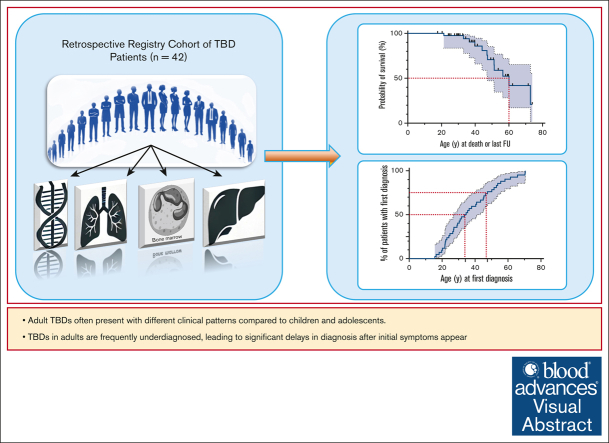
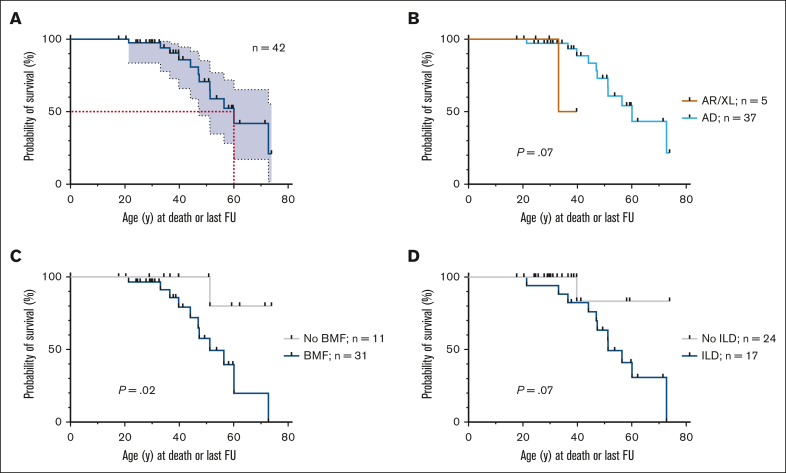
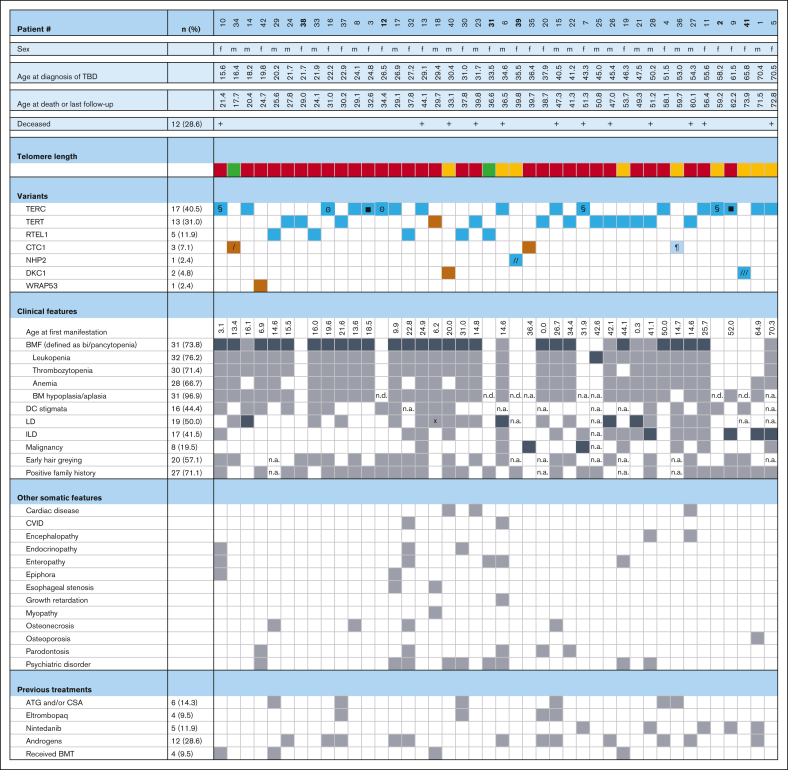
Abstract: Pathogenic germ line variants affecting proper telomere maintenance result in premature telomere shortening and cause telomere biology disorders (TBDs). Although classical dyskeratosis congenita in children is rather well defined, late-onset ("cryptic") TBDs remain underrecognized, resulting in underdiagnosis and inadequate treatment in affected adults. Here, we present a series of adult TBD cases collected through the German TBD reference center between 2014 and 2024. Patients aged ≥18 years with an age-matched telomere length (TL) <10th percentile in lymphocytes, a detection of either a variant of uncertain significance, a pathogenic, or a likely pathogenic variant in TBD-associated genes, and available clinical data were included in this analysis. Based on this, a novel point-based algorithm for categorization into proven, probable, and suspected-only TBD cases was developed. Of 1537 TL analyses, 42 patients with proven (n = 29) or probable (n = 13) TBD were identified. The median age at first clinical manifestation and at diagnosis was 20.0 and 34.1 years, respectively. Bone marrow failure (BMF) was the most frequent manifestation observed in our cohort (73.8%), followed by liver or interstitial lung diseases (50.0% and 41.5%, respectively). Immunosuppressive therapy was administered in 6 patients with BMF, but none of them responded. In comparison, 8 of 8 evaluable patients treated with androgen derivatives showed hematologic response. Our data provide novel real-world insights into the clinical manifestation spectrum, diagnosis, clinical course, and treatment of TBD in adult, late-onset cases of this hereditary disease.
期刊介绍:
Blood Advances, a semimonthly medical journal published by the American Society of Hematology, marks the first addition to the Blood family in 70 years. This peer-reviewed, online-only, open-access journal was launched under the leadership of founding editor-in-chief Robert Negrin, MD, from Stanford University Medical Center in Stanford, CA, with its inaugural issue released on November 29, 2016.
Blood Advances serves as an international platform for original articles detailing basic laboratory, translational, and clinical investigations in hematology. The journal comprehensively covers all aspects of hematology, including disorders of leukocytes (both benign and malignant), erythrocytes, platelets, hemostatic mechanisms, vascular biology, immunology, and hematologic oncology. Each article undergoes a rigorous peer-review process, with selection based on the originality of the findings, the high quality of the work presented, and the clarity of the presentation.




 京公网安备 11010802042870号
京ICP备2023020795号-1
京公网安备 11010802042870号
京ICP备2023020795号-1

 分享
分享
 求助内容:
求助内容: 应助结果提醒方式:
 扫码关注我们
