Anwai Archit, Luca Freckmann, Sushmita Nair, Nabeel Khalid, Paul Hilt, Vikas Rajashekar, Marei Freitag, Carolin Teuber, Genevieve Buckley, Sebastian von Haaren, Sagnik Gupta, Andreas Dengel, Sheraz Ahmed, Constantin Pape
{"title":"Segment Anything for Microscopy","authors":"Anwai Archit, Luca Freckmann, Sushmita Nair, Nabeel Khalid, Paul Hilt, Vikas Rajashekar, Marei Freitag, Carolin Teuber, Genevieve Buckley, Sebastian von Haaren, Sagnik Gupta, Andreas Dengel, Sheraz Ahmed, Constantin Pape","doi":"10.1038/s41592-024-02580-4","DOIUrl":null,"url":null,"abstract":"Accurate segmentation of objects in microscopy images remains a bottleneck for many researchers despite the number of tools developed for this purpose. Here, we present Segment Anything for Microscopy (μSAM), a tool for segmentation and tracking in multidimensional microscopy data. It is based on Segment Anything, a vision foundation model for image segmentation. We extend it by fine-tuning generalist models for light and electron microscopy that clearly improve segmentation quality for a wide range of imaging conditions. We also implement interactive and automatic segmentation in a napari plugin that can speed up diverse segmentation tasks and provides a unified solution for microscopy annotation across different microscopy modalities. Our work constitutes the application of vision foundation models in microscopy, laying the groundwork for solving image analysis tasks in this domain with a small set of powerful deep learning models. Segment Anything for Microscopy (μSAM) builds on the vision foundation model Segment Anything for high-quality image segmentation over a wide range of imaging conditions including light and electron microscopy.","PeriodicalId":18981,"journal":{"name":"Nature Methods","volume":"22 3","pages":"579-591"},"PeriodicalIF":32.1000,"publicationDate":"2025-02-12","publicationTypes":"Journal Article","fieldsOfStudy":null,"isOpenAccess":false,"openAccessPdf":"https://www.nature.com/articles/s41592-024-02580-4.pdf","citationCount":"0","resultStr":null,"platform":"Semanticscholar","paperid":null,"PeriodicalName":"Nature Methods","FirstCategoryId":"99","ListUrlMain":"https://www.nature.com/articles/s41592-024-02580-4","RegionNum":1,"RegionCategory":"生物学","ArticlePicture":[],"TitleCN":null,"AbstractTextCN":null,"PMCID":null,"EPubDate":"","PubModel":"","JCR":"Q1","JCRName":"BIOCHEMICAL RESEARCH METHODS","Score":null,"Total":0}
引用次数: 0
Abstract
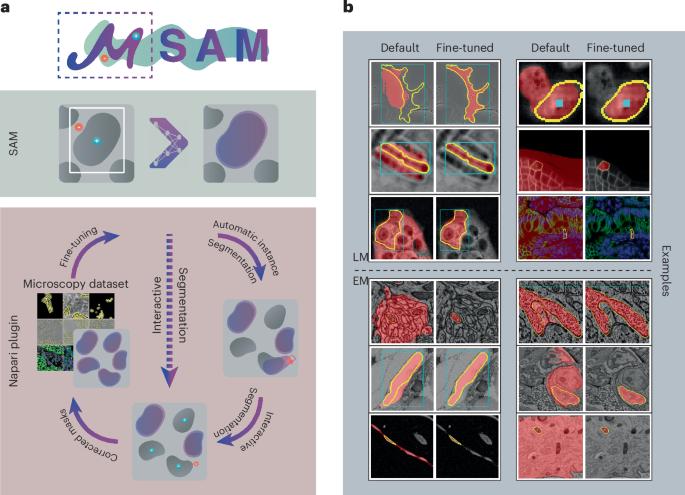
Accurate segmentation of objects in microscopy images remains a bottleneck for many researchers despite the number of tools developed for this purpose. Here, we present Segment Anything for Microscopy (μSAM), a tool for segmentation and tracking in multidimensional microscopy data. It is based on Segment Anything, a vision foundation model for image segmentation. We extend it by fine-tuning generalist models for light and electron microscopy that clearly improve segmentation quality for a wide range of imaging conditions. We also implement interactive and automatic segmentation in a napari plugin that can speed up diverse segmentation tasks and provides a unified solution for microscopy annotation across different microscopy modalities. Our work constitutes the application of vision foundation models in microscopy, laying the groundwork for solving image analysis tasks in this domain with a small set of powerful deep learning models. Segment Anything for Microscopy (μSAM) builds on the vision foundation model Segment Anything for high-quality image segmentation over a wide range of imaging conditions including light and electron microscopy.
尽管为此目的开发了许多工具,但显微镜图像中物体的准确分割仍然是许多研究人员的瓶颈。在这里,我们提出了一种用于分割和跟踪多维显微镜数据的工具μSAM (Segment Anything for Microscopy)。它是基于分割任何东西,一个视觉基础模型的图像分割。我们通过微调光学和电子显微镜的通用模型来扩展它,这明显提高了广泛成像条件下的分割质量。我们还在napari插件中实现了交互式和自动分割,可以加快不同的分割任务,并为不同显微镜模式的显微镜注释提供统一的解决方案。我们的工作构成了视觉基础模型在显微镜中的应用,为使用一组功能强大的深度学习模型解决该领域的图像分析任务奠定了基础。
期刊介绍:
Nature Methods is a monthly journal that focuses on publishing innovative methods and substantial enhancements to fundamental life sciences research techniques. Geared towards a diverse, interdisciplinary readership of researchers in academia and industry engaged in laboratory work, the journal offers new tools for research and emphasizes the immediate practical significance of the featured work. It publishes primary research papers and reviews recent technical and methodological advancements, with a particular interest in primary methods papers relevant to the biological and biomedical sciences. This includes methods rooted in chemistry with practical applications for studying biological problems.



 京公网安备 11010802042870号
京ICP备2023020795号-1
京公网安备 11010802042870号
京ICP备2023020795号-1

 分享
分享
 求助内容:
求助内容: 应助结果提醒方式:
 扫码关注我们
