{"title":"Effects of Guar Gum and Sodium Benzoate on the Properties and Hydrophilicity of Silk Fibroin Hydrogels.","authors":"Ansaya Thonpho, Yodthong Baimark, Suchai Tanisood, Prasong Srihanam","doi":"10.3390/polym17030425","DOIUrl":null,"url":null,"abstract":"<p><p>Silk fibroin (SF)-based hydrogels were prepared by the simple evaporation method. The outcomes of SF-based hydrogels were assessed for consideration in terms of practical and convenient use. Guar gum (GG) and sodium benzoate (SB) are blending reagents to the SF solution and are poured into the petri dish to make the hydrogels. After leaving the mixture solution for three days to solidify, all SF-based hydrogels were peeled off and characterized. The SF-blend guar gum (SF-GG) and SF-GG-blend sodium benzoate (SF-GG-SB) could be constructed, but in different textures and levels of transparency. The SB affected the solid texture and resulted in a higher water contact angle (WCA) value of the prepared SF hydrogel than of the SF-GG. The results from Fourier transform infrared spectroscopy (FTIR) indicated all the main functional groups of substances that were contained in the blending hydrogels. Moreover, some interactions between the functional groups were also detected. A thermogravimetric analyzer (TGA) was used to determine the hydrogel decomposition as a function of temperature. The DTG thermograms, which exhibit the maximum decomposition temperature, revealed that the interaction forces between blending substances and SF, as well as their structure, are the reason for the thermal stability of the SF-based hydrogels. SF-GG-SB hydrogels have higher tensile strength than the SF-GG hydrogels. In conclusion, the appearance, texture, hydrophilicity, thermal stability, and tensile strength of the SF-based hydrogels were affected by the types and concentrations of the blending substances. This suggests that the SF-based hydrogel properties could be designed and adjusted to attain desirable textures for fitting target applications.</p>","PeriodicalId":20416,"journal":{"name":"Polymers","volume":"17 3","pages":""},"PeriodicalIF":4.9000,"publicationDate":"2025-02-06","publicationTypes":"Journal Article","fieldsOfStudy":null,"isOpenAccess":false,"openAccessPdf":"https://www.ncbi.nlm.nih.gov/pmc/articles/PMC11820424/pdf/","citationCount":"0","resultStr":null,"platform":"Semanticscholar","paperid":null,"PeriodicalName":"Polymers","FirstCategoryId":"5","ListUrlMain":"https://doi.org/10.3390/polym17030425","RegionNum":3,"RegionCategory":"工程技术","ArticlePicture":[],"TitleCN":null,"AbstractTextCN":null,"PMCID":null,"EPubDate":"","PubModel":"","JCR":"Q1","JCRName":"POLYMER SCIENCE","Score":null,"Total":0}
引用次数: 0
Abstract
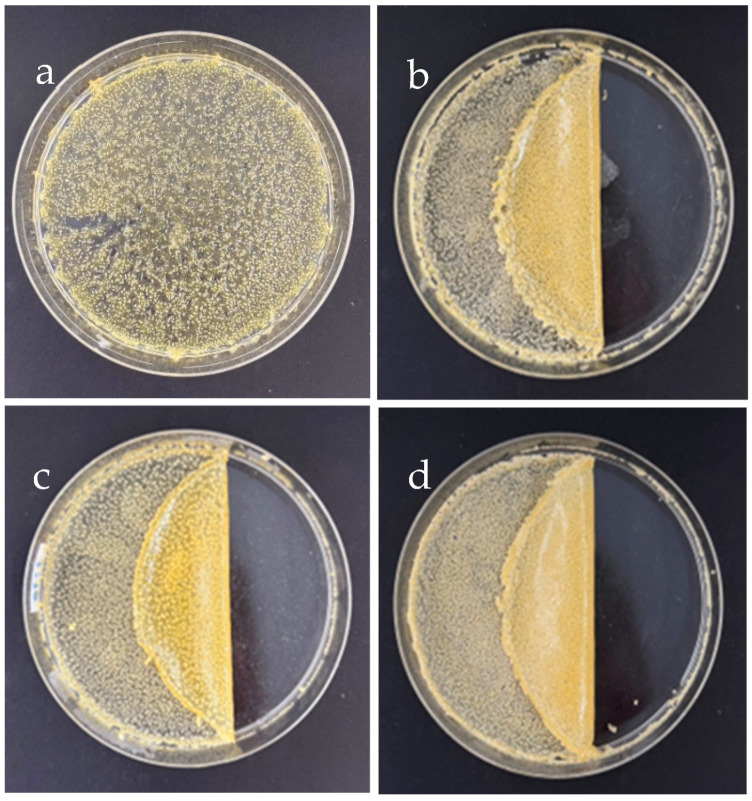
Silk fibroin (SF)-based hydrogels were prepared by the simple evaporation method. The outcomes of SF-based hydrogels were assessed for consideration in terms of practical and convenient use. Guar gum (GG) and sodium benzoate (SB) are blending reagents to the SF solution and are poured into the petri dish to make the hydrogels. After leaving the mixture solution for three days to solidify, all SF-based hydrogels were peeled off and characterized. The SF-blend guar gum (SF-GG) and SF-GG-blend sodium benzoate (SF-GG-SB) could be constructed, but in different textures and levels of transparency. The SB affected the solid texture and resulted in a higher water contact angle (WCA) value of the prepared SF hydrogel than of the SF-GG. The results from Fourier transform infrared spectroscopy (FTIR) indicated all the main functional groups of substances that were contained in the blending hydrogels. Moreover, some interactions between the functional groups were also detected. A thermogravimetric analyzer (TGA) was used to determine the hydrogel decomposition as a function of temperature. The DTG thermograms, which exhibit the maximum decomposition temperature, revealed that the interaction forces between blending substances and SF, as well as their structure, are the reason for the thermal stability of the SF-based hydrogels. SF-GG-SB hydrogels have higher tensile strength than the SF-GG hydrogels. In conclusion, the appearance, texture, hydrophilicity, thermal stability, and tensile strength of the SF-based hydrogels were affected by the types and concentrations of the blending substances. This suggests that the SF-based hydrogel properties could be designed and adjusted to attain desirable textures for fitting target applications.
期刊介绍:
Polymers (ISSN 2073-4360) is an international, open access journal of polymer science. It publishes research papers, short communications and review papers. Our aim is to encourage scientists to publish their experimental and theoretical results in as much detail as possible. Therefore, there is no restriction on the length of the papers. The full experimental details must be provided so that the results can be reproduced. Polymers provides an interdisciplinary forum for publishing papers which advance the fields of (i) polymerization methods, (ii) theory, simulation, and modeling, (iii) understanding of new physical phenomena, (iv) advances in characterization techniques, and (v) harnessing of self-assembly and biological strategies for producing complex multifunctional structures.





 京公网安备 11010802042870号
京ICP备2023020795号-1
京公网安备 11010802042870号
京ICP备2023020795号-1

 分享
分享
 求助内容:
求助内容: 应助结果提醒方式:
 扫码关注我们
