{"title":"Partially hydrolyzed guar gum attenuates symptoms and modulates the gut microbiota in a model of SARS-CoV-2 infection.","authors":"Jiayue Yang, Isaiah Song, Misa Saito, Tenagy Hartanto, Takeshi Ichinohe, Shinji Fukuda","doi":"10.1017/gmb.2024.7","DOIUrl":null,"url":null,"abstract":"<p><p>The coronavirus disease 2019 (COVID-19) pandemic has caused health issues worldwide. Studies have suggested that modulation of the gut microbiota could attenuate the severity of COVID-19 symptoms. In light of this, we explored the effects of the prebiotic dietary fibre partially hydrolyzed guar gum (PHGG) on SARS-CoV-2 infection in a Syrian hamster model, hypothesizing that modulation of the gut microbiome and intestinal metabolites through PHGG administration would improve COVID-19 disease outcomes. Eight hamsters each were assigned to the PHGG administration and control groups. The PHGG group was given a diet supplemented with 5% PHGG for two weeks. Consequently, PHGG improved the host survival rate to 100% compared to 25% of the control group (P = 0.003) and attenuated morbid weight loss. Another non-infected set of hamsters was used for the analysis of the gut microbiome composition with 16S rRNA amplicon sequencing, serum, and faecal metabolites with GC-MS and LC-MS. PHGG altered the gut microbiome composition and increased the relative abundances of <i>Ileibacterium</i>, <i>Bifidobacterium</i>, and <i>Prevotella.</i> Furthermore, it elevated the concentrations of faecal valeric acid, propionic acid, ursodeoxycholic acid, and serum deoxycholic acid. Taken together, our data suggest that the prebiotic PHGG modulates gut metabolites and has the potential to reduce COVID-19 morbidity.</p>","PeriodicalId":73187,"journal":{"name":"Gut microbiome (Cambridge, England)","volume":"6 ","pages":"e1"},"PeriodicalIF":0.0000,"publicationDate":"2025-01-14","publicationTypes":"Journal Article","fieldsOfStudy":null,"isOpenAccess":false,"openAccessPdf":"https://www.ncbi.nlm.nih.gov/pmc/articles/PMC11810603/pdf/","citationCount":"0","resultStr":null,"platform":"Semanticscholar","paperid":null,"PeriodicalName":"Gut microbiome (Cambridge, England)","FirstCategoryId":"1085","ListUrlMain":"https://doi.org/10.1017/gmb.2024.7","RegionNum":0,"RegionCategory":null,"ArticlePicture":[],"TitleCN":null,"AbstractTextCN":null,"PMCID":null,"EPubDate":"2025/1/1 0:00:00","PubModel":"eCollection","JCR":"","JCRName":"","Score":null,"Total":0}
引用次数: 0
Abstract
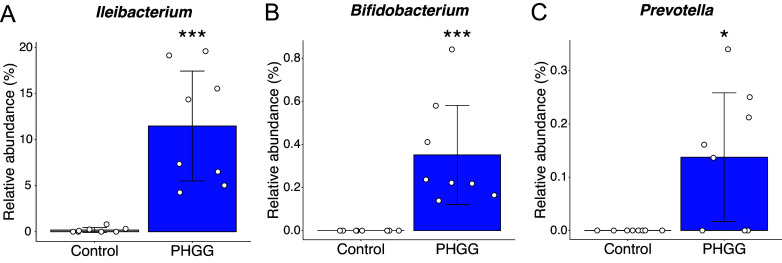
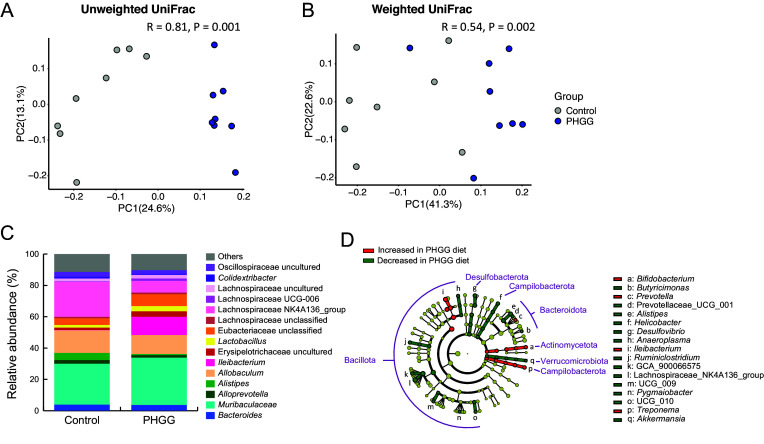
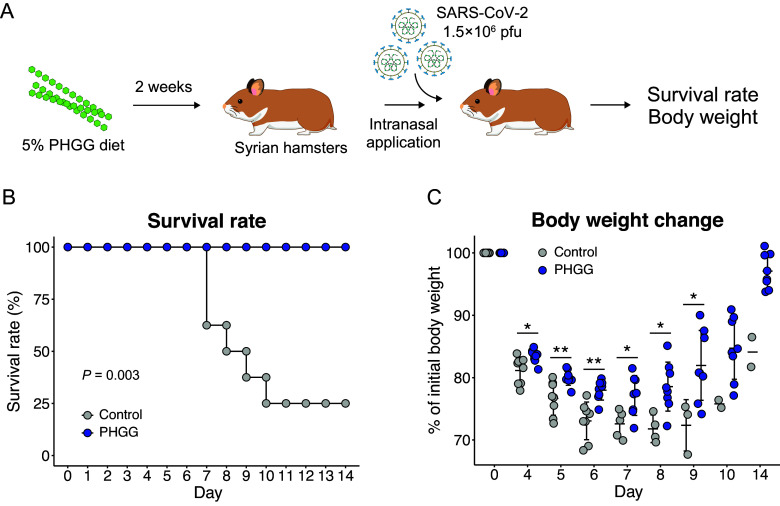
The coronavirus disease 2019 (COVID-19) pandemic has caused health issues worldwide. Studies have suggested that modulation of the gut microbiota could attenuate the severity of COVID-19 symptoms. In light of this, we explored the effects of the prebiotic dietary fibre partially hydrolyzed guar gum (PHGG) on SARS-CoV-2 infection in a Syrian hamster model, hypothesizing that modulation of the gut microbiome and intestinal metabolites through PHGG administration would improve COVID-19 disease outcomes. Eight hamsters each were assigned to the PHGG administration and control groups. The PHGG group was given a diet supplemented with 5% PHGG for two weeks. Consequently, PHGG improved the host survival rate to 100% compared to 25% of the control group (P = 0.003) and attenuated morbid weight loss. Another non-infected set of hamsters was used for the analysis of the gut microbiome composition with 16S rRNA amplicon sequencing, serum, and faecal metabolites with GC-MS and LC-MS. PHGG altered the gut microbiome composition and increased the relative abundances of Ileibacterium, Bifidobacterium, and Prevotella. Furthermore, it elevated the concentrations of faecal valeric acid, propionic acid, ursodeoxycholic acid, and serum deoxycholic acid. Taken together, our data suggest that the prebiotic PHGG modulates gut metabolites and has the potential to reduce COVID-19 morbidity.



 京公网安备 11010802042870号
京ICP备2023020795号-1
京公网安备 11010802042870号
京ICP备2023020795号-1

 分享
分享

 求助内容:
求助内容: 应助结果提醒方式:
 扫码关注我们
