{"title":"Tracking Cognitive Trajectories in Mild Cognitive Impairment Using a Machine Learning Technique of Subtype and Stage Inference.","authors":"Hui Jin Ryu, Kyoung Ja Kwon, Yeonsil Moon","doi":"10.12779/dnd.2025.24.1.44","DOIUrl":null,"url":null,"abstract":"<p><strong>Background and purpose: </strong>Recognizing cognitive decline patterns in mild cognitive impairment (MCI) is crucial for early screening and preventive interventions. However, studies on the trajectory of individual cognitive functions in MCI are limited. Thus, the purpose of this study was to identify subtypes and stages of cognitive decline in MCI using a machine learning method.</p><p><strong>Methods: </strong>A total of 944 subjects consisting of those who were cognitively normal and those with MCI were enrolled. Fifteen neuropsychological tasks were used in the analysis. The optimal number of subtypes was determined based on the cross-validation information criterion. Fifteen stages of cognitive trajectory were estimated for each subtype.</p><p><strong>Results: </strong>The following three subtypes were identified: amnestic-verbal subtype, dysexecutive subtype, and amnestic-visual subtype. Of 723 (76.6%) subjects who had reached stage 1 at least, amnestic-verbal subtype accounted for the most (n=340, 47.0%), followed by dysexecutive subtype (n=253, 35.0%) and amnestic-visual subtype (n=130, 18%). The amnestic-verbal subtype had significantly more males (amnestic-verbal: 41.8%, dysexecutive: 31.2%, and amnestic-visual: 28.5%), younger subjects (amnestic-verbal: 72.01 years, dysexecutive: 74.43 years, and amnestic-visual: 75.06 years), higher educational years (amnestic-verbal: 11.06 years, dysexecutive: 9.53 years, and amnestic-visual: 9.79 years), lower Clinical Dementia Rating sum of boxes (amnestic-verbal: 1.40, dysexecutive: 1.61, and amnestic-visual: 1.71), and lower Korean-Instrumental Activities of Daily Living score (amnestic-verbal: 0.20, dysexecutive: 0.27, and amnestic-visual: 0.26).</p><p><strong>Conclusions: </strong>Three types of MCIs were extracted using SuStaIn. Pathways of MCI deterioration could be different. The amnestic type could be bisected based on whether episodic verbal or visual memory is degraded first.</p>","PeriodicalId":72779,"journal":{"name":"Dementia and neurocognitive disorders","volume":"24 1","pages":"44-53"},"PeriodicalIF":0.0000,"publicationDate":"2025-01-01","publicationTypes":"Journal Article","fieldsOfStudy":null,"isOpenAccess":false,"openAccessPdf":"https://www.ncbi.nlm.nih.gov/pmc/articles/PMC11813553/pdf/","citationCount":"0","resultStr":null,"platform":"Semanticscholar","paperid":null,"PeriodicalName":"Dementia and neurocognitive disorders","FirstCategoryId":"1085","ListUrlMain":"https://doi.org/10.12779/dnd.2025.24.1.44","RegionNum":0,"RegionCategory":null,"ArticlePicture":[],"TitleCN":null,"AbstractTextCN":null,"PMCID":null,"EPubDate":"2025/1/7 0:00:00","PubModel":"Epub","JCR":"","JCRName":"","Score":null,"Total":0}
引用次数: 0
Abstract
Background and purpose: Recognizing cognitive decline patterns in mild cognitive impairment (MCI) is crucial for early screening and preventive interventions. However, studies on the trajectory of individual cognitive functions in MCI are limited. Thus, the purpose of this study was to identify subtypes and stages of cognitive decline in MCI using a machine learning method.
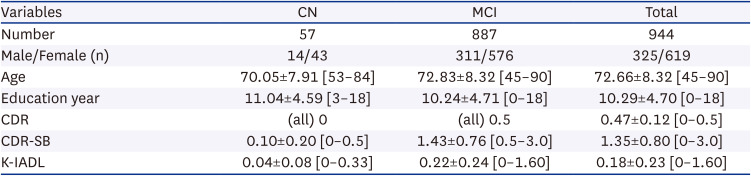
Methods: A total of 944 subjects consisting of those who were cognitively normal and those with MCI were enrolled. Fifteen neuropsychological tasks were used in the analysis. The optimal number of subtypes was determined based on the cross-validation information criterion. Fifteen stages of cognitive trajectory were estimated for each subtype.
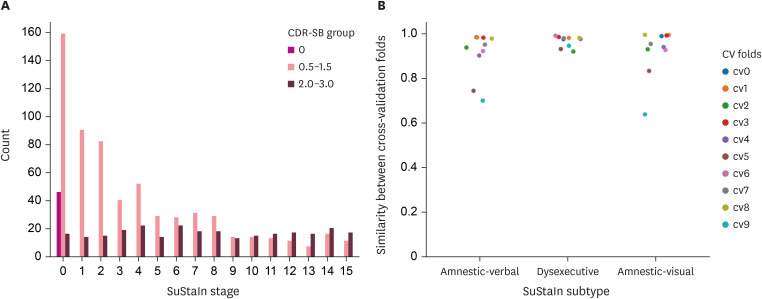
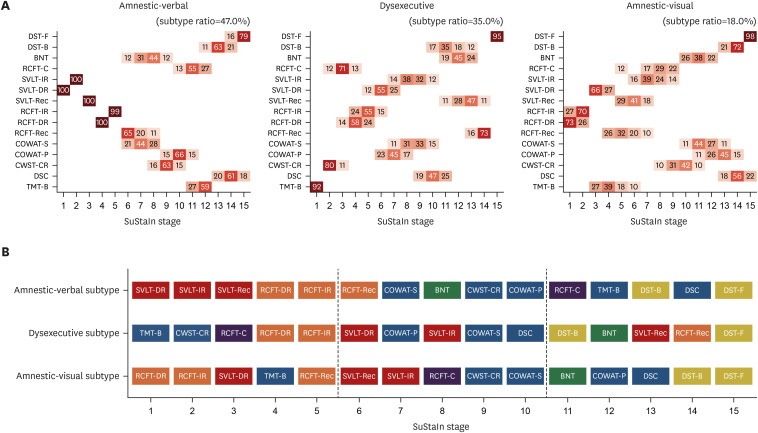
Results: The following three subtypes were identified: amnestic-verbal subtype, dysexecutive subtype, and amnestic-visual subtype. Of 723 (76.6%) subjects who had reached stage 1 at least, amnestic-verbal subtype accounted for the most (n=340, 47.0%), followed by dysexecutive subtype (n=253, 35.0%) and amnestic-visual subtype (n=130, 18%). The amnestic-verbal subtype had significantly more males (amnestic-verbal: 41.8%, dysexecutive: 31.2%, and amnestic-visual: 28.5%), younger subjects (amnestic-verbal: 72.01 years, dysexecutive: 74.43 years, and amnestic-visual: 75.06 years), higher educational years (amnestic-verbal: 11.06 years, dysexecutive: 9.53 years, and amnestic-visual: 9.79 years), lower Clinical Dementia Rating sum of boxes (amnestic-verbal: 1.40, dysexecutive: 1.61, and amnestic-visual: 1.71), and lower Korean-Instrumental Activities of Daily Living score (amnestic-verbal: 0.20, dysexecutive: 0.27, and amnestic-visual: 0.26).
Conclusions: Three types of MCIs were extracted using SuStaIn. Pathways of MCI deterioration could be different. The amnestic type could be bisected based on whether episodic verbal or visual memory is degraded first.



 京公网安备 11010802042870号
京ICP备2023020795号-1
京公网安备 11010802042870号
京ICP备2023020795号-1

 分享
分享

 求助内容:
求助内容: 应助结果提醒方式:
 扫码关注我们
