Group B Streptococcal Membrane Vesicles Induce Proinflammatory Cytokine Production and Are Sensed in an NLRP3 Inflammasome-Dependent Mechanism in a Human Macrophage-like Cell Line.
Cole R McCutcheon, Jennifer A Gaddy, David M Aronoff, Shannon D Manning, Margaret G Petroff
{"title":"Group B Streptococcal Membrane Vesicles Induce Proinflammatory Cytokine Production and Are Sensed in an NLRP3 Inflammasome-Dependent Mechanism in a Human Macrophage-like Cell Line.","authors":"Cole R McCutcheon, Jennifer A Gaddy, David M Aronoff, Shannon D Manning, Margaret G Petroff","doi":"10.1021/acsinfecdis.4c00641","DOIUrl":null,"url":null,"abstract":"<p><p>Group B <i>Streptococcus</i> (GBS) is a major cause of fetal and neonatal mortality worldwide. Many of the adverse effects of invasive GBS are associated with inflammation; therefore, understanding bacterial factors that promote inflammation is of critical importance. Membrane vesicles (MVs), which are produced by many bacteria, may modulate host inflammatory responses. While it is known that mice injected intra-amniotically with GBS MVs exhibit large-scale leukocyte infiltration, preterm birth, and subsequent fetal death, the immune effectors driving this response remain unclear. Here, we hypothesized that THP-1 macrophage-like cells respond to GBS-derived MVs by producing proinflammatory cytokines and are recognized through one or more pattern recognition receptors. We show that THP-1s produce high levels of neutrophil- and monocyte-specific chemokines in response to MVs derived from different clinical isolates of GBS. Using antibody microarrays and multiplex Luminex assays, we found that GBS MVs elicit significantly (<i>p</i> < 0.05) higher levels of CCL1, CCL2, CCL20, CXCL1, CXCL10, and IL-1β relative to untreated THP-1s. Using chemical inhibitors in combination with caspase-1 activity assays and Luminex assays, we further demonstrate that GBS MVs upregulated IL-1β production in a caspase-1 and NLRP3-dependent manner, ultimately identifying NLRP3 as a sensor of GBS MVs. These data indicate that MVs contain one or more pathogen-associated molecular patterns that can be sensed by the immune system and show that the NLRP3 inflammasome is a novel sensor of GBS MVs. Our data additionally indicate that MVs may serve as immune effectors that can be targeted for immunotherapeutics.</p>","PeriodicalId":17,"journal":{"name":"ACS Infectious Diseases","volume":"11 2","pages":"453-462"},"PeriodicalIF":3.8000,"publicationDate":"2025-02-14","publicationTypes":"Journal Article","fieldsOfStudy":null,"isOpenAccess":false,"openAccessPdf":"https://www.ncbi.nlm.nih.gov/pmc/articles/PMC11833861/pdf/","citationCount":"0","resultStr":null,"platform":"Semanticscholar","paperid":null,"PeriodicalName":"ACS Infectious Diseases","FirstCategoryId":"3","ListUrlMain":"https://doi.org/10.1021/acsinfecdis.4c00641","RegionNum":2,"RegionCategory":"医学","ArticlePicture":[],"TitleCN":null,"AbstractTextCN":null,"PMCID":null,"EPubDate":"2025/1/6 0:00:00","PubModel":"Epub","JCR":"Q2","JCRName":"CHEMISTRY, MEDICINAL","Score":null,"Total":0}
引用次数: 0
Abstract
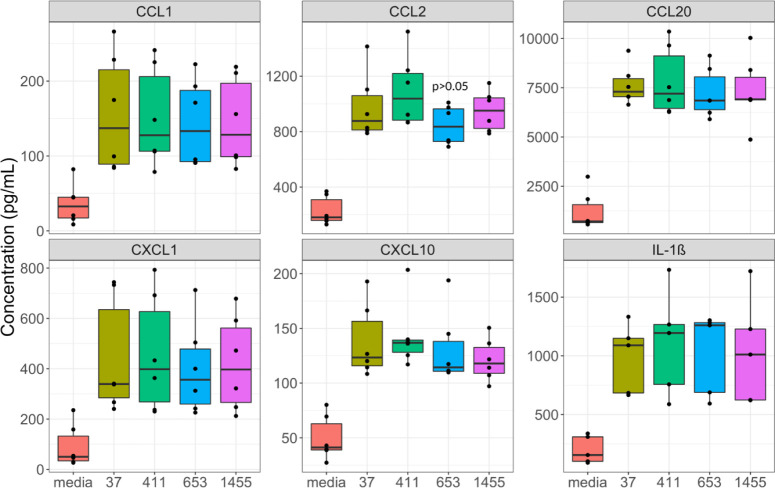
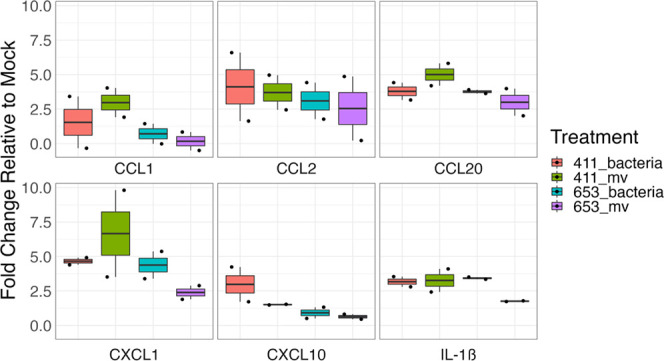
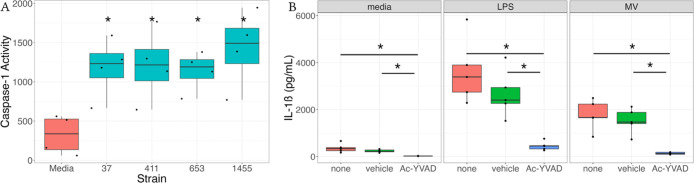
Group B Streptococcus (GBS) is a major cause of fetal and neonatal mortality worldwide. Many of the adverse effects of invasive GBS are associated with inflammation; therefore, understanding bacterial factors that promote inflammation is of critical importance. Membrane vesicles (MVs), which are produced by many bacteria, may modulate host inflammatory responses. While it is known that mice injected intra-amniotically with GBS MVs exhibit large-scale leukocyte infiltration, preterm birth, and subsequent fetal death, the immune effectors driving this response remain unclear. Here, we hypothesized that THP-1 macrophage-like cells respond to GBS-derived MVs by producing proinflammatory cytokines and are recognized through one or more pattern recognition receptors. We show that THP-1s produce high levels of neutrophil- and monocyte-specific chemokines in response to MVs derived from different clinical isolates of GBS. Using antibody microarrays and multiplex Luminex assays, we found that GBS MVs elicit significantly (p < 0.05) higher levels of CCL1, CCL2, CCL20, CXCL1, CXCL10, and IL-1β relative to untreated THP-1s. Using chemical inhibitors in combination with caspase-1 activity assays and Luminex assays, we further demonstrate that GBS MVs upregulated IL-1β production in a caspase-1 and NLRP3-dependent manner, ultimately identifying NLRP3 as a sensor of GBS MVs. These data indicate that MVs contain one or more pathogen-associated molecular patterns that can be sensed by the immune system and show that the NLRP3 inflammasome is a novel sensor of GBS MVs. Our data additionally indicate that MVs may serve as immune effectors that can be targeted for immunotherapeutics.
期刊介绍:
ACS Infectious Diseases will be the first journal to highlight chemistry and its role in this multidisciplinary and collaborative research area. The journal will cover a diverse array of topics including, but not limited to:
* Discovery and development of new antimicrobial agents — identified through target- or phenotypic-based approaches as well as compounds that induce synergy with antimicrobials.
* Characterization and validation of drug target or pathways — use of single target and genome-wide knockdown and knockouts, biochemical studies, structural biology, new technologies to facilitate characterization and prioritization of potential drug targets.
* Mechanism of drug resistance — fundamental research that advances our understanding of resistance; strategies to prevent resistance.
* Mechanisms of action — use of genetic, metabolomic, and activity- and affinity-based protein profiling to elucidate the mechanism of action of clinical and experimental antimicrobial agents.
* Host-pathogen interactions — tools for studying host-pathogen interactions, cellular biochemistry of hosts and pathogens, and molecular interactions of pathogens with host microbiota.
* Small molecule vaccine adjuvants for infectious disease.
* Viral and bacterial biochemistry and molecular biology.



 京公网安备 11010802042870号
京ICP备2023020795号-1
京公网安备 11010802042870号
京ICP备2023020795号-1

 分享
分享
 求助内容:
求助内容: 应助结果提醒方式:
 扫码关注我们
