Carlos Celis-Preciado, Simon Leclerc, Martine Duval, Dominic O Cliche, Lucie Brazeau, Félix-Antoine Vézina, Marylène Dussault, Pierre Larivée, Samuel Lemaire-Paquette, Simon Lévesque, Philippe Lachapelle, Simon Couillard
{"title":"Phenotyping the responses to systemic corticosteroids in the management of asthma attacks (PRISMA).","authors":"Carlos Celis-Preciado, Simon Leclerc, Martine Duval, Dominic O Cliche, Lucie Brazeau, Félix-Antoine Vézina, Marylène Dussault, Pierre Larivée, Samuel Lemaire-Paquette, Simon Lévesque, Philippe Lachapelle, Simon Couillard","doi":"10.1183/13993003.02391-2024","DOIUrl":null,"url":null,"abstract":"<p><strong>Background: </strong>Asthma attacks are heterogeneous. It is not known whether the response to oral corticosteroids (OCS) in acute asthma varies according to type 2 (T2) inflammatory biomarkers, blood eosinophil count (BEC) and fractional exhaled nitric oxide (<i>F</i> <sub>ENO</sub>). We aimed to explore the relationship between T2 biomarkers and response to OCS in acute asthma.</p><p><strong>Methods: </strong>We conducted a longitudinal observational study of people experiencing an asthma attack evaluated before and after a 7-day OCS course. The primary outcome was post-bronchodilator change in forced expiratory volume in 1 s (FEV<sub>1</sub>) according to ordinal BEC-<i>F</i> <sub>ENO</sub> three-group categories (T2-Low/Low: BEC <0.15×10<sup>9</sup> cells·L<sup>-1</sup> and <i>F</i> <sub>ENO</sub> <25 ppb; T2-High/High: BEC ≥0.30×10<sup>9</sup> cells·L<sup>-1</sup> and <i>F</i> <sub>ENO</sub> ≥35 ppb; T2-Mid: not meeting Low/Low or High/High criteria). A key secondary outcome was the change in Asthma Control Questionnaire-5 score. Exploratory outcomes included OCS-attributable adverse events.</p><p><strong>Results: </strong>53 people were enrolled, with 16 (30%) T2-Low/Low, 27 (51%) T2-Mid and 10 (19%) T2-High/High asthma attacks. Post-bronchodilator FEV<sub>1</sub> changes increased with combined BEC-<i>F</i> <sub>ENO</sub> elevation (p for interaction=0.007), peaking in the T2-High/High phenotype (0.390±0.512 L, p for trend<0.0001). Conversely, T2-Low/Low attacks showed nonsignificant FEV<sub>1</sub> changes (0.017±0.153 L). In univariable and multivariable analyses, only ordinal BEC-<i>F</i> <sub>ENO</sub> stratification, not symptoms nor FEV<sub>1</sub>, predicted subsequent post-bronchodilator FEV<sub>1</sub> improvement. All patients had improved Asthma Control Questionnaire-5 score, numerically peaking in the T2-High/High phenotype (-1.58±0.60, p for trend=0.08). All groups experienced similar OCS-attributable adverse events, with 33 patients (62%) reporting at least one event.</p><p><strong>Conclusions: </strong>We found that objective improvement following OCS is confined to T2-High events. As in chronic asthma, greater T2 burden identifies a distinct clinical and therapeutic trajectory, whereas OCS‑related adverse events are uniformly distributed.</p>","PeriodicalId":12265,"journal":{"name":"European Respiratory Journal","volume":" ","pages":""},"PeriodicalIF":21.0000,"publicationDate":"2025-05-22","publicationTypes":"Journal Article","fieldsOfStudy":null,"isOpenAccess":false,"openAccessPdf":"https://www.ncbi.nlm.nih.gov/pmc/articles/PMC12095907/pdf/","citationCount":"0","resultStr":null,"platform":"Semanticscholar","paperid":null,"PeriodicalName":"European Respiratory Journal","FirstCategoryId":"3","ListUrlMain":"https://doi.org/10.1183/13993003.02391-2024","RegionNum":1,"RegionCategory":"医学","ArticlePicture":[],"TitleCN":null,"AbstractTextCN":null,"PMCID":null,"EPubDate":"2025/5/1 0:00:00","PubModel":"Print","JCR":"Q1","JCRName":"RESPIRATORY SYSTEM","Score":null,"Total":0}
引用次数: 0
Abstract
Background: Asthma attacks are heterogeneous. It is not known whether the response to oral corticosteroids (OCS) in acute asthma varies according to type 2 (T2) inflammatory biomarkers, blood eosinophil count (BEC) and fractional exhaled nitric oxide (FENO). We aimed to explore the relationship between T2 biomarkers and response to OCS in acute asthma.
Methods: We conducted a longitudinal observational study of people experiencing an asthma attack evaluated before and after a 7-day OCS course. The primary outcome was post-bronchodilator change in forced expiratory volume in 1 s (FEV1) according to ordinal BEC-FENO three-group categories (T2-Low/Low: BEC <0.15×10⁹ cells·L-1 and FENO <25 ppb; T2-High/High: BEC ≥0.30×10⁹ cells·L-1 and FENO ≥35 ppb; T2-Mid: not meeting Low/Low or High/High criteria). A key secondary outcome was the change in Asthma Control Questionnaire-5 score. Exploratory outcomes included OCS-attributable adverse events.
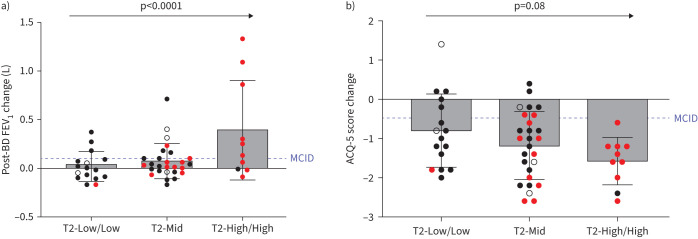
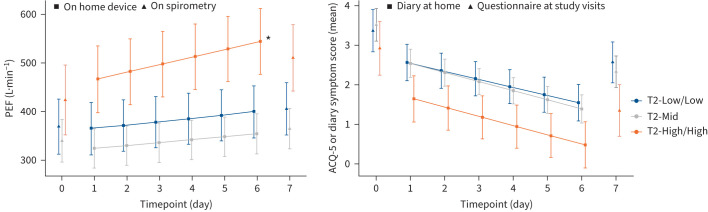
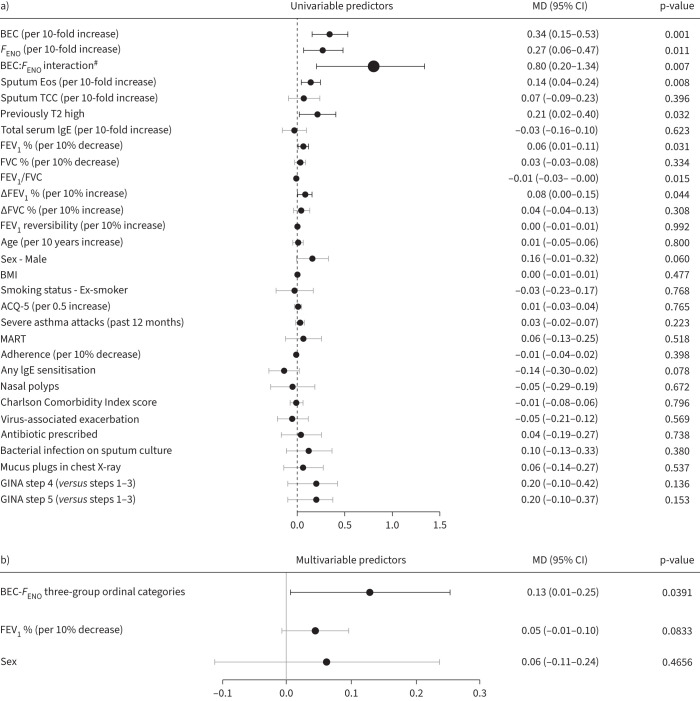
Results: 53 people were enrolled, with 16 (30%) T2-Low/Low, 27 (51%) T2-Mid and 10 (19%) T2-High/High asthma attacks. Post-bronchodilator FEV1 changes increased with combined BEC-FENO elevation (p for interaction=0.007), peaking in the T2-High/High phenotype (0.390±0.512 L, p for trend<0.0001). Conversely, T2-Low/Low attacks showed nonsignificant FEV1 changes (0.017±0.153 L). In univariable and multivariable analyses, only ordinal BEC-FENO stratification, not symptoms nor FEV1, predicted subsequent post-bronchodilator FEV1 improvement. All patients had improved Asthma Control Questionnaire-5 score, numerically peaking in the T2-High/High phenotype (-1.58±0.60, p for trend=0.08). All groups experienced similar OCS-attributable adverse events, with 33 patients (62%) reporting at least one event.
Conclusions: We found that objective improvement following OCS is confined to T2-High events. As in chronic asthma, greater T2 burden identifies a distinct clinical and therapeutic trajectory, whereas OCS‑related adverse events are uniformly distributed.
期刊介绍:
The European Respiratory Journal (ERJ) is the flagship journal of the European Respiratory Society. It has a current impact factor of 24.9. The journal covers various aspects of adult and paediatric respiratory medicine, including cell biology, epidemiology, immunology, oncology, pathophysiology, imaging, occupational medicine, intensive care, sleep medicine, and thoracic surgery. In addition to original research material, the ERJ publishes editorial commentaries, reviews, short research letters, and correspondence to the editor. The articles are published continuously and collected into 12 monthly issues in two volumes per year.




 京公网安备 11010802042870号
京ICP备2023020795号-1
京公网安备 11010802042870号
京ICP备2023020795号-1

 分享
分享
 求助内容:
求助内容: 应助结果提醒方式:
 扫码关注我们
