Oriol Barrachina-Esteve, A Anguita, A Reverter, J Espinosa, C Lafuente, M Rubio-Roy, M Crosas, C Vila-Sala, C Acero, M Navarro, D Cánovas, G Ribera, M Jodar, J Estela
{"title":"Neurologic features in hospitalized patients with COVID-19: a prospective cohort in a catalan hospital.","authors":"Oriol Barrachina-Esteve, A Anguita, A Reverter, J Espinosa, C Lafuente, M Rubio-Roy, M Crosas, C Vila-Sala, C Acero, M Navarro, D Cánovas, G Ribera, M Jodar, J Estela","doi":"10.1007/s10072-025-08031-y","DOIUrl":null,"url":null,"abstract":"<p><strong>Objectives: </strong>To study the prevalence and timing of neurological manifestations, including cognitive involvement, in patients hospitalized for Coronavirus disease 2019 (COVID-19). To analyze the pathogenic mechanisms and any association they have with disease severity.</p><p><strong>Methods: </strong>Longitudinal cohort study with prospective follow-up of patients who required hospitalization. Patients under 65 who had no pre-existing cognitive impairment and did not require an ICU stay were evaluated 3 and 12 months after discharge using a battery of neuropsychological tests.</p><p><strong>Results: </strong>Of 205 patients hospitalized for COVID-19, 153 (74.6%) presented with neurological manifestations. The most frequent were myalgia (32.7%), headache (31.7%), dysgeusia (29.2%), and anosmia (24.9%). Patients with more severe illness at the time of hospitalization presented fewer neurological manifestations. Of the 62 patients who underwent neuropsychological examination 3 months after discharge, 22.6% had impaired attention, 19.4% impaired working memory, 16.1% impaired learning and retrieval, 9.7% impaired executive functions, and 8.2% impaired processing speed. Patients with anosmia also presented with more headache (OR 5.45; p < 0.001) and greater risk of working memory impairment (OR 5.87; p 0.03). At follow-up 12 months after hospital discharge, 14.3% of patients still showed impaired attention, 2.4% impaired working memory, 2.5% impaired executive functions, and 2.5% impaired processing speed.</p><p><strong>Discussion: </strong>Neurological manifestations are common in patients hospitalized for COVID-19 regardless of severity. The high prevalence of anosmia and its association with headache and working memory impairment at 3 months, suggest potential direct or indirect damage to the prefrontal cortex via invasion of the olfactory bulb by COVID-19.</p>","PeriodicalId":19191,"journal":{"name":"Neurological Sciences","volume":" ","pages":"1477-1488"},"PeriodicalIF":2.4000,"publicationDate":"2025-04-01","publicationTypes":"Journal Article","fieldsOfStudy":null,"isOpenAccess":false,"openAccessPdf":"https://www.ncbi.nlm.nih.gov/pmc/articles/PMC11920300/pdf/","citationCount":"0","resultStr":null,"platform":"Semanticscholar","paperid":null,"PeriodicalName":"Neurological Sciences","FirstCategoryId":"3","ListUrlMain":"https://doi.org/10.1007/s10072-025-08031-y","RegionNum":4,"RegionCategory":"医学","ArticlePicture":[],"TitleCN":null,"AbstractTextCN":null,"PMCID":null,"EPubDate":"2025/2/14 0:00:00","PubModel":"Epub","JCR":"Q2","JCRName":"CLINICAL NEUROLOGY","Score":null,"Total":0}
引用次数: 0
Abstract
Objectives: To study the prevalence and timing of neurological manifestations, including cognitive involvement, in patients hospitalized for Coronavirus disease 2019 (COVID-19). To analyze the pathogenic mechanisms and any association they have with disease severity.
Methods: Longitudinal cohort study with prospective follow-up of patients who required hospitalization. Patients under 65 who had no pre-existing cognitive impairment and did not require an ICU stay were evaluated 3 and 12 months after discharge using a battery of neuropsychological tests.
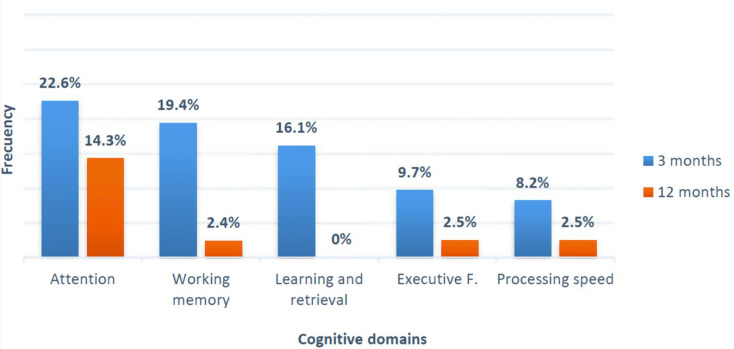
Results: Of 205 patients hospitalized for COVID-19, 153 (74.6%) presented with neurological manifestations. The most frequent were myalgia (32.7%), headache (31.7%), dysgeusia (29.2%), and anosmia (24.9%). Patients with more severe illness at the time of hospitalization presented fewer neurological manifestations. Of the 62 patients who underwent neuropsychological examination 3 months after discharge, 22.6% had impaired attention, 19.4% impaired working memory, 16.1% impaired learning and retrieval, 9.7% impaired executive functions, and 8.2% impaired processing speed. Patients with anosmia also presented with more headache (OR 5.45; p < 0.001) and greater risk of working memory impairment (OR 5.87; p 0.03). At follow-up 12 months after hospital discharge, 14.3% of patients still showed impaired attention, 2.4% impaired working memory, 2.5% impaired executive functions, and 2.5% impaired processing speed.
Discussion: Neurological manifestations are common in patients hospitalized for COVID-19 regardless of severity. The high prevalence of anosmia and its association with headache and working memory impairment at 3 months, suggest potential direct or indirect damage to the prefrontal cortex via invasion of the olfactory bulb by COVID-19.
期刊介绍:
Neurological Sciences is intended to provide a medium for the communication of results and ideas in the field of neuroscience. The journal welcomes contributions in both the basic and clinical aspects of the neurosciences. The official language of the journal is English. Reports are published in the form of original articles, short communications, editorials, reviews and letters to the editor. Original articles present the results of experimental or clinical studies in the neurosciences, while short communications are succinct reports permitting the rapid publication of novel results. Original contributions may be submitted for the special sections History of Neurology, Health Care and Neurological Digressions - a forum for cultural topics related to the neurosciences. The journal also publishes correspondence book reviews, meeting reports and announcements.





 京公网安备 11010802042870号
京ICP备2023020795号-1
京公网安备 11010802042870号
京ICP备2023020795号-1

 分享
分享
 求助内容:
求助内容: 应助结果提醒方式:
 扫码关注我们
