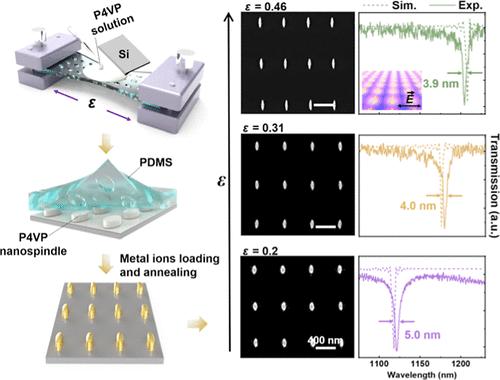
{"title":"Scalable Manufacturing of Low-Symmetry Plasmonic Nanospindle Arrays with Tunable Surface Lattice Resonance.","authors":"Hongyan Li, Jingyi Zhao, Yazi Wang, Haitao Liu, Qianyun Chen, Yilin Bao, Miaoen Zhou, Yue Li, Yutao Sang, Fan Yang, Zhihong Nie","doi":"10.1021/acsnano.4c18423","DOIUrl":null,"url":null,"abstract":"<p><p>Geometry-dependent plasmonic surface lattice resonances (SLRs) have garnered great interest across a range of applications, including nanolasers, sensors, photocatalysis, and nonlinear optics. However, the rational fabrication of high-quality, low-symmetry, plasmonic nanoparticle arrays over large areas remains challenging. Herein, we report a versatile strategy for the scalable fabrication of centimeter-scale plasmonic nanospindle (NS) arrays with high positional and orientational precision. Our approach combines solvent-assisted soft lithography with in situ reduction of metal precursors, enabling the cost-effective production of large-area and well-ordered NS arrays without the need of specialized equipment. The Au NS arrays exhibit superior SLRs with a ultranarrow line width of 3.9 nm and a quality factor (<i>Q</i>-factor) of 309. The aspect ratio and lattice geometry of the NSs can be precisely tuned by applying mechanical strain to the stretchable elastomeric template, thus, allowing us to customize the SLR performance across the near-infrared spectrum. This technique enables the precise engineering of anisotropic nanoparticle arrays in a standard chemistry laboratory, opening new possibilities for advanced plasmonic devices.</p>","PeriodicalId":21,"journal":{"name":"ACS Nano","volume":" ","pages":"7391-7400"},"PeriodicalIF":16.0000,"publicationDate":"2025-02-25","publicationTypes":"Journal Article","fieldsOfStudy":null,"isOpenAccess":false,"openAccessPdf":"","citationCount":"0","resultStr":null,"platform":"Semanticscholar","paperid":null,"PeriodicalName":"ACS Nano","FirstCategoryId":"88","ListUrlMain":"https://doi.org/10.1021/acsnano.4c18423","RegionNum":1,"RegionCategory":"材料科学","ArticlePicture":[],"TitleCN":null,"AbstractTextCN":null,"PMCID":null,"EPubDate":"2025/2/14 0:00:00","PubModel":"Epub","JCR":"Q1","JCRName":"CHEMISTRY, MULTIDISCIPLINARY","Score":null,"Total":0}
引用次数: 0
Abstract
Geometry-dependent plasmonic surface lattice resonances (SLRs) have garnered great interest across a range of applications, including nanolasers, sensors, photocatalysis, and nonlinear optics. However, the rational fabrication of high-quality, low-symmetry, plasmonic nanoparticle arrays over large areas remains challenging. Herein, we report a versatile strategy for the scalable fabrication of centimeter-scale plasmonic nanospindle (NS) arrays with high positional and orientational precision. Our approach combines solvent-assisted soft lithography with in situ reduction of metal precursors, enabling the cost-effective production of large-area and well-ordered NS arrays without the need of specialized equipment. The Au NS arrays exhibit superior SLRs with a ultranarrow line width of 3.9 nm and a quality factor (Q-factor) of 309. The aspect ratio and lattice geometry of the NSs can be precisely tuned by applying mechanical strain to the stretchable elastomeric template, thus, allowing us to customize the SLR performance across the near-infrared spectrum. This technique enables the precise engineering of anisotropic nanoparticle arrays in a standard chemistry laboratory, opening new possibilities for advanced plasmonic devices.
期刊介绍:
ACS Nano, published monthly, serves as an international forum for comprehensive articles on nanoscience and nanotechnology research at the intersections of chemistry, biology, materials science, physics, and engineering. The journal fosters communication among scientists in these communities, facilitating collaboration, new research opportunities, and advancements through discoveries. ACS Nano covers synthesis, assembly, characterization, theory, and simulation of nanostructures, nanobiotechnology, nanofabrication, methods and tools for nanoscience and nanotechnology, and self- and directed-assembly. Alongside original research articles, it offers thorough reviews, perspectives on cutting-edge research, and discussions envisioning the future of nanoscience and nanotechnology.



 京公网安备 11010802042870号
京ICP备2023020795号-1
京公网安备 11010802042870号
京ICP备2023020795号-1

 分享
分享
 求助内容:
求助内容: 应助结果提醒方式:
 扫码关注我们
