Mingming Yan, Rong Yang, Cuibo Liu, Ying Gao, Bin Zhang
{"title":"In Situ Probing the Anion-Widened Anodic Electric Double Layer for Enhanced Faradaic Efficiency of Chlorine-Involved Reactions","authors":"Mingming Yan, Rong Yang, Cuibo Liu, Ying Gao, Bin Zhang","doi":"10.1021/jacs.4c16173","DOIUrl":null,"url":null,"abstract":"The electric double layer (EDL), which is directly related to ions, influences the electrocatalytic performance. However, the effects of anions on the anodic EDL and reaction kinetics are unclear, especially in water-mediated electrosynthesis. Here, ClO<sub>4</sub><sup>–</sup> anions are discovered to widen the anodic EDL to inhibit the competitive oxygen evolution reaction (OER) for the gram-scale electrosynthesis of 2-chlorocyclohexanol with a 90% Faradaic efficiency (FE) at 100 mA cm<sup>–2</sup>. The combined results of molecular dynamics simulations and in situ spectroscopies provide solid evidence for the widened EDL that originates from the repulsion of water molecules from the interface by ClO<sub>4</sub><sup>–</sup>. The addition of ClO<sub>4</sub><sup>–</sup> has a negligible effect on chlorination kinetics because of the electrostatic interaction between the anode and Cl<sup>–</sup> but obviously suppresses the interaction between water and the anode, leading to high FEs of anodic electrosynthesis by increasing the energy barrier of the undesirable OER. In addition, this method is suitable for other chlorination reactions with enhanced FEs at 100 mA cm<sup>–2</sup>.","PeriodicalId":49,"journal":{"name":"Journal of the American Chemical Society","volume":"30 1","pages":""},"PeriodicalIF":15.6000,"publicationDate":"2025-02-15","publicationTypes":"Journal Article","fieldsOfStudy":null,"isOpenAccess":false,"openAccessPdf":"","citationCount":"0","resultStr":null,"platform":"Semanticscholar","paperid":null,"PeriodicalName":"Journal of the American Chemical Society","FirstCategoryId":"92","ListUrlMain":"https://doi.org/10.1021/jacs.4c16173","RegionNum":1,"RegionCategory":"化学","ArticlePicture":[],"TitleCN":null,"AbstractTextCN":null,"PMCID":null,"EPubDate":"","PubModel":"","JCR":"Q1","JCRName":"CHEMISTRY, MULTIDISCIPLINARY","Score":null,"Total":0}
引用次数: 0
Abstract
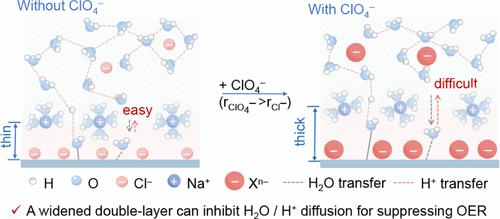
The electric double layer (EDL), which is directly related to ions, influences the electrocatalytic performance. However, the effects of anions on the anodic EDL and reaction kinetics are unclear, especially in water-mediated electrosynthesis. Here, ClO4– anions are discovered to widen the anodic EDL to inhibit the competitive oxygen evolution reaction (OER) for the gram-scale electrosynthesis of 2-chlorocyclohexanol with a 90% Faradaic efficiency (FE) at 100 mA cm–2. The combined results of molecular dynamics simulations and in situ spectroscopies provide solid evidence for the widened EDL that originates from the repulsion of water molecules from the interface by ClO4–. The addition of ClO4– has a negligible effect on chlorination kinetics because of the electrostatic interaction between the anode and Cl– but obviously suppresses the interaction between water and the anode, leading to high FEs of anodic electrosynthesis by increasing the energy barrier of the undesirable OER. In addition, this method is suitable for other chlorination reactions with enhanced FEs at 100 mA cm–2.
双电层(EDL)与离子直接相关,影响电催化性能。然而,阴离子对阳极EDL和反应动力学的影响尚不清楚,特别是在水介导的电合成中。在100 mA cm-2下,ClO4 -阴离子扩大了阳极EDL,抑制了2-氯环己醇克级电合成的竞争性析氧反应(OER),其法拉第效率为90%。分子动力学模拟和原位光谱相结合的结果提供了坚实的证据,证明了扩大的EDL是由于水分子被ClO4 -排斥出界面而引起的。由于阳极与Cl -之间的静电相互作用,ClO4 -的加入对氯化动力学的影响可以忽略不计,但明显抑制了水与阳极之间的相互作用,通过增加不良OER的能垒导致阳极电合成的高FEs。此外,该方法也适用于其他在100 mA cm-2下fe增强的氯化反应。
期刊介绍:
The flagship journal of the American Chemical Society, known as the Journal of the American Chemical Society (JACS), has been a prestigious publication since its establishment in 1879. It holds a preeminent position in the field of chemistry and related interdisciplinary sciences. JACS is committed to disseminating cutting-edge research papers, covering a wide range of topics, and encompasses approximately 19,000 pages of Articles, Communications, and Perspectives annually. With a weekly publication frequency, JACS plays a vital role in advancing the field of chemistry by providing essential research.



 京公网安备 11010802042870号
京ICP备2023020795号-1
京公网安备 11010802042870号
京ICP备2023020795号-1

 分享
分享
 求助内容:
求助内容: 应助结果提醒方式:
 扫码关注我们
