{"title":"Correlation of molecular weight diversity and colloidal disability performance of anionic lignin derived polymer","authors":"Farzad Gholami , Weijue Gao , Ehsan Behzadfar , Pedram Fatehi","doi":"10.1016/j.eurpolymj.2025.113820","DOIUrl":null,"url":null,"abstract":"<div><div>Polymerization is considered one of the valorization techniques of lignin for various applications. Generally, polymerization techniques affect the molecular structure of polymers. In this work, we evaluated a hypothesis that the polymerization strategy and, thus, the molecular weight distribution of lignin-derived polymers would impact their effectiveness as a colloidal disability agent (i.e., flocculant) for a suspension system. To achieve our goal, different lignin-polymethacrylic acid (PMAA) polymers were synthesized via free radical polymerization (FRP) and atom transfer radical polymerization (ATRP) techniques. The experiments were designed such that two sets of polymers with different molecular polydispersities but similar average molecular weights, charge densities, radii of gyration, and hydrodynamic diameters were obtained. Both systems developed colloidal destabilization mainly via bridging phenomenon. The flocculation performance of the ATRP-synthesized samples with narrower molecular weight distribution was notably better than that of FRP-induced samples. The rheological and flocculation analyses under different shear rates confirmed that the ATRP-induced sample promoted the entanglement of particles and had a higher flocculation efficiency. The flocculant prepared using the ATRP technique demonstrated a significantly lower optimal dosage, requiring only 0.4 mg per gram, compared to 25.6 mg per gram for the samples produced using the FRP method. Also, this sample produced stronger flocs with more re-flocculation tendency under different shear rates, while it generated larger flocs under stirring conditions. Such ATRP-derived flocs had an average chord length of approximately 60 μm, and those of FRP-based ones had a 30 μm chord length, while both FRP and ATRP polymers had 500 Da molecular weight. The results of this work confirmed that, while lignin-derived polymers can be an effective flocculant, strategies must be taken into account for generating lignin-derived polymers with a controlled and preferably narrow molecular weight distribution.</div></div>","PeriodicalId":315,"journal":{"name":"European Polymer Journal","volume":"228 ","pages":"Article 113820"},"PeriodicalIF":6.3000,"publicationDate":"2025-03-19","publicationTypes":"Journal Article","fieldsOfStudy":null,"isOpenAccess":false,"openAccessPdf":"","citationCount":"0","resultStr":null,"platform":"Semanticscholar","paperid":null,"PeriodicalName":"European Polymer Journal","FirstCategoryId":"92","ListUrlMain":"https://www.sciencedirect.com/science/article/pii/S0014305725001089","RegionNum":2,"RegionCategory":"化学","ArticlePicture":[],"TitleCN":null,"AbstractTextCN":null,"PMCID":null,"EPubDate":"2025/2/10 0:00:00","PubModel":"Epub","JCR":"Q1","JCRName":"POLYMER SCIENCE","Score":null,"Total":0}
引用次数: 0
Abstract
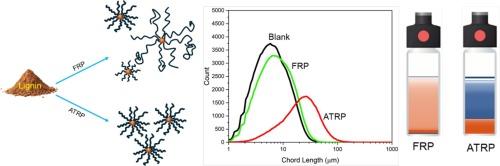
Polymerization is considered one of the valorization techniques of lignin for various applications. Generally, polymerization techniques affect the molecular structure of polymers. In this work, we evaluated a hypothesis that the polymerization strategy and, thus, the molecular weight distribution of lignin-derived polymers would impact their effectiveness as a colloidal disability agent (i.e., flocculant) for a suspension system. To achieve our goal, different lignin-polymethacrylic acid (PMAA) polymers were synthesized via free radical polymerization (FRP) and atom transfer radical polymerization (ATRP) techniques. The experiments were designed such that two sets of polymers with different molecular polydispersities but similar average molecular weights, charge densities, radii of gyration, and hydrodynamic diameters were obtained. Both systems developed colloidal destabilization mainly via bridging phenomenon. The flocculation performance of the ATRP-synthesized samples with narrower molecular weight distribution was notably better than that of FRP-induced samples. The rheological and flocculation analyses under different shear rates confirmed that the ATRP-induced sample promoted the entanglement of particles and had a higher flocculation efficiency. The flocculant prepared using the ATRP technique demonstrated a significantly lower optimal dosage, requiring only 0.4 mg per gram, compared to 25.6 mg per gram for the samples produced using the FRP method. Also, this sample produced stronger flocs with more re-flocculation tendency under different shear rates, while it generated larger flocs under stirring conditions. Such ATRP-derived flocs had an average chord length of approximately 60 μm, and those of FRP-based ones had a 30 μm chord length, while both FRP and ATRP polymers had 500 Da molecular weight. The results of this work confirmed that, while lignin-derived polymers can be an effective flocculant, strategies must be taken into account for generating lignin-derived polymers with a controlled and preferably narrow molecular weight distribution.
期刊介绍:
European Polymer Journal is dedicated to publishing work on fundamental and applied polymer chemistry and macromolecular materials. The journal covers all aspects of polymer synthesis, including polymerization mechanisms and chemical functional transformations, with a focus on novel polymers and the relationships between molecular structure and polymer properties. In addition, we welcome submissions on bio-based or renewable polymers, stimuli-responsive systems and polymer bio-hybrids. European Polymer Journal also publishes research on the biomedical application of polymers, including drug delivery and regenerative medicine. The main scope is covered but not limited to the following core research areas:
Polymer synthesis and functionalization
• Novel synthetic routes for polymerization, functional modification, controlled/living polymerization and precision polymers.
Stimuli-responsive polymers
• Including shape memory and self-healing polymers.
Supramolecular polymers and self-assembly
• Molecular recognition and higher order polymer structures.
Renewable and sustainable polymers
• Bio-based, biodegradable and anti-microbial polymers and polymeric bio-nanocomposites.
Polymers at interfaces and surfaces
• Chemistry and engineering of surfaces with biological relevance, including patterning, antifouling polymers and polymers for membrane applications.
Biomedical applications and nanomedicine
• Polymers for regenerative medicine, drug delivery molecular release and gene therapy
The scope of European Polymer Journal no longer includes Polymer Physics.



 京公网安备 11010802042870号
京ICP备2023020795号-1
京公网安备 11010802042870号
京ICP备2023020795号-1

 分享
分享
 求助内容:
求助内容: 应助结果提醒方式:
 扫码关注我们
