{"title":"A choline bio-ionic liquid-functionalized gelatin methacryloyl hydrogel for chronic wound healing","authors":"Aihik Banerjee , Parnian Jabbari , Manuela Martins-Green , Iman Noshadi","doi":"10.1016/j.eurpolymj.2025.113787","DOIUrl":null,"url":null,"abstract":"<div><div>Chronic wounds present a major healthcare challenge due to delayed healing, risk of infection, and limited treatment options. Current biomaterials-based chronic wound treatment strategies lack the multifunctional attributes necessary for tackling a myriad of pathophysiological complexities presented by chronic wounds. Here, we introduce a choline-based bio-ionic liquid (BIL)-functionalized gelatin methacryloyl (GelMA) hydrogel (BioGel) formulated for treating diabetic chronic wounds in a unique mouse model that recapitulates chronic wounds in humans. We tested the <em>in vitro</em> angiogenic potential of BioGel using human umbilical vein endothelial cells (HUVECs) and human mesenchymal stem cells (hMSCs). Finally, we applied the BioGel hydrogel on chronic wounds in <em>db/db<sup>-/-</sup></em> mice, twice weekly for 21 days or until wound closure. BioGel improved angiogenesis in co-cultures of HUVECs and hMSCs as evidenced by a significantly increased number of intact vascular tube formations compared to GelMA, highlighting the pro-angiogenic function of choline in BioGel. The application of BioGel accelerated wound closure, reduced biofilm, and promoted hair regrowth, in our human-relevant diabetic chronic wound model. These results suggest that BioGel offers a multifunctional, effective solution for chronic wound management, surpassing the limitations of current treatments.</div></div>","PeriodicalId":315,"journal":{"name":"European Polymer Journal","volume":"228 ","pages":"Article 113787"},"PeriodicalIF":6.3000,"publicationDate":"2025-03-19","publicationTypes":"Journal Article","fieldsOfStudy":null,"isOpenAccess":false,"openAccessPdf":"","citationCount":"0","resultStr":null,"platform":"Semanticscholar","paperid":null,"PeriodicalName":"European Polymer Journal","FirstCategoryId":"92","ListUrlMain":"https://www.sciencedirect.com/science/article/pii/S0014305725000758","RegionNum":2,"RegionCategory":"化学","ArticlePicture":[],"TitleCN":null,"AbstractTextCN":null,"PMCID":null,"EPubDate":"2025/2/2 0:00:00","PubModel":"Epub","JCR":"Q1","JCRName":"POLYMER SCIENCE","Score":null,"Total":0}
引用次数: 0
Abstract
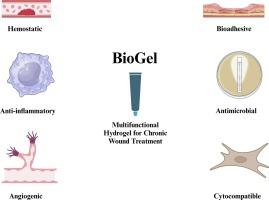
Chronic wounds present a major healthcare challenge due to delayed healing, risk of infection, and limited treatment options. Current biomaterials-based chronic wound treatment strategies lack the multifunctional attributes necessary for tackling a myriad of pathophysiological complexities presented by chronic wounds. Here, we introduce a choline-based bio-ionic liquid (BIL)-functionalized gelatin methacryloyl (GelMA) hydrogel (BioGel) formulated for treating diabetic chronic wounds in a unique mouse model that recapitulates chronic wounds in humans. We tested the in vitro angiogenic potential of BioGel using human umbilical vein endothelial cells (HUVECs) and human mesenchymal stem cells (hMSCs). Finally, we applied the BioGel hydrogel on chronic wounds in db/db-/- mice, twice weekly for 21 days or until wound closure. BioGel improved angiogenesis in co-cultures of HUVECs and hMSCs as evidenced by a significantly increased number of intact vascular tube formations compared to GelMA, highlighting the pro-angiogenic function of choline in BioGel. The application of BioGel accelerated wound closure, reduced biofilm, and promoted hair regrowth, in our human-relevant diabetic chronic wound model. These results suggest that BioGel offers a multifunctional, effective solution for chronic wound management, surpassing the limitations of current treatments.
期刊介绍:
European Polymer Journal is dedicated to publishing work on fundamental and applied polymer chemistry and macromolecular materials. The journal covers all aspects of polymer synthesis, including polymerization mechanisms and chemical functional transformations, with a focus on novel polymers and the relationships between molecular structure and polymer properties. In addition, we welcome submissions on bio-based or renewable polymers, stimuli-responsive systems and polymer bio-hybrids. European Polymer Journal also publishes research on the biomedical application of polymers, including drug delivery and regenerative medicine. The main scope is covered but not limited to the following core research areas:
Polymer synthesis and functionalization
• Novel synthetic routes for polymerization, functional modification, controlled/living polymerization and precision polymers.
Stimuli-responsive polymers
• Including shape memory and self-healing polymers.
Supramolecular polymers and self-assembly
• Molecular recognition and higher order polymer structures.
Renewable and sustainable polymers
• Bio-based, biodegradable and anti-microbial polymers and polymeric bio-nanocomposites.
Polymers at interfaces and surfaces
• Chemistry and engineering of surfaces with biological relevance, including patterning, antifouling polymers and polymers for membrane applications.
Biomedical applications and nanomedicine
• Polymers for regenerative medicine, drug delivery molecular release and gene therapy
The scope of European Polymer Journal no longer includes Polymer Physics.



 京公网安备 11010802042870号
京ICP备2023020795号-1
京公网安备 11010802042870号
京ICP备2023020795号-1

 分享
分享
 求助内容:
求助内容: 应助结果提醒方式:
 扫码关注我们
