Arturo Zenone , V. Maximiliano Giacalone , Marco Martinez , Carlo Pipitone , Adriana Alagna , Eduardo Infantes , Giovanni D'Anna , Fabio Badalamenti
{"title":"Stitching up Posidonia oceanica (L.) Delile anchorage scars using beach-cast seeds: Results of a six-year study","authors":"Arturo Zenone , V. Maximiliano Giacalone , Marco Martinez , Carlo Pipitone , Adriana Alagna , Eduardo Infantes , Giovanni D'Anna , Fabio Badalamenti","doi":"10.1016/j.biocon.2025.111032","DOIUrl":null,"url":null,"abstract":"<div><div>Seagrass meadows are experiencing a worldwide decline, driven by human activities and natural disturbances. The degradation of these meadows raises significant concerns regarding the loss of essential ecosystem services. <em>Posidonia oceanica</em>, a Mediterranean endemic seagrass, plays a crucial role in coastal ecosystems, contributing to biodiversity, carbon storage, water purification, and shoreline protection. This study reports the outcomes of a six-year transplantation experiment aimed at restoring small damaged patches in a <em>Posidonia oceanica</em> meadow in the southwestern Tyrrhenian Sea, within the Egadi Marine Protected Area (MPA). The damage, likely caused by boat anchoring, was addressed using seedlings grown in the laboratory from beach-cast seeds. The experiment evaluated the survival and growth of seedlings planted at three different densities in two sites. After six years, the intermediate planting density (100 seedlings per m<sup>2</sup>) yielded the highest survival rate (76.9 %), while the lowest density (40 seedlings per m<sup>2</sup>) resulted in the lowest survival rate (5.1 %). Seedlings showed significantly different growth rates and biomass accumulation in the two sites, likely due to variability in sediment accumulation, seabed slope and hydrodynamic conditions. This research highlights the potential of seed-based techniques for restoring seagrass meadows, emphasizing that long-term monitoring and careful selection of transplant sites are essential for the success of such restoration efforts.</div></div>","PeriodicalId":55375,"journal":{"name":"Biological Conservation","volume":"303 ","pages":"Article 111032"},"PeriodicalIF":4.4000,"publicationDate":"2025-03-01","publicationTypes":"Journal Article","fieldsOfStudy":null,"isOpenAccess":false,"openAccessPdf":"","citationCount":"0","resultStr":null,"platform":"Semanticscholar","paperid":null,"PeriodicalName":"Biological Conservation","FirstCategoryId":"93","ListUrlMain":"https://www.sciencedirect.com/science/article/pii/S0006320725000692","RegionNum":1,"RegionCategory":"环境科学与生态学","ArticlePicture":[],"TitleCN":null,"AbstractTextCN":null,"PMCID":null,"EPubDate":"2025/2/14 0:00:00","PubModel":"Epub","JCR":"Q1","JCRName":"BIODIVERSITY CONSERVATION","Score":null,"Total":0}
引用次数: 0
Abstract
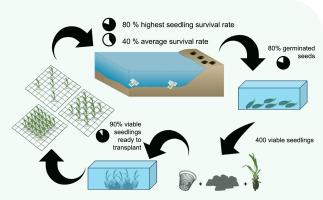
Seagrass meadows are experiencing a worldwide decline, driven by human activities and natural disturbances. The degradation of these meadows raises significant concerns regarding the loss of essential ecosystem services. Posidonia oceanica, a Mediterranean endemic seagrass, plays a crucial role in coastal ecosystems, contributing to biodiversity, carbon storage, water purification, and shoreline protection. This study reports the outcomes of a six-year transplantation experiment aimed at restoring small damaged patches in a Posidonia oceanica meadow in the southwestern Tyrrhenian Sea, within the Egadi Marine Protected Area (MPA). The damage, likely caused by boat anchoring, was addressed using seedlings grown in the laboratory from beach-cast seeds. The experiment evaluated the survival and growth of seedlings planted at three different densities in two sites. After six years, the intermediate planting density (100 seedlings per m2) yielded the highest survival rate (76.9 %), while the lowest density (40 seedlings per m2) resulted in the lowest survival rate (5.1 %). Seedlings showed significantly different growth rates and biomass accumulation in the two sites, likely due to variability in sediment accumulation, seabed slope and hydrodynamic conditions. This research highlights the potential of seed-based techniques for restoring seagrass meadows, emphasizing that long-term monitoring and careful selection of transplant sites are essential for the success of such restoration efforts.
期刊介绍:
Biological Conservation is an international leading journal in the discipline of conservation biology. The journal publishes articles spanning a diverse range of fields that contribute to the biological, sociological, and economic dimensions of conservation and natural resource management. The primary aim of Biological Conservation is the publication of high-quality papers that advance the science and practice of conservation, or which demonstrate the application of conservation principles for natural resource management and policy. Therefore it will be of interest to a broad international readership.



 京公网安备 11010802042870号
京ICP备2023020795号-1
京公网安备 11010802042870号
京ICP备2023020795号-1

 分享
分享
 求助内容:
求助内容: 应助结果提醒方式:
 扫码关注我们
