{"title":"Exploration of oral microbiota alteration and AI-driven non-invasive hyperspectral imaging for CAD prediction.","authors":"Zeyan Li, Xiaomeng Yang, Dingming Zhang, Xiaoyu Shi, Lei Lei, Fei Zhou, Wenjing Li, Tianyou Xu, Xinyu Liu, Songyun Wang, Jian Yang, Xinyu Wang, Yanfei Zhong, Lilei Yu","doi":"10.1186/s12872-025-04555-5","DOIUrl":null,"url":null,"abstract":"<p><strong>Background: </strong>Oral microbiome dysbiosis is an important risk factor affecting the occurrence and progression of coronary artery disease (CAD). However, the dysbiosis on the tongue in patients with CAD is still unclear, and whether the oral alteration caused by these disorders can be identified by other tools for CAD diagnosis needs to be further explored. Hyperspectral imaging (HSI) is characterized as high spectral resolution, broad spectral range, and superior spatial resolution. Hyperspectral images contain high-dimensional data that generally require machine learning algorithms for feature identification and model construction. Therefore, this study aims to investigate the variation of tongue microbiota and the effectiveness of HSI models in CAD diagnosis.</p><p><strong>Methods: </strong>Between 2023 and 2024, we prospectively approached 276 patients with chest pain and exhibiting risk for CAD who underwent coronary artery angiography (CAG). And 190 patients were enrolled in this study. Tongue dorsum swabs were collected for subsequent 16sRNA sequencing and microbiome analysis. Tongue dorsum features were extracted from hyperspectral images. The HSI analysis incorporated a total of 4750 hyperspectral images from all patients. All images are divided into training set (N = 2555), internal test set (N = 1095) and external test set (N = 1095). A total of 31 models were constructed. 30 single machine learning algorithms were used to construct and test the CAD prediction models. Furthermore, the best performing fusion model was established. The efficacy of the model was evaluated employing several metrics, including area under the curve (AUC), decision curve analysis (DCA), calibration curve, accuracy (ACC), sensitivity (SE), specificity (SP), positive predictive value (PPV), negative predictive value (NPV) and F1 score.</p><p><strong>Results: </strong>The 16sRNA sequencing results indicated significant dysbiosis in the oral microbiota of patients with CAD, with decreased microbial abundance, network complexity and stability. The fusion model (GP-GB-SVM) demonstrated the highest performance, achieving an AUC of 0.92, ACC of 0.82, SE of 0.70, SP of 0.92, PPV of 0.88 and NPV of 0.79 in the internal test set and AUC of 0.86, ACC of 0.70, SE of 0.90, SP of 0.46, PPV of 0.60 and NPV of 0.90 in the external test set.</p><p><strong>Conclusion: </strong>These findings not only emphasize the significant alteration of microbiome colonized on the tongue dorsum in CAD patients but also demonstrate the tongue features associated with microbiome dysbiosis can be identified in hyperspectral images. Thereby the integration of HSI and machine learning provides novel insights into non-invasive diagnosis of CAD.</p>","PeriodicalId":9195,"journal":{"name":"BMC Cardiovascular Disorders","volume":"25 1","pages":"102"},"PeriodicalIF":2.3000,"publicationDate":"2025-02-15","publicationTypes":"Journal Article","fieldsOfStudy":null,"isOpenAccess":false,"openAccessPdf":"https://www.ncbi.nlm.nih.gov/pmc/articles/PMC11829377/pdf/","citationCount":"0","resultStr":null,"platform":"Semanticscholar","paperid":null,"PeriodicalName":"BMC Cardiovascular Disorders","FirstCategoryId":"3","ListUrlMain":"https://doi.org/10.1186/s12872-025-04555-5","RegionNum":3,"RegionCategory":"医学","ArticlePicture":[],"TitleCN":null,"AbstractTextCN":null,"PMCID":null,"EPubDate":"","PubModel":"","JCR":"Q3","JCRName":"CARDIAC & CARDIOVASCULAR SYSTEMS","Score":null,"Total":0}
引用次数: 0
Abstract
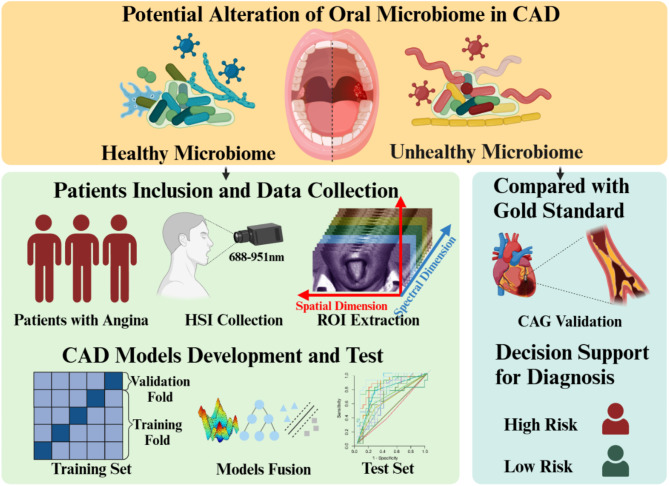
Background: Oral microbiome dysbiosis is an important risk factor affecting the occurrence and progression of coronary artery disease (CAD). However, the dysbiosis on the tongue in patients with CAD is still unclear, and whether the oral alteration caused by these disorders can be identified by other tools for CAD diagnosis needs to be further explored. Hyperspectral imaging (HSI) is characterized as high spectral resolution, broad spectral range, and superior spatial resolution. Hyperspectral images contain high-dimensional data that generally require machine learning algorithms for feature identification and model construction. Therefore, this study aims to investigate the variation of tongue microbiota and the effectiveness of HSI models in CAD diagnosis.
Methods: Between 2023 and 2024, we prospectively approached 276 patients with chest pain and exhibiting risk for CAD who underwent coronary artery angiography (CAG). And 190 patients were enrolled in this study. Tongue dorsum swabs were collected for subsequent 16sRNA sequencing and microbiome analysis. Tongue dorsum features were extracted from hyperspectral images. The HSI analysis incorporated a total of 4750 hyperspectral images from all patients. All images are divided into training set (N = 2555), internal test set (N = 1095) and external test set (N = 1095). A total of 31 models were constructed. 30 single machine learning algorithms were used to construct and test the CAD prediction models. Furthermore, the best performing fusion model was established. The efficacy of the model was evaluated employing several metrics, including area under the curve (AUC), decision curve analysis (DCA), calibration curve, accuracy (ACC), sensitivity (SE), specificity (SP), positive predictive value (PPV), negative predictive value (NPV) and F1 score.
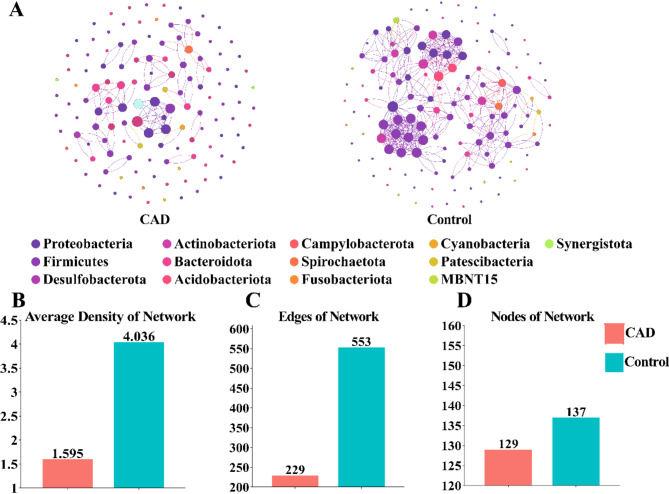
Results: The 16sRNA sequencing results indicated significant dysbiosis in the oral microbiota of patients with CAD, with decreased microbial abundance, network complexity and stability. The fusion model (GP-GB-SVM) demonstrated the highest performance, achieving an AUC of 0.92, ACC of 0.82, SE of 0.70, SP of 0.92, PPV of 0.88 and NPV of 0.79 in the internal test set and AUC of 0.86, ACC of 0.70, SE of 0.90, SP of 0.46, PPV of 0.60 and NPV of 0.90 in the external test set.
Conclusion: These findings not only emphasize the significant alteration of microbiome colonized on the tongue dorsum in CAD patients but also demonstrate the tongue features associated with microbiome dysbiosis can be identified in hyperspectral images. Thereby the integration of HSI and machine learning provides novel insights into non-invasive diagnosis of CAD.
期刊介绍:
BMC Cardiovascular Disorders is an open access, peer-reviewed journal that considers articles on all aspects of the prevention, diagnosis and management of disorders of the heart and circulatory system, as well as related molecular and cell biology, genetics, pathophysiology, epidemiology, and controlled trials.




 京公网安备 11010802042870号
京ICP备2023020795号-1
京公网安备 11010802042870号
京ICP备2023020795号-1

 分享
分享
 求助内容:
求助内容: 应助结果提醒方式:
 扫码关注我们
