Simeon Rüdesheim, Helena Leonie Hanae Loer, Denise Feick, Fatima Zahra Marok, Laura Maria Fuhr, Dominik Selzer, Donato Teutonico, Annika R. P. Schneider, Juri Solodenko, Sebastian Frechen, Maaike van der Lee, Dirk Jan A. R. Moes, Jesse J. Swen, Matthias Schwab, Thorsten Lehr
{"title":"A Comprehensive CYP2D6 Drug–Drug–Gene Interaction Network for Application in Precision Dosing and Drug Development","authors":"Simeon Rüdesheim, Helena Leonie Hanae Loer, Denise Feick, Fatima Zahra Marok, Laura Maria Fuhr, Dominik Selzer, Donato Teutonico, Annika R. P. Schneider, Juri Solodenko, Sebastian Frechen, Maaike van der Lee, Dirk Jan A. R. Moes, Jesse J. Swen, Matthias Schwab, Thorsten Lehr","doi":"10.1002/cpt.3604","DOIUrl":null,"url":null,"abstract":"<p>Conducting clinical studies on drug–drug-gene interactions (DDGIs) and extrapolating the findings into clinical dose recommendations is challenging due to the high complexity of these interactions. Here, physiologically-based pharmacokinetic (PBPK) modeling networks present a new avenue for exploring such complex scenarios, potentially informing clinical guidelines and handling patient-specific DDGIs at the bedside. Moreover, they provide an established framework for drug–drug interaction (DDI) submissions to regulatory agencies. The cytochrome P450 (CYP) 2D6 enzyme is particularly prone to DDGIs due to the high prevalence of genetic variation and common use of CYP2D6 inhibiting drugs. In this study, we present a comprehensive PBPK network covering CYP2D6 drug–gene interactions (DGIs), DDIs, and DDGIs. The network covers sensitive and moderate sensitive substrates, and strong and weak inhibitors of CYP2D6 according to the United States Food and Drug Administration (FDA) guidance. For the analyzed CYP2D6 substrates and inhibitors, DD(G)Is mediated by CYP3A4 and P-glycoprotein were included. Overall, the network comprises 23 compounds and was developed based on 30 DGI, 45 DDI, and seven DDGI studies, covering 32 unique drug combinations. Good predictive performance was demonstrated for all interaction types, as reflected in mean geometric mean fold errors of 1.40, 1.38, and 1.56 for the DD(G)I area under the curve ratios as well as 1.29, 1.43, and 1.60 for DD(G)I maximum plasma concentration ratios. Finally, the presented network was utilized to calculate dose adaptations for CYP2D6 substrates atomoxetine (sensitive) and metoprolol (moderate sensitive) for clinically untested DDGI scenarios, showcasing a potential clinical application of DDGI model networks in the field of model-informed precision dosing.</p>","PeriodicalId":153,"journal":{"name":"Clinical Pharmacology & Therapeutics","volume":"117 6","pages":"1718-1731"},"PeriodicalIF":5.5000,"publicationDate":"2025-02-14","publicationTypes":"Journal Article","fieldsOfStudy":null,"isOpenAccess":false,"openAccessPdf":"https://onlinelibrary.wiley.com/doi/epdf/10.1002/cpt.3604","citationCount":"0","resultStr":null,"platform":"Semanticscholar","paperid":null,"PeriodicalName":"Clinical Pharmacology & Therapeutics","FirstCategoryId":"3","ListUrlMain":"https://ascpt.onlinelibrary.wiley.com/doi/10.1002/cpt.3604","RegionNum":2,"RegionCategory":"医学","ArticlePicture":[],"TitleCN":null,"AbstractTextCN":null,"PMCID":null,"EPubDate":"","PubModel":"","JCR":"Q1","JCRName":"PHARMACOLOGY & PHARMACY","Score":null,"Total":0}
引用次数: 0
Abstract
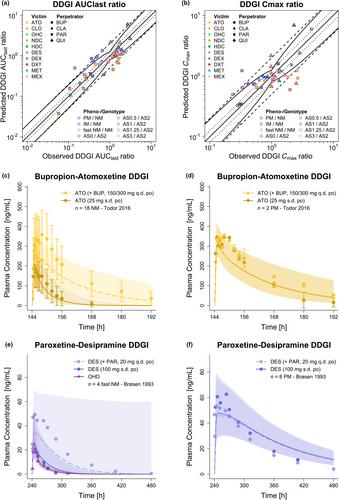
Conducting clinical studies on drug–drug-gene interactions (DDGIs) and extrapolating the findings into clinical dose recommendations is challenging due to the high complexity of these interactions. Here, physiologically-based pharmacokinetic (PBPK) modeling networks present a new avenue for exploring such complex scenarios, potentially informing clinical guidelines and handling patient-specific DDGIs at the bedside. Moreover, they provide an established framework for drug–drug interaction (DDI) submissions to regulatory agencies. The cytochrome P450 (CYP) 2D6 enzyme is particularly prone to DDGIs due to the high prevalence of genetic variation and common use of CYP2D6 inhibiting drugs. In this study, we present a comprehensive PBPK network covering CYP2D6 drug–gene interactions (DGIs), DDIs, and DDGIs. The network covers sensitive and moderate sensitive substrates, and strong and weak inhibitors of CYP2D6 according to the United States Food and Drug Administration (FDA) guidance. For the analyzed CYP2D6 substrates and inhibitors, DD(G)Is mediated by CYP3A4 and P-glycoprotein were included. Overall, the network comprises 23 compounds and was developed based on 30 DGI, 45 DDI, and seven DDGI studies, covering 32 unique drug combinations. Good predictive performance was demonstrated for all interaction types, as reflected in mean geometric mean fold errors of 1.40, 1.38, and 1.56 for the DD(G)I area under the curve ratios as well as 1.29, 1.43, and 1.60 for DD(G)I maximum plasma concentration ratios. Finally, the presented network was utilized to calculate dose adaptations for CYP2D6 substrates atomoxetine (sensitive) and metoprolol (moderate sensitive) for clinically untested DDGI scenarios, showcasing a potential clinical application of DDGI model networks in the field of model-informed precision dosing.
期刊介绍:
Clinical Pharmacology & Therapeutics (CPT) is the authoritative cross-disciplinary journal in experimental and clinical medicine devoted to publishing advances in the nature, action, efficacy, and evaluation of therapeutics. CPT welcomes original Articles in the emerging areas of translational, predictive and personalized medicine; new therapeutic modalities including gene and cell therapies; pharmacogenomics, proteomics and metabolomics; bioinformation and applied systems biology complementing areas of pharmacokinetics and pharmacodynamics, human investigation and clinical trials, pharmacovigilence, pharmacoepidemiology, pharmacometrics, and population pharmacology.





 京公网安备 11010802042870号
京ICP备2023020795号-1
京公网安备 11010802042870号
京ICP备2023020795号-1

 分享
分享

 求助内容:
求助内容: 应助结果提醒方式:
 扫码关注我们
