Jingchen Yu, Huang Tang, Yana Chen, Zuoqiang Wang, Wanqiu Huang, Tao Zhou, Bingjie Wen, Chengyue Wang, Shuang Gu, Jinjing Ni, Jing Tao, Danni Wang, Jie Lu, Qing Xie, Yu-Feng Yao
{"title":"<i>Salmonella</i> utilizes L-arabinose to silence virulence gene expression for accelerated pathogen growth within the host.","authors":"Jingchen Yu, Huang Tang, Yana Chen, Zuoqiang Wang, Wanqiu Huang, Tao Zhou, Bingjie Wen, Chengyue Wang, Shuang Gu, Jinjing Ni, Jing Tao, Danni Wang, Jie Lu, Qing Xie, Yu-Feng Yao","doi":"10.1080/19490976.2025.2467187","DOIUrl":null,"url":null,"abstract":"<p><p>Carbon source is an important nutrient for bacteria to sustain growth and often acts as a signal that modulates virulence expression. L-arabinose is produced by plants and plays an important role in regulating the global gene expression of bacteria. Previously, we have shown that L-arabinose induces a more severe systemic infection in <i>Salmonella</i>-infected mice with normal microbiota, but does not affect the disease progression in mice with microbiota depleted by antibiotic treatment. The underlying mechanism remains elusive. In this study, we demonstrate that L-arabinose represses the expression of <i>Salmonella</i> type III secretion system 1 (T3SS-1) genes by negatively regulating the activity of the cyclic 3' 5'-AMP (cAMP)-cAMP receptor protein (CRP) complex. The cAMP-CRP complex can activate ribosome-associated inhibitor A, encoded by <i>yfiA</i>, to maintain the stability of HilD, a key transcriptional regulator of T3SS-1. L-arabinose supplementation promotes <i>Salmonella</i> initial bloom in the antibiotic-pretreated mouse gut and ultimately compensates for reduced virulence within the host. These results decipher the molecular mechanism by which cAMP-CRP directs regulatory changes of virulence in response to L-arabinose in <i>Salmonella</i>. It further implies that <i>Salmonella</i> exploits L-arabinose both as a nutrient and a regulatory signal to maintain a balance between growth and virulence within the host.</p>","PeriodicalId":12909,"journal":{"name":"Gut Microbes","volume":"17 1","pages":"2467187"},"PeriodicalIF":11.0000,"publicationDate":"2025-12-01","publicationTypes":"Journal Article","fieldsOfStudy":null,"isOpenAccess":false,"openAccessPdf":"https://www.ncbi.nlm.nih.gov/pmc/articles/PMC11834461/pdf/","citationCount":"0","resultStr":null,"platform":"Semanticscholar","paperid":null,"PeriodicalName":"Gut Microbes","FirstCategoryId":"3","ListUrlMain":"https://doi.org/10.1080/19490976.2025.2467187","RegionNum":1,"RegionCategory":"医学","ArticlePicture":[],"TitleCN":null,"AbstractTextCN":null,"PMCID":null,"EPubDate":"2025/2/15 0:00:00","PubModel":"Epub","JCR":"Q1","JCRName":"GASTROENTEROLOGY & HEPATOLOGY","Score":null,"Total":0}
引用次数: 0
Abstract
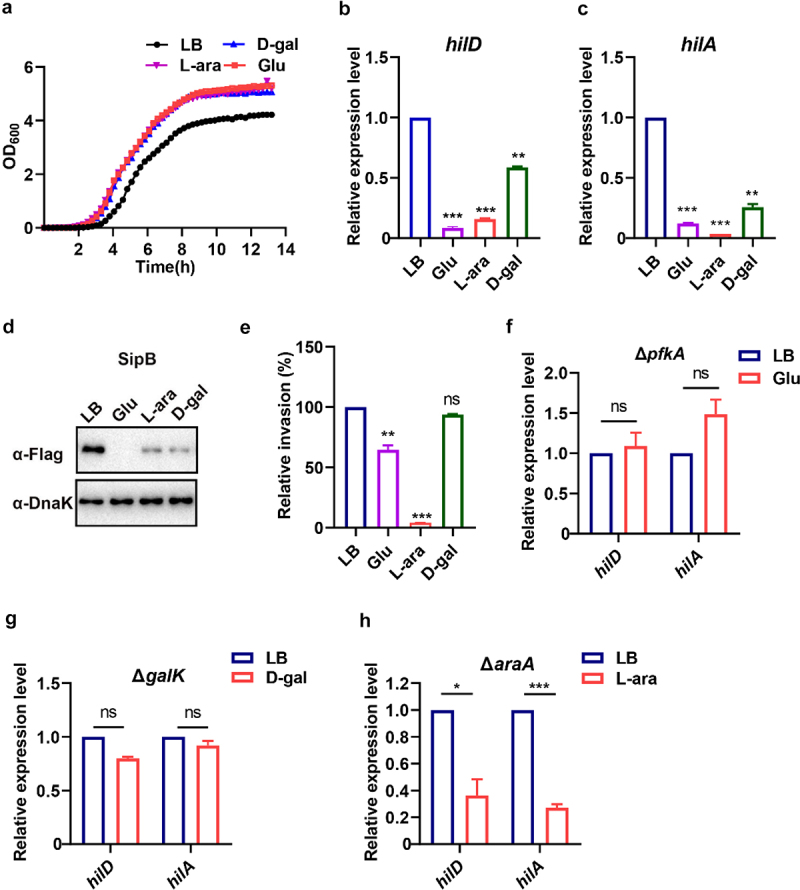
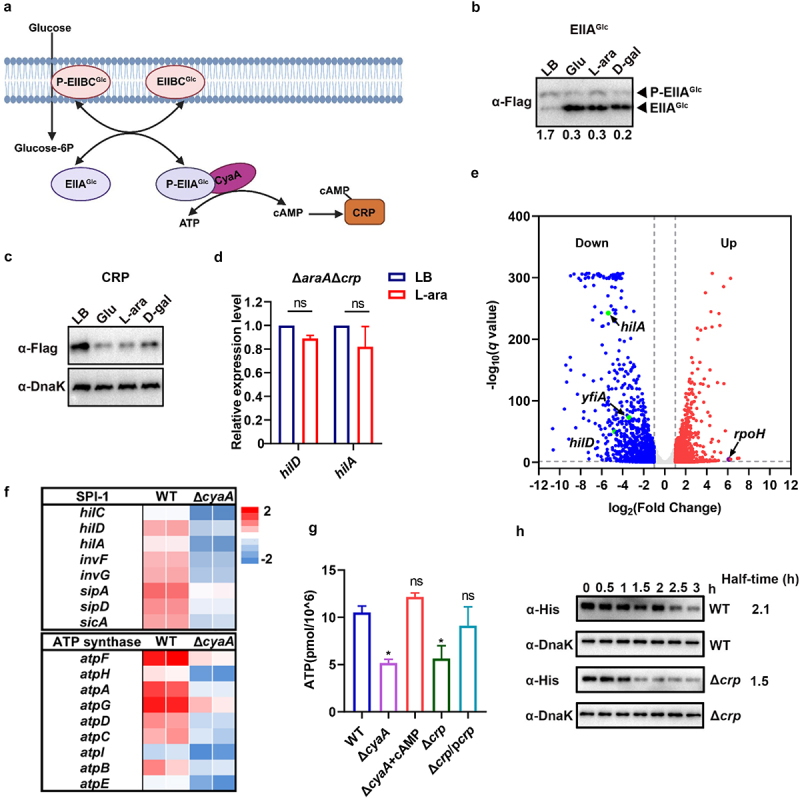
Carbon source is an important nutrient for bacteria to sustain growth and often acts as a signal that modulates virulence expression. L-arabinose is produced by plants and plays an important role in regulating the global gene expression of bacteria. Previously, we have shown that L-arabinose induces a more severe systemic infection in Salmonella-infected mice with normal microbiota, but does not affect the disease progression in mice with microbiota depleted by antibiotic treatment. The underlying mechanism remains elusive. In this study, we demonstrate that L-arabinose represses the expression of Salmonella type III secretion system 1 (T3SS-1) genes by negatively regulating the activity of the cyclic 3' 5'-AMP (cAMP)-cAMP receptor protein (CRP) complex. The cAMP-CRP complex can activate ribosome-associated inhibitor A, encoded by yfiA, to maintain the stability of HilD, a key transcriptional regulator of T3SS-1. L-arabinose supplementation promotes Salmonella initial bloom in the antibiotic-pretreated mouse gut and ultimately compensates for reduced virulence within the host. These results decipher the molecular mechanism by which cAMP-CRP directs regulatory changes of virulence in response to L-arabinose in Salmonella. It further implies that Salmonella exploits L-arabinose both as a nutrient and a regulatory signal to maintain a balance between growth and virulence within the host.
期刊介绍:
The intestinal microbiota plays a crucial role in human physiology, influencing various aspects of health and disease such as nutrition, obesity, brain function, allergic responses, immunity, inflammatory bowel disease, irritable bowel syndrome, cancer development, cardiac disease, liver disease, and more.
Gut Microbes serves as a platform for showcasing and discussing state-of-the-art research related to the microorganisms present in the intestine. The journal emphasizes mechanistic and cause-and-effect studies. Additionally, it has a counterpart, Gut Microbes Reports, which places a greater focus on emerging topics and comparative and incremental studies.



 京公网安备 11010802042870号
京ICP备2023020795号-1
京公网安备 11010802042870号
京ICP备2023020795号-1

 分享
分享
 求助内容:
求助内容: 应助结果提醒方式:
 扫码关注我们
