{"title":"Predictive value of perioperative fasting blood glucose for post pancreatectomy diabetes mellitus in pancreatic ductal carcinoma patients.","authors":"Shuai Wang, Hanshen Zhou, Kaili Cai, Yiqun Fan, Xiaohui Yang, Bo Zhang, Yulian Wu","doi":"10.1186/s12957-025-03705-5","DOIUrl":null,"url":null,"abstract":"<p><strong>Background: </strong>To explore the risk factors of post pancreatectomy diabetes mellitus (PPTDM)in pancreatic ductal carcinoma (PDAC) patients and the value of perioperative fasting blood glucose (FBG) level expression on the long-term survival after surgery.</p><p><strong>Materials and methods: </strong>Between December 2015 and December 2019, a cohort of 509 patients diagnosed with PDAC and undergoing resection at our hospital was analyzed. They were stratified into two groups, Control group (Control) and study group (PPTDM), depending on the onset of postoperative diabetes mellitus. We analyzed the survival rates at 6 months, 12 months and 24 months post-operation in the two groups. We use univariate and logostic multivariate regressions to analyze the risk factors for PPTDM. ROC curve analysis was conducted to assess the diagnostic significance of perioperative FBG levels regarding patients' long-term survival rates. The Kaplan-Meier method was employed to assess the impact of both preoperative and postoperative FBG levels on the survival rates within 24 months for each patient group.</p><p><strong>Results: </strong>The comparison of general clinical data between the two groups shows marginal differences without statistical significance(P > 0.05); Patients in PPTDM group had significantly higher BMI, preoperative jaundice proportion, larger tumor diameter, higher TNM stage and higher proportion of distal pancreatectomy (DP), with P values of 0.023, 0.010, 0.040, 0.012 and 0.005, respectively. The levels of preoperative FBG and postoperative FBG in PPTDM patients exhibited statistically significant elevation compared to the control group (P < 0.05). There were no significant differences in surgery-related indicators between the two groups in operative time, number of dissected positive lymph nodes, total number of dissected lymph nodes, intraoperative blood loss and other related data (P > 0.05). Hospitalization duration of PPTDM patients was longer than control group (P = 0.047). PPTDM group had significantly higher expression concentrations of BUN, Cr, TG, LDL and Apo-B factors (P = 0.023, 0.024, 0.013, 0.045 and 0.017). 17 patients (5.03%) died in the PPTDM group and 4 patients (2.35%) in control group which had significantly difference (P = 0.020). In univariate and logostic multivariate regression analysis indicated tumor size, jaundice, BUN, Cr, TG, LDL, Apo-B concentrations and DP approach were significantly correlated to the risk for PPTDM (P < 0.05). ROC curve analysis results showed combining of preoperative and postoperation FBG showed the highest diagnostic efficacy, followed by postoperation FBG and preoperative FBG. The AUC areas of the three groups were 0.745, 0.623 and 0.588, respectively, and the critical values of the three groups were 9.81/9.95 mmol/L, 10.18 mmol/L and 10.23 mmol/L, respectively, with statistical significance (P < 0.05). Results were considered statistically significant if the p-value was less than 0.05.</p><p><strong>Conclusion: </strong>PPTDM stands as a significant postoperative complication following pancreatic cancer surgery, characterized by a high incidence and severity. Several risk factors have garnered considerable attention among clinical surgeon. PPTDM may be an influential factor in postoperative prognosis of pancreatic cancer. The expression levels of preoperative and postoperative blood glucose hold diagnostic value for the long-term prognosis of pancreatic cancer patients. Early regulation and intervention by surgeons concerning perioperative FBG could potentially mitigate the risk of PPTDM.</p>","PeriodicalId":23856,"journal":{"name":"World Journal of Surgical Oncology","volume":"23 1","pages":"55"},"PeriodicalIF":2.5000,"publicationDate":"2025-02-15","publicationTypes":"Journal Article","fieldsOfStudy":null,"isOpenAccess":false,"openAccessPdf":"https://www.ncbi.nlm.nih.gov/pmc/articles/PMC11830169/pdf/","citationCount":"0","resultStr":null,"platform":"Semanticscholar","paperid":null,"PeriodicalName":"World Journal of Surgical Oncology","FirstCategoryId":"3","ListUrlMain":"https://doi.org/10.1186/s12957-025-03705-5","RegionNum":3,"RegionCategory":"医学","ArticlePicture":[],"TitleCN":null,"AbstractTextCN":null,"PMCID":null,"EPubDate":"","PubModel":"","JCR":"Q3","JCRName":"ONCOLOGY","Score":null,"Total":0}
引用次数: 0
Abstract
Background: To explore the risk factors of post pancreatectomy diabetes mellitus (PPTDM)in pancreatic ductal carcinoma (PDAC) patients and the value of perioperative fasting blood glucose (FBG) level expression on the long-term survival after surgery.
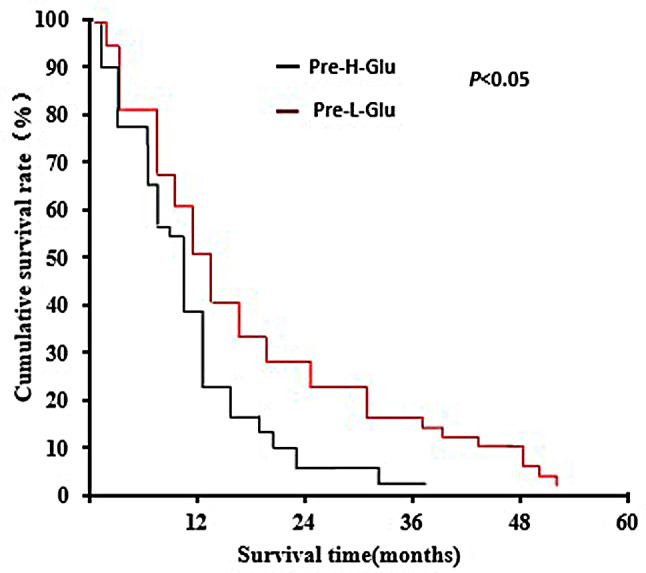
Materials and methods: Between December 2015 and December 2019, a cohort of 509 patients diagnosed with PDAC and undergoing resection at our hospital was analyzed. They were stratified into two groups, Control group (Control) and study group (PPTDM), depending on the onset of postoperative diabetes mellitus. We analyzed the survival rates at 6 months, 12 months and 24 months post-operation in the two groups. We use univariate and logostic multivariate regressions to analyze the risk factors for PPTDM. ROC curve analysis was conducted to assess the diagnostic significance of perioperative FBG levels regarding patients' long-term survival rates. The Kaplan-Meier method was employed to assess the impact of both preoperative and postoperative FBG levels on the survival rates within 24 months for each patient group.
Results: The comparison of general clinical data between the two groups shows marginal differences without statistical significance(P > 0.05); Patients in PPTDM group had significantly higher BMI, preoperative jaundice proportion, larger tumor diameter, higher TNM stage and higher proportion of distal pancreatectomy (DP), with P values of 0.023, 0.010, 0.040, 0.012 and 0.005, respectively. The levels of preoperative FBG and postoperative FBG in PPTDM patients exhibited statistically significant elevation compared to the control group (P < 0.05). There were no significant differences in surgery-related indicators between the two groups in operative time, number of dissected positive lymph nodes, total number of dissected lymph nodes, intraoperative blood loss and other related data (P > 0.05). Hospitalization duration of PPTDM patients was longer than control group (P = 0.047). PPTDM group had significantly higher expression concentrations of BUN, Cr, TG, LDL and Apo-B factors (P = 0.023, 0.024, 0.013, 0.045 and 0.017). 17 patients (5.03%) died in the PPTDM group and 4 patients (2.35%) in control group which had significantly difference (P = 0.020). In univariate and logostic multivariate regression analysis indicated tumor size, jaundice, BUN, Cr, TG, LDL, Apo-B concentrations and DP approach were significantly correlated to the risk for PPTDM (P < 0.05). ROC curve analysis results showed combining of preoperative and postoperation FBG showed the highest diagnostic efficacy, followed by postoperation FBG and preoperative FBG. The AUC areas of the three groups were 0.745, 0.623 and 0.588, respectively, and the critical values of the three groups were 9.81/9.95 mmol/L, 10.18 mmol/L and 10.23 mmol/L, respectively, with statistical significance (P < 0.05). Results were considered statistically significant if the p-value was less than 0.05.
Conclusion: PPTDM stands as a significant postoperative complication following pancreatic cancer surgery, characterized by a high incidence and severity. Several risk factors have garnered considerable attention among clinical surgeon. PPTDM may be an influential factor in postoperative prognosis of pancreatic cancer. The expression levels of preoperative and postoperative blood glucose hold diagnostic value for the long-term prognosis of pancreatic cancer patients. Early regulation and intervention by surgeons concerning perioperative FBG could potentially mitigate the risk of PPTDM.
期刊介绍:
World Journal of Surgical Oncology publishes articles related to surgical oncology and its allied subjects, such as epidemiology, cancer research, biomarkers, prevention, pathology, radiology, cancer treatment, clinical trials, multimodality treatment and molecular biology. Emphasis is placed on original research articles. The journal also publishes significant clinical case reports, as well as balanced and timely reviews on selected topics.
Oncology is a multidisciplinary super-speciality of which surgical oncology forms an integral component, especially with solid tumors. Surgical oncologists around the world are involved in research extending from detecting the mechanisms underlying the causation of cancer, to its treatment and prevention. The role of a surgical oncologist extends across the whole continuum of care. With continued developments in diagnosis and treatment, the role of a surgical oncologist is ever-changing. Hence, World Journal of Surgical Oncology aims to keep readers abreast with latest developments that will ultimately influence the work of surgical oncologists.






 京公网安备 11010802042870号
京ICP备2023020795号-1
京公网安备 11010802042870号
京ICP备2023020795号-1

 分享
分享
 求助内容:
求助内容: 应助结果提醒方式:
 扫码关注我们
