Zhenxiang Zhao, Senhao Wang, Xiaomei Shi, Hongbing Fu and Long Wang
{"title":"Multiple effects of aromatic substituents on excited-state properties and singlet fission process in azaquinodimethane systems†","authors":"Zhenxiang Zhao, Senhao Wang, Xiaomei Shi, Hongbing Fu and Long Wang","doi":"10.1039/D4SC06494A","DOIUrl":null,"url":null,"abstract":"<p >Singlet fission (SF) could offset the thermalization loss of high-energy photons <em>via</em> multiexciton generations, thus holding great potential in improving the power conversion efficiency of solar cells. However, the development of SF-based devices has basically remained stagnant so far owing to the limited scope of practical SF materials. Therefore, designing and developing practical SF material systems have been imperative, yet challenging so far. In this work, we comprehensively investigated the effects of aromatic substituents on excited-state properties and SF process of azaquinodimethane systems. Results indicated that the aromatic substituents have a significant influence on molecular diradical characters, thereby determining the excited-state energetics of the SF material system, including optical band gaps and triplet energy. Moreover, the aromatic substituents influenced charge transfer coupling interactions by adjusting molecular packing in the aggregate state to shunt the excited-state population to exert SF process or trap in excimer species. These results not only offer a deep insight into the multiple regulatory effects of the aromatic substituents on excited-state properties and SF process but also provide a practical SF material system, which could lay the foundation for the discovery of new SF-active chromophores and practical applications of new-generation light-harvesting materials.</p>","PeriodicalId":9909,"journal":{"name":"Chemical Science","volume":" 13","pages":" 5565-5572"},"PeriodicalIF":7.4000,"publicationDate":"2025-02-17","publicationTypes":"Journal Article","fieldsOfStudy":null,"isOpenAccess":false,"openAccessPdf":"https://pubs.rsc.org/en/content/articlepdf/2025/sc/d4sc06494a?page=search","citationCount":"0","resultStr":null,"platform":"Semanticscholar","paperid":null,"PeriodicalName":"Chemical Science","FirstCategoryId":"92","ListUrlMain":"https://pubs.rsc.org/en/content/articlelanding/2025/sc/d4sc06494a","RegionNum":1,"RegionCategory":"化学","ArticlePicture":[],"TitleCN":null,"AbstractTextCN":null,"PMCID":null,"EPubDate":"","PubModel":"","JCR":"Q1","JCRName":"CHEMISTRY, MULTIDISCIPLINARY","Score":null,"Total":0}
引用次数: 0
Abstract
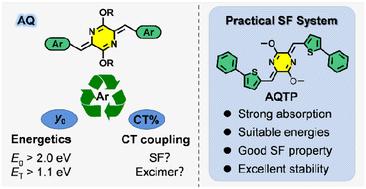
Singlet fission (SF) could offset the thermalization loss of high-energy photons via multiexciton generations, thus holding great potential in improving the power conversion efficiency of solar cells. However, the development of SF-based devices has basically remained stagnant so far owing to the limited scope of practical SF materials. Therefore, designing and developing practical SF material systems have been imperative, yet challenging so far. In this work, we comprehensively investigated the effects of aromatic substituents on excited-state properties and SF process of azaquinodimethane systems. Results indicated that the aromatic substituents have a significant influence on molecular diradical characters, thereby determining the excited-state energetics of the SF material system, including optical band gaps and triplet energy. Moreover, the aromatic substituents influenced charge transfer coupling interactions by adjusting molecular packing in the aggregate state to shunt the excited-state population to exert SF process or trap in excimer species. These results not only offer a deep insight into the multiple regulatory effects of the aromatic substituents on excited-state properties and SF process but also provide a practical SF material system, which could lay the foundation for the discovery of new SF-active chromophores and practical applications of new-generation light-harvesting materials.
期刊介绍:
Chemical Science is a journal that encompasses various disciplines within the chemical sciences. Its scope includes publishing ground-breaking research with significant implications for its respective field, as well as appealing to a wider audience in related areas. To be considered for publication, articles must showcase innovative and original advances in their field of study and be presented in a manner that is understandable to scientists from diverse backgrounds. However, the journal generally does not publish highly specialized research.




 京公网安备 11010802042870号
京ICP备2023020795号-1
京公网安备 11010802042870号
京ICP备2023020795号-1

 分享
分享
 求助内容:
求助内容: 应助结果提醒方式:
 扫码关注我们
