Yuchen Song , Qiang Wang , Qiankun Shi , Tongyin Xiong , Biru Wu , Jucai Gao , Fang Hu
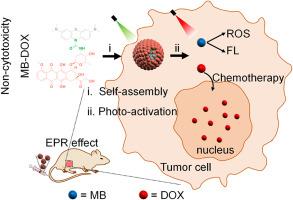
{"title":"Atom-efficient and self-delivered prodrug based on methylene blue and doxorubicin for tumor combination therapy","authors":"Yuchen Song , Qiang Wang , Qiankun Shi , Tongyin Xiong , Biru Wu , Jucai Gao , Fang Hu","doi":"10.1016/j.dyepig.2025.112699","DOIUrl":null,"url":null,"abstract":"<div><div>Traditional cancer treatments often lead to significant side effects and exhibit limited circulation within the body. To address these issues, considerable efforts have been directed towards developing drug delivery systems and prodrug strategies. However, the inclusion of supplementary carrier materials and protective groups complicates the clinical transition process. Here, we introduce a prodrug nano-assembly formed by conjugating methylene blue (MB) and doxorubicin (DOX) through a urea linkage. Notably, the resulting MB-DOX structure incorporates only 1.9 % additional atoms compared to clinical MB and DOX. This formulation effectively masks the cytotoxicity of DOX and eliminates the photosensitivity of MB. Moreover, the amphiphilic nature of MB-DOX facilitates self-assembly into nanostructures without requiring additional carriers, realizing self-delivery. Upon accumulation at the tumor site, light-induced cleavage of the urea bond releases therapeutic MB and DOX, enabling combined photodynamic therapy and chemotherapy with minimal adverse effects. Crucially, our design fulfills self-delivery and reduces the side effects of MB and DOX by simply introducing a urea linkage, eliminating the necessity for carrier materials and bulk protective groups, and holding promise for expediting the clinical translation of prodrugs.</div></div>","PeriodicalId":302,"journal":{"name":"Dyes and Pigments","volume":"237 ","pages":"Article 112699"},"PeriodicalIF":4.2000,"publicationDate":"2025-02-13","publicationTypes":"Journal Article","fieldsOfStudy":null,"isOpenAccess":false,"openAccessPdf":"","citationCount":"0","resultStr":null,"platform":"Semanticscholar","paperid":null,"PeriodicalName":"Dyes and Pigments","FirstCategoryId":"88","ListUrlMain":"https://www.sciencedirect.com/science/article/pii/S0143720825000695","RegionNum":3,"RegionCategory":"工程技术","ArticlePicture":[],"TitleCN":null,"AbstractTextCN":null,"PMCID":null,"EPubDate":"","PubModel":"","JCR":"Q2","JCRName":"CHEMISTRY, APPLIED","Score":null,"Total":0}
引用次数: 0
Abstract
Traditional cancer treatments often lead to significant side effects and exhibit limited circulation within the body. To address these issues, considerable efforts have been directed towards developing drug delivery systems and prodrug strategies. However, the inclusion of supplementary carrier materials and protective groups complicates the clinical transition process. Here, we introduce a prodrug nano-assembly formed by conjugating methylene blue (MB) and doxorubicin (DOX) through a urea linkage. Notably, the resulting MB-DOX structure incorporates only 1.9 % additional atoms compared to clinical MB and DOX. This formulation effectively masks the cytotoxicity of DOX and eliminates the photosensitivity of MB. Moreover, the amphiphilic nature of MB-DOX facilitates self-assembly into nanostructures without requiring additional carriers, realizing self-delivery. Upon accumulation at the tumor site, light-induced cleavage of the urea bond releases therapeutic MB and DOX, enabling combined photodynamic therapy and chemotherapy with minimal adverse effects. Crucially, our design fulfills self-delivery and reduces the side effects of MB and DOX by simply introducing a urea linkage, eliminating the necessity for carrier materials and bulk protective groups, and holding promise for expediting the clinical translation of prodrugs.
期刊介绍:
Dyes and Pigments covers the scientific and technical aspects of the chemistry and physics of dyes, pigments and their intermediates. Emphasis is placed on the properties of the colouring matters themselves rather than on their applications or the system in which they may be applied.
Thus the journal accepts research and review papers on the synthesis of dyes, pigments and intermediates, their physical or chemical properties, e.g. spectroscopic, surface, solution or solid state characteristics, the physical aspects of their preparation, e.g. precipitation, nucleation and growth, crystal formation, liquid crystalline characteristics, their photochemical, ecological or biological properties and the relationship between colour and chemical constitution. However, papers are considered which deal with the more fundamental aspects of colourant application and of the interactions of colourants with substrates or media.
The journal will interest a wide variety of workers in a range of disciplines whose work involves dyes, pigments and their intermediates, and provides a platform for investigators with common interests but diverse fields of activity such as cosmetics, reprographics, dye and pigment synthesis, medical research, polymers, etc.



 京公网安备 11010802042870号
京ICP备2023020795号-1
京公网安备 11010802042870号
京ICP备2023020795号-1

 分享
分享
 求助内容:
求助内容: 应助结果提醒方式:
 扫码关注我们
