Peng Gan, Kai Zhang, Jinze Li, Qixi Xu, Guihua Yang, Yunlai Zhang, Xinchuang Dong, Baobin Wang, Lei Zhang, Jiachuan Chen
{"title":"Optimization strategies for the low-temperature NACO pulping process of sugarcane bagasse and response surface modeling","authors":"Peng Gan, Kai Zhang, Jinze Li, Qixi Xu, Guihua Yang, Yunlai Zhang, Xinchuang Dong, Baobin Wang, Lei Zhang, Jiachuan Chen","doi":"10.1007/s10570-024-06364-z","DOIUrl":null,"url":null,"abstract":"<div><p>This study focuses on using agricultural straw—specifically sugarcane bagasse—as the raw material and employs single-factor optimization and response surface modeling strategies to develop a low-temperature NACO pulping process. A mathematical prediction model was constructed to explore the leaching patterns of chemical components in sugarcane bagasse, reveal the reaction mechanism of selective lignin removal through the new oxygen-alkali synergistic approach, and elucidate the green pulping mechanism of the low-temperature NACO method. The research findings indicate that at a temperature as low as 114.3 °C and a Na<sub>2</sub>CO<sub>3</sub>/ NaOH mass ratio of 1.86, the paper pulp exhibits optimal performance, with a freeness yield of 52.83%, a viscosity of 675.77 ml/g, a whiteness of 40.95% ISO, and a kappa number of 19.85. At this condition, only 43.96% of the silicon element enters the black liquor. Response surface variance analysis shows that the studied variables have statistically significant effects on different response levels, with all correlation coefficients (R<sup>2</sup>) greater than 0.93, indicating that the model has good predictive capability for the low-temperature NACO pulping process. Finally, the paper produced from the pulp under the optimal conditions exhibits excellent physical properties, with a tear index of 4.9 kPa·m<sup>2</sup>·g⁻<sup>1</sup>, burst index of 3.8 mN·m<sup>2</sup>·g⁻<sup>1</sup>, tensile index of 70.9 N·m·g⁻<sup>1</sup>, and ring crush index of 11.6 N·m·g⁻<sup>1</sup>, which are 1.9, 1.8, 1.6, and 2.3 times, respectively, compared to the performance of paper made by traditional oxygen-alkali chemical pulping methods.</p></div>","PeriodicalId":511,"journal":{"name":"Cellulose","volume":"32 3","pages":"1893 - 1915"},"PeriodicalIF":4.8000,"publicationDate":"2024-12-31","publicationTypes":"Journal Article","fieldsOfStudy":null,"isOpenAccess":false,"openAccessPdf":"","citationCount":"0","resultStr":null,"platform":"Semanticscholar","paperid":null,"PeriodicalName":"Cellulose","FirstCategoryId":"88","ListUrlMain":"https://link.springer.com/article/10.1007/s10570-024-06364-z","RegionNum":2,"RegionCategory":"工程技术","ArticlePicture":[],"TitleCN":null,"AbstractTextCN":null,"PMCID":null,"EPubDate":"","PubModel":"","JCR":"Q1","JCRName":"MATERIALS SCIENCE, PAPER & WOOD","Score":null,"Total":0}
引用次数: 0
Abstract
This study focuses on using agricultural straw—specifically sugarcane bagasse—as the raw material and employs single-factor optimization and response surface modeling strategies to develop a low-temperature NACO pulping process. A mathematical prediction model was constructed to explore the leaching patterns of chemical components in sugarcane bagasse, reveal the reaction mechanism of selective lignin removal through the new oxygen-alkali synergistic approach, and elucidate the green pulping mechanism of the low-temperature NACO method. The research findings indicate that at a temperature as low as 114.3 °C and a Na2CO3/ NaOH mass ratio of 1.86, the paper pulp exhibits optimal performance, with a freeness yield of 52.83%, a viscosity of 675.77 ml/g, a whiteness of 40.95% ISO, and a kappa number of 19.85. At this condition, only 43.96% of the silicon element enters the black liquor. Response surface variance analysis shows that the studied variables have statistically significant effects on different response levels, with all correlation coefficients (R2) greater than 0.93, indicating that the model has good predictive capability for the low-temperature NACO pulping process. Finally, the paper produced from the pulp under the optimal conditions exhibits excellent physical properties, with a tear index of 4.9 kPa·m2·g⁻1, burst index of 3.8 mN·m2·g⁻1, tensile index of 70.9 N·m·g⁻1, and ring crush index of 11.6 N·m·g⁻1, which are 1.9, 1.8, 1.6, and 2.3 times, respectively, compared to the performance of paper made by traditional oxygen-alkali chemical pulping methods.
期刊介绍:
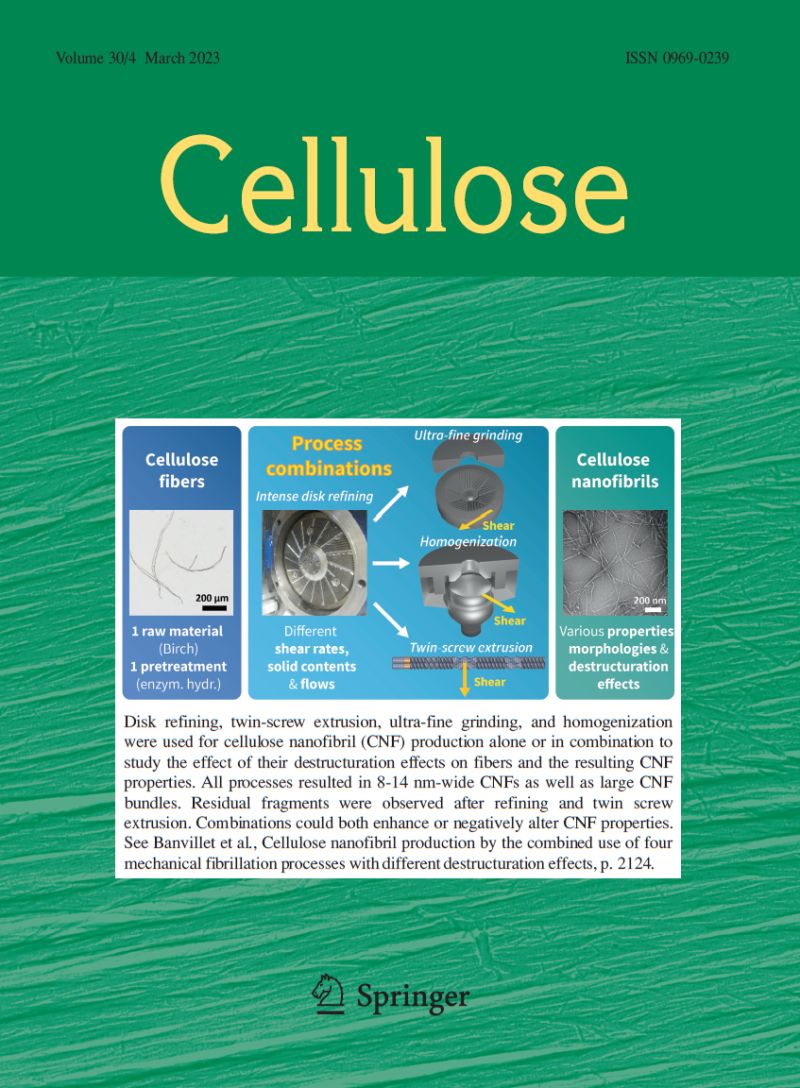
Cellulose is an international journal devoted to the dissemination of research and scientific and technological progress in the field of cellulose and related naturally occurring polymers. The journal is concerned with the pure and applied science of cellulose and related materials, and also with the development of relevant new technologies. This includes the chemistry, biochemistry, physics and materials science of cellulose and its sources, including wood and other biomass resources, and their derivatives. Coverage extends to the conversion of these polymers and resources into manufactured goods, such as pulp, paper, textiles, and manufactured as well natural fibers, and to the chemistry of materials used in their processing. Cellulose publishes review articles, research papers, and technical notes.



 京公网安备 11010802042870号
京ICP备2023020795号-1
京公网安备 11010802042870号
京ICP备2023020795号-1

 分享
分享
 求助内容:
求助内容: 应助结果提醒方式:
 扫码关注我们
