A Laboratory Module for Physical Chemistry and Analytical Chemistry: The Kinetics of Aspirin Hydrolysis and Its Quantitation in Pharmaceutical Tablets.
Victoire Delattre, Remi Olivier Labeille, Nicholas Slade Shropshire, Kyra Grace Kaiser, Brent Kirkland, Keith Zvoch, Ioana Emilia Pavel
{"title":"A Laboratory Module for Physical Chemistry and Analytical Chemistry: The Kinetics of Aspirin Hydrolysis and Its Quantitation in Pharmaceutical Tablets.","authors":"Victoire Delattre, Remi Olivier Labeille, Nicholas Slade Shropshire, Kyra Grace Kaiser, Brent Kirkland, Keith Zvoch, Ioana Emilia Pavel","doi":"10.1021/acs.jchemed.4c00809","DOIUrl":null,"url":null,"abstract":"<p><p>In this three-component laboratory module, upper-division chemistry students were introduced to the kinetics of the aspirin hydrolysis reaction and determined the concentration of its active pharmaceutical ingredient (acetylsalicylic acid-ASA) using a modern, benchtop ultraviolet-visible (UV-vis) absorption spectrophotometer. In the first component, students prepared analyte solutions from over-the-counter aspirin tablets and a relevant number of standards (n = 9-10) through both serial and parallel dilutions. In the second component, the ASA concentrations of three over-the-counter formulations (325 mg per tablet) were determined with percent differences as small as 1.1% using the Beer-Lambert law and external calibration curves. In the third component, students evaluated the reaction order (pseudo-first order), the rate constant (e.g., k <i>=</i> 3.0 × 10<sup>-4</sup> s<sup>-1</sup> at 75 °C), and the activation energy (<i>E</i> <sub>a</sub> ∼ 67.3 kJ mol<sup>-1</sup>) of the hydrolysis reaction of ASA at various temperatures (e.g., 25, 37, 50, 75, and 85 °C). The last component was completed using a student-centered instructional approach, namely, process-oriented guided-inquiry learning (POGIL), which helped refine students' research process skills and both basic and in-depth laboratory skills (weighing, solution handling, micropipetting, operation of a pH meter and a modern, benchtop absorption spectrophotometer). The student and instructor evaluations indicated a positive learning experience and high interest in this laboratory that was inspired by the quality control and quality assurance of pharmaceutical drugs.</p>","PeriodicalId":43,"journal":{"name":"Journal of Chemical Education","volume":"102 2","pages":"746-753"},"PeriodicalIF":2.9000,"publicationDate":"2025-01-31","publicationTypes":"Journal Article","fieldsOfStudy":null,"isOpenAccess":false,"openAccessPdf":"https://www.ncbi.nlm.nih.gov/pmc/articles/PMC11823444/pdf/","citationCount":"0","resultStr":null,"platform":"Semanticscholar","paperid":null,"PeriodicalName":"Journal of Chemical Education","FirstCategoryId":"92","ListUrlMain":"https://doi.org/10.1021/acs.jchemed.4c00809","RegionNum":3,"RegionCategory":"教育学","ArticlePicture":[],"TitleCN":null,"AbstractTextCN":null,"PMCID":null,"EPubDate":"2025/2/11 0:00:00","PubModel":"eCollection","JCR":"Q2","JCRName":"CHEMISTRY, MULTIDISCIPLINARY","Score":null,"Total":0}
引用次数: 0
Abstract
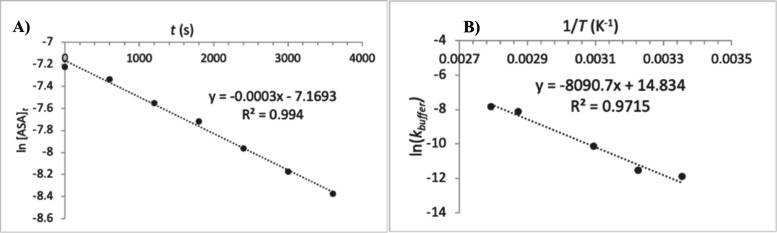
In this three-component laboratory module, upper-division chemistry students were introduced to the kinetics of the aspirin hydrolysis reaction and determined the concentration of its active pharmaceutical ingredient (acetylsalicylic acid-ASA) using a modern, benchtop ultraviolet-visible (UV-vis) absorption spectrophotometer. In the first component, students prepared analyte solutions from over-the-counter aspirin tablets and a relevant number of standards (n = 9-10) through both serial and parallel dilutions. In the second component, the ASA concentrations of three over-the-counter formulations (325 mg per tablet) were determined with percent differences as small as 1.1% using the Beer-Lambert law and external calibration curves. In the third component, students evaluated the reaction order (pseudo-first order), the rate constant (e.g., k = 3.0 × 10⁻⁴ s-1 at 75 °C), and the activation energy (Ea ∼ 67.3 kJ mol-1) of the hydrolysis reaction of ASA at various temperatures (e.g., 25, 37, 50, 75, and 85 °C). The last component was completed using a student-centered instructional approach, namely, process-oriented guided-inquiry learning (POGIL), which helped refine students' research process skills and both basic and in-depth laboratory skills (weighing, solution handling, micropipetting, operation of a pH meter and a modern, benchtop absorption spectrophotometer). The student and instructor evaluations indicated a positive learning experience and high interest in this laboratory that was inspired by the quality control and quality assurance of pharmaceutical drugs.
期刊介绍:
The Journal of Chemical Education is the official journal of the Division of Chemical Education of the American Chemical Society, co-published with the American Chemical Society Publications Division. Launched in 1924, the Journal of Chemical Education is the world’s premier chemical education journal. The Journal publishes peer-reviewed articles and related information as a resource to those in the field of chemical education and to those institutions that serve them. JCE typically addresses chemical content, activities, laboratory experiments, instructional methods, and pedagogies. The Journal serves as a means of communication among people across the world who are interested in the teaching and learning of chemistry. This includes instructors of chemistry from middle school through graduate school, professional staff who support these teaching activities, as well as some scientists in commerce, industry, and government.





 京公网安备 11010802042870号
京ICP备2023020795号-1
京公网安备 11010802042870号
京ICP备2023020795号-1

 分享
分享
 求助内容:
求助内容: 应助结果提醒方式:
 扫码关注我们
