Philip Binner, Ilya Starshynov, Gonzalo Tejeda, Aisling McFall, Colin Molloy, Giuseppe Ciccone, Matthew Walker, Massimo Vassalli, Andrew B Tobin, Daniele Faccio
{"title":"Optical, contact-free assessment of brain tissue stiffness and neurodegeneration.","authors":"Philip Binner, Ilya Starshynov, Gonzalo Tejeda, Aisling McFall, Colin Molloy, Giuseppe Ciccone, Matthew Walker, Massimo Vassalli, Andrew B Tobin, Daniele Faccio","doi":"10.1364/BOE.545580","DOIUrl":null,"url":null,"abstract":"<p><p>Dementia affects a large proportion of the world's population. Approaches that allow for early disease detection and non-invasive monitoring of disease progression are desperately needed. Current approaches are centred on costly imaging technologies such as positron emission tomography and magnetic resonance imaging. We propose an alternative approach to assess neurodegeneration based on diffuse correlation spectroscopy (DCS), a remote and optical sensing technique. We employ this approach to assess neurodegeneration in mouse brains from healthy animals and those with prion disease. We find a statistically significant difference in the optical speckle decorrelation times between prion-diseased and healthy animals. We directly calibrated our DCS technique using hydrogel samples of varying Young's modulus, indicating that we can optically measure changes in the brain tissue stiffness in the order of 60 Pa (corresponding to a 1 s change in speckle decorrelation time). DCS holds promise for contact-free assessment of tissue stiffness alteration due to neurodegeneration, with a similar sensitivity to contact-based (e.g. nanoindentation) approaches.</p>","PeriodicalId":8969,"journal":{"name":"Biomedical optics express","volume":"16 2","pages":"447-459"},"PeriodicalIF":3.2000,"publicationDate":"2025-01-06","publicationTypes":"Journal Article","fieldsOfStudy":null,"isOpenAccess":false,"openAccessPdf":"https://www.ncbi.nlm.nih.gov/pmc/articles/PMC11828460/pdf/","citationCount":"0","resultStr":null,"platform":"Semanticscholar","paperid":null,"PeriodicalName":"Biomedical optics express","FirstCategoryId":"3","ListUrlMain":"https://doi.org/10.1364/BOE.545580","RegionNum":2,"RegionCategory":"医学","ArticlePicture":[],"TitleCN":null,"AbstractTextCN":null,"PMCID":null,"EPubDate":"2025/2/1 0:00:00","PubModel":"eCollection","JCR":"Q2","JCRName":"BIOCHEMICAL RESEARCH METHODS","Score":null,"Total":0}
引用次数: 0
Abstract
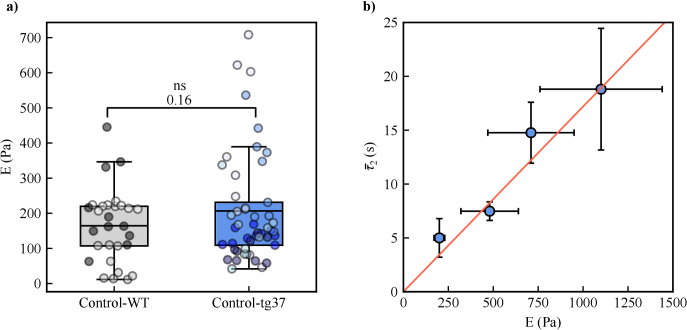
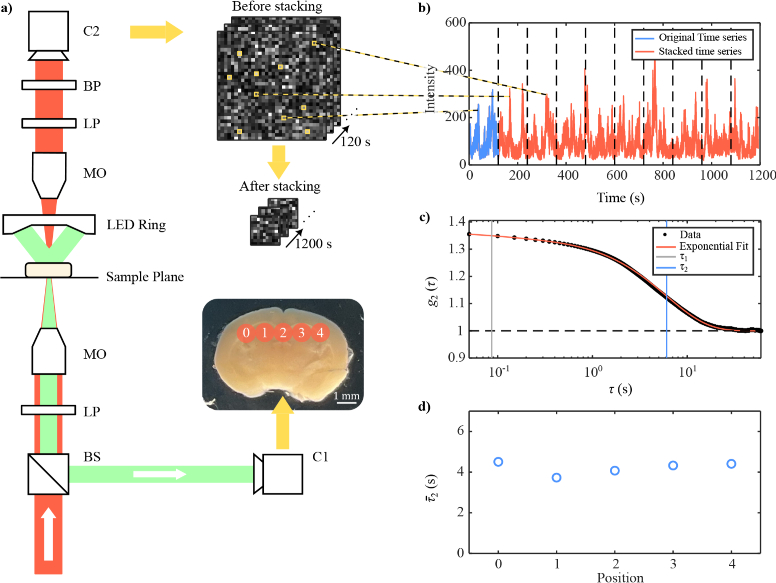
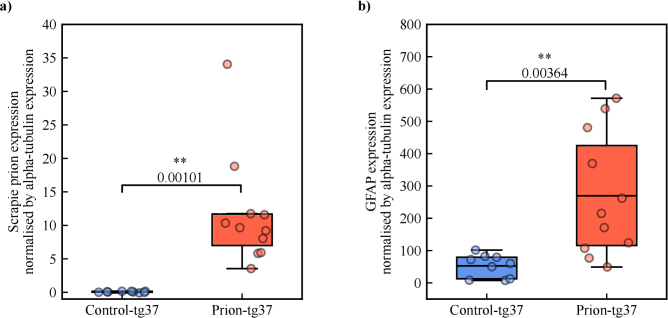
Dementia affects a large proportion of the world's population. Approaches that allow for early disease detection and non-invasive monitoring of disease progression are desperately needed. Current approaches are centred on costly imaging technologies such as positron emission tomography and magnetic resonance imaging. We propose an alternative approach to assess neurodegeneration based on diffuse correlation spectroscopy (DCS), a remote and optical sensing technique. We employ this approach to assess neurodegeneration in mouse brains from healthy animals and those with prion disease. We find a statistically significant difference in the optical speckle decorrelation times between prion-diseased and healthy animals. We directly calibrated our DCS technique using hydrogel samples of varying Young's modulus, indicating that we can optically measure changes in the brain tissue stiffness in the order of 60 Pa (corresponding to a 1 s change in speckle decorrelation time). DCS holds promise for contact-free assessment of tissue stiffness alteration due to neurodegeneration, with a similar sensitivity to contact-based (e.g. nanoindentation) approaches.
期刊介绍:
The journal''s scope encompasses fundamental research, technology development, biomedical studies and clinical applications. BOEx focuses on the leading edge topics in the field, including:
Tissue optics and spectroscopy
Novel microscopies
Optical coherence tomography
Diffuse and fluorescence tomography
Photoacoustic and multimodal imaging
Molecular imaging and therapies
Nanophotonic biosensing
Optical biophysics/photobiology
Microfluidic optical devices
Vision research.




 京公网安备 11010802042870号
京ICP备2023020795号-1
京公网安备 11010802042870号
京ICP备2023020795号-1

 分享
分享
 求助内容:
求助内容: 应助结果提醒方式:
 扫码关注我们
