A novel PRDM13 gene duplication causing congenital North Carolina macular dystrophy phenotype in a Mexican family.
IF 1.4 3区 医学Q4 BIOCHEMISTRY & MOLECULAR BIOLOGYMolecular VisionPub Date : 2024-11-22eCollection Date: 2024-01-01
Oscar Francisco Chacon-Camacho, Luis Leonardo Flores-Lagunes, Kent W Small, Nitin Udar, Uma Udar, Amber Diaz, Rocío Arce-González, Carolina Molina-Garay, Alan Martínez-Aguilar, Luis Montes-Almanza, Froylan Garcia-Martinez, Adriana Gudiño, Rodrigo Matsui-Serrano, Scarlett Fest-Parra, Carmen Alaez-Verson, Fadi Shaya, Juan Carlos Zenteno
{"title":"A novel <i>PRDM13</i> gene duplication causing congenital North Carolina macular dystrophy phenotype in a Mexican family.","authors":"Oscar Francisco Chacon-Camacho, Luis Leonardo Flores-Lagunes, Kent W Small, Nitin Udar, Uma Udar, Amber Diaz, Rocío Arce-González, Carolina Molina-Garay, Alan Martínez-Aguilar, Luis Montes-Almanza, Froylan Garcia-Martinez, Adriana Gudiño, Rodrigo Matsui-Serrano, Scarlett Fest-Parra, Carmen Alaez-Verson, Fadi Shaya, Juan Carlos Zenteno","doi":"","DOIUrl":null,"url":null,"abstract":"<p><strong>Purpose: </strong>North Carolina macular dystrophy (NCMD) is a rare autosomal dominantly inherited congenital maculopathy caused by either non-coding point mutations or tandem duplications in the DNase I hypersensitivity site DHS6S1, at chromosome 6q16 (MCDR1), or at chromosome 5 (MCDR3). To date, at least 30 NCMD pedigrees from different ethnicities have been genetically identified worldwide. Herein, we report the clinical and genetic features of a newly found NCMD family in Mexico with a novel tandem duplication involving both the DNASE1 site and the <i>PRDM13</i> gene.</p><p><strong>Methods: </strong>Seven affected subjects from a Mexican family underwent a complete ophthalmic assessment that included dilated indirect ophthalmoscopy, fundus photography, optical coherence tomography (OCT), fundus autofluorescence (FAF), kinetic and chromatic perimetry, and electroretinography (ERG). Next-generation sequencing (NGS), followed by array-based comparative genomic hybridization (array-CGH) and quantitative polymerase chain reaction (qPCR) analyzes, were employed to demonstrate the causative molecular defect.</p><p><strong>Results: </strong>All seven affected patients had a severe appearing phenotype characterized by symmetric excavated atrophic coloboma-like chorioretinal macular lesions. In addition, using OCT, lacunae in the inner retinal layers and inner retinal loss were observed in all patients. NGS identified a heterozygous tandem duplication of the entire coding sequence of the <i>PRDM13</i> gene in all seven affected individuals, whereas subsequent array CGH, NGS, and Sanger sequencing allowed for the identification of the precise boundaries of a ~148 kb MCDR1 duplication containing the whole <i>PRMD13</i> gene and the DNASE1 site.</p><p><strong>Conclusions: </strong>The phenotypic features in this NCMD pedigree continue to support the concept that this disorder is a congenital macular malformation rather than a progressive dystrophic entity. Unlike most NCMD families, there was no variable expressivity found in this study, possibly due to the relatively small size of the family. The other hypothesis is that the duplication involves genomic segments that are more consistently or tightly bound to other regulatory regions of PRDM13. The identification of a novel causative tandem duplication involving the DNASE1 site and the <i>PRDM13</i> gene in this family allows for the expansion of the mutational spectrum of the disease.</p>","PeriodicalId":18866,"journal":{"name":"Molecular Vision","volume":"30 ","pages":"400-408"},"PeriodicalIF":1.4000,"publicationDate":"2024-11-22","publicationTypes":"Journal Article","fieldsOfStudy":null,"isOpenAccess":false,"openAccessPdf":"https://www.ncbi.nlm.nih.gov/pmc/articles/PMC11829779/pdf/","citationCount":"0","resultStr":null,"platform":"Semanticscholar","paperid":null,"PeriodicalName":"Molecular Vision","FirstCategoryId":"3","ListUrlMain":"","RegionNum":3,"RegionCategory":"医学","ArticlePicture":[],"TitleCN":null,"AbstractTextCN":null,"PMCID":null,"EPubDate":"2024/1/1 0:00:00","PubModel":"eCollection","JCR":"Q4","JCRName":"BIOCHEMISTRY & MOLECULAR BIOLOGY","Score":null,"Total":0}
引用次数: 0
Abstract
Purpose: North Carolina macular dystrophy (NCMD) is a rare autosomal dominantly inherited congenital maculopathy caused by either non-coding point mutations or tandem duplications in the DNase I hypersensitivity site DHS6S1, at chromosome 6q16 (MCDR1), or at chromosome 5 (MCDR3). To date, at least 30 NCMD pedigrees from different ethnicities have been genetically identified worldwide. Herein, we report the clinical and genetic features of a newly found NCMD family in Mexico with a novel tandem duplication involving both the DNASE1 site and the PRDM13 gene.
Methods: Seven affected subjects from a Mexican family underwent a complete ophthalmic assessment that included dilated indirect ophthalmoscopy, fundus photography, optical coherence tomography (OCT), fundus autofluorescence (FAF), kinetic and chromatic perimetry, and electroretinography (ERG). Next-generation sequencing (NGS), followed by array-based comparative genomic hybridization (array-CGH) and quantitative polymerase chain reaction (qPCR) analyzes, were employed to demonstrate the causative molecular defect.
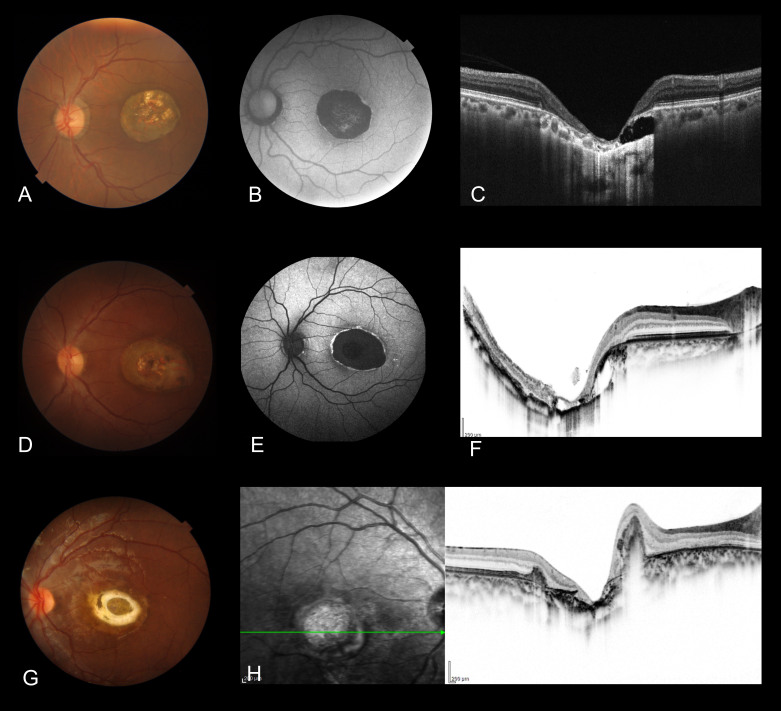
Results: All seven affected patients had a severe appearing phenotype characterized by symmetric excavated atrophic coloboma-like chorioretinal macular lesions. In addition, using OCT, lacunae in the inner retinal layers and inner retinal loss were observed in all patients. NGS identified a heterozygous tandem duplication of the entire coding sequence of the PRDM13 gene in all seven affected individuals, whereas subsequent array CGH, NGS, and Sanger sequencing allowed for the identification of the precise boundaries of a ~148 kb MCDR1 duplication containing the whole PRMD13 gene and the DNASE1 site.
Conclusions: The phenotypic features in this NCMD pedigree continue to support the concept that this disorder is a congenital macular malformation rather than a progressive dystrophic entity. Unlike most NCMD families, there was no variable expressivity found in this study, possibly due to the relatively small size of the family. The other hypothesis is that the duplication involves genomic segments that are more consistently or tightly bound to other regulatory regions of PRDM13. The identification of a novel causative tandem duplication involving the DNASE1 site and the PRDM13 gene in this family allows for the expansion of the mutational spectrum of the disease.
期刊介绍:
Molecular Vision is a peer-reviewed journal dedicated to the dissemination of research results in molecular biology, cell biology, and the genetics of the visual system (ocular and cortical).
Molecular Vision publishes articles presenting original research that has not previously been published and comprehensive articles reviewing the current status of a particular field or topic. Submissions to Molecular Vision are subjected to rigorous peer review. Molecular Vision does NOT publish preprints.
For authors, Molecular Vision provides a rapid means of communicating important results. Access to Molecular Vision is free and unrestricted, allowing the widest possible audience for your article. Digital publishing allows you to use color images freely (and without fees). Additionally, you may publish animations, sounds, or other supplementary information that clarifies or supports your article. Each of the authors of an article may also list an electronic mail address (which will be updated upon request) to give interested readers easy access to authors.


 分享
分享



 京公网安备 11010802042870号
京ICP备2023020795号-1
京公网安备 11010802042870号
京ICP备2023020795号-1

 求助内容:
求助内容: 应助结果提醒方式:
 扫码关注我们
