Barriers to effective communication in UAE community pharmacies: general public perspectives on enhancing patient-pharmacist interaction and policy development.
Zelal Kharaba, Ahmad Al-Azayzih, Sayer Al-Azzam, Anan Jarab, Hisham E Hasan, Dania Rahhal, Feras Jirjees, Khalid A Al-Kubaisi, Monia H Aljumah, Faris El-Dahiyat, Sara Meer, Mohammad A Y Alqudah, Mamoon A Aldeyab, Karem H Alzoubi
{"title":"Barriers to effective communication in UAE community pharmacies: general public perspectives on enhancing patient-pharmacist interaction and policy development.","authors":"Zelal Kharaba, Ahmad Al-Azayzih, Sayer Al-Azzam, Anan Jarab, Hisham E Hasan, Dania Rahhal, Feras Jirjees, Khalid A Al-Kubaisi, Monia H Aljumah, Faris El-Dahiyat, Sara Meer, Mohammad A Y Alqudah, Mamoon A Aldeyab, Karem H Alzoubi","doi":"10.1080/20523211.2025.2460744","DOIUrl":null,"url":null,"abstract":"<p><strong>Background: </strong>Community pharmacies serve as accessible points of care, offering essential services such as medication dispensing, health consultations, vaccinations, and chronic disease management, thereby playing a critical role in the healthcare system. This study aims to identify and evaluate the factors that obstruct general public-pharmacist interactions, providing insights to enhance pharmacy environments.</p><p><strong>Methods: </strong>A total of 406 general publics were surveyed using a validated questionnaire. Statistical analysis was performed with categorical variables presented as frequencies and percentages, and continuous variables as medians with 95% confidence intervals. Binary regression models were used to explore the relationships between sociodemographic characteristics and communication barriers, with a significance level set at <i>p</i> < 0.05 for all analyses.</p><p><strong>Results: </strong>The primary reasons for pharmacy visits were collecting prescription medications (61.58%) and purchasing OTC products (55.17%), while health screenings were less common (9.11%). Barriers to effective communication included crowded environments (61.58%), limited counseling time (45.81%), and lack of privacy (45.07%). Binary logistic regression revealed that participants who visited the pharmacy weekly were 5.5 times more likely to experience high environmental barriers (OR: 5.502, <i>p</i> = 0.002), while interacting with younger pharmacists increased the likelihood of personal barriers (OR: 12.357, <i>p</i> = 0.025). Pharmacy proximity (75.12%) and shorter waiting times (47.29%) were the most influential factors in pharmacy preference, while additional services had minimal impact (20.2%).</p><p><strong>Conclusion: </strong>Effective communication is crucial in community pharmacies for high-quality healthcare. This study identifies key barriers in the UAE and offers insights into targeted interventions to improve communication and public satisfaction.</p>","PeriodicalId":16740,"journal":{"name":"Journal of Pharmaceutical Policy and Practice","volume":"18 1","pages":"2460744"},"PeriodicalIF":2.5000,"publicationDate":"2025-02-13","publicationTypes":"Journal Article","fieldsOfStudy":null,"isOpenAccess":false,"openAccessPdf":"https://www.ncbi.nlm.nih.gov/pmc/articles/PMC11827033/pdf/","citationCount":"0","resultStr":null,"platform":"Semanticscholar","paperid":null,"PeriodicalName":"Journal of Pharmaceutical Policy and Practice","FirstCategoryId":"1085","ListUrlMain":"https://doi.org/10.1080/20523211.2025.2460744","RegionNum":0,"RegionCategory":null,"ArticlePicture":[],"TitleCN":null,"AbstractTextCN":null,"PMCID":null,"EPubDate":"2025/1/1 0:00:00","PubModel":"eCollection","JCR":"Q1","JCRName":"HEALTH POLICY & SERVICES","Score":null,"Total":0}
引用次数: 0
Abstract
Background: Community pharmacies serve as accessible points of care, offering essential services such as medication dispensing, health consultations, vaccinations, and chronic disease management, thereby playing a critical role in the healthcare system. This study aims to identify and evaluate the factors that obstruct general public-pharmacist interactions, providing insights to enhance pharmacy environments.
Methods: A total of 406 general publics were surveyed using a validated questionnaire. Statistical analysis was performed with categorical variables presented as frequencies and percentages, and continuous variables as medians with 95% confidence intervals. Binary regression models were used to explore the relationships between sociodemographic characteristics and communication barriers, with a significance level set at p < 0.05 for all analyses.
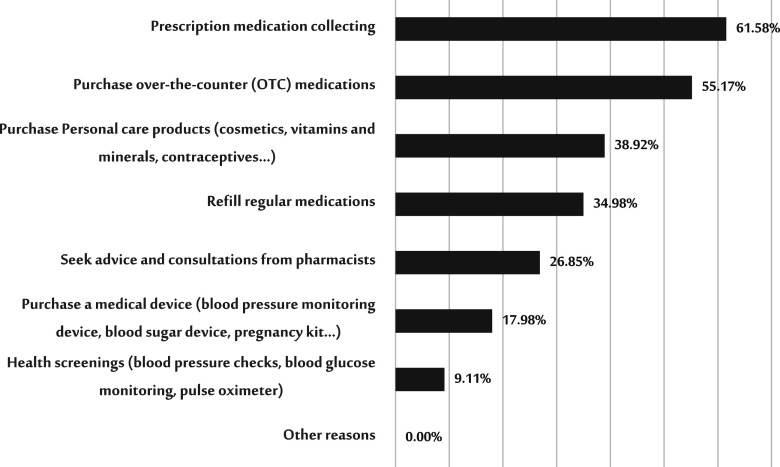
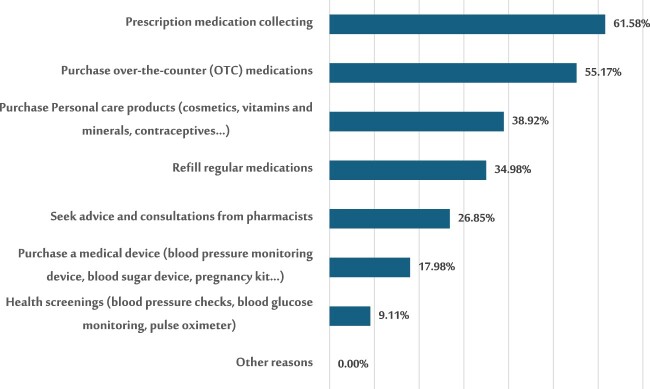
Results: The primary reasons for pharmacy visits were collecting prescription medications (61.58%) and purchasing OTC products (55.17%), while health screenings were less common (9.11%). Barriers to effective communication included crowded environments (61.58%), limited counseling time (45.81%), and lack of privacy (45.07%). Binary logistic regression revealed that participants who visited the pharmacy weekly were 5.5 times more likely to experience high environmental barriers (OR: 5.502, p = 0.002), while interacting with younger pharmacists increased the likelihood of personal barriers (OR: 12.357, p = 0.025). Pharmacy proximity (75.12%) and shorter waiting times (47.29%) were the most influential factors in pharmacy preference, while additional services had minimal impact (20.2%).
Conclusion: Effective communication is crucial in community pharmacies for high-quality healthcare. This study identifies key barriers in the UAE and offers insights into targeted interventions to improve communication and public satisfaction.



 京公网安备 11010802042870号
京ICP备2023020795号-1
京公网安备 11010802042870号
京ICP备2023020795号-1

 分享
分享
 求助内容:
求助内容: 应助结果提醒方式:
 扫码关注我们
