Rafik Tadros, Sean L. Zheng, Christopher Grace, Paloma Jordà, Catherine Francis, Dominique M. West, Sean J. Jurgens, Kate L. Thomson, Andrew R. Harper, Elizabeth Ormondroyd, Xiao Xu, Pantazis I. Theotokis, Rachel J. Buchan, Kathryn A. McGurk, Francesco Mazzarotto, Beatrice Boschi, Elisabetta Pelo, Michael Lee, Michela Noseda, Amanda Varnava, Alexa M. C. Vermeer, Roddy Walsh, Ahmad S. Amin, Marjon A. van Slegtenhorst, Nicole M. Roslin, Lisa J. Strug, Erika Salvi, Chiara Lanzani, Antonio de Marvao, Hypergenes InterOmics Collaborators, Jason D. Roberts, Maxime Tremblay-Gravel, Genevieve Giraldeau, Julia Cadrin-Tourigny, Philippe L. L’Allier, Patrick Garceau, Mario Talajic, Sarah A. Gagliano Taliun, Yigal M. Pinto, Harry Rakowski, Antonis Pantazis, Wenjia Bai, John Baksi, Brian P. Halliday, Sanjay K. Prasad, Paul J. R. Barton, Declan P. O’Regan, Stuart A. Cook, Rudolf A. de Boer, Imke Christiaans, Michelle Michels, Christopher M. Kramer, Carolyn Y. Ho, Stefan Neubauer, HCMR Investigators, Paul M. Matthews, Arthur A. M. Wilde, Jean-Claude Tardif, Iacopo Olivotto, Arnon Adler, Anuj Goel, James S. Ware, Connie R. Bezzina, Hugh Watkins
{"title":"Large-scale genome-wide association analyses identify novel genetic loci and mechanisms in hypertrophic cardiomyopathy","authors":"Rafik Tadros, Sean L. Zheng, Christopher Grace, Paloma Jordà, Catherine Francis, Dominique M. West, Sean J. Jurgens, Kate L. Thomson, Andrew R. Harper, Elizabeth Ormondroyd, Xiao Xu, Pantazis I. Theotokis, Rachel J. Buchan, Kathryn A. McGurk, Francesco Mazzarotto, Beatrice Boschi, Elisabetta Pelo, Michael Lee, Michela Noseda, Amanda Varnava, Alexa M. C. Vermeer, Roddy Walsh, Ahmad S. Amin, Marjon A. van Slegtenhorst, Nicole M. Roslin, Lisa J. Strug, Erika Salvi, Chiara Lanzani, Antonio de Marvao, Hypergenes InterOmics Collaborators, Jason D. Roberts, Maxime Tremblay-Gravel, Genevieve Giraldeau, Julia Cadrin-Tourigny, Philippe L. L’Allier, Patrick Garceau, Mario Talajic, Sarah A. Gagliano Taliun, Yigal M. Pinto, Harry Rakowski, Antonis Pantazis, Wenjia Bai, John Baksi, Brian P. Halliday, Sanjay K. Prasad, Paul J. R. Barton, Declan P. O’Regan, Stuart A. Cook, Rudolf A. de Boer, Imke Christiaans, Michelle Michels, Christopher M. Kramer, Carolyn Y. Ho, Stefan Neubauer, HCMR Investigators, Paul M. Matthews, Arthur A. M. Wilde, Jean-Claude Tardif, Iacopo Olivotto, Arnon Adler, Anuj Goel, James S. Ware, Connie R. Bezzina, Hugh Watkins","doi":"10.1038/s41588-025-02087-4","DOIUrl":null,"url":null,"abstract":"Hypertrophic cardiomyopathy (HCM) is an important cause of morbidity and mortality with both monogenic and polygenic components. Here, we report results from a large genome-wide association study and multitrait analysis including 5,900 HCM cases, 68,359 controls and 36,083 UK Biobank participants with cardiac magnetic resonance imaging. We identified 70 loci (50 novel) associated with HCM and 62 loci (20 novel) associated with relevant left ventricular traits. Among the prioritized genes in the HCM loci, we identify a novel HCM disease gene, SVIL, which encodes the actin-binding protein supervillin, showing that rare truncating SVIL variants confer a roughly tenfold increased risk of HCM. Mendelian randomization analyses support a causal role of increased left ventricular contractility in both obstructive and nonobstructive forms of HCM, suggesting common disease mechanisms and anticipating shared response to therapy. Taken together, these findings increase our understanding of the genetic basis of HCM, with potential implications for disease management. Genome-wide and multitrait analyses identify novel loci associated with hypertrophic cardiomyopathy and relevant left ventricular traits. Gene-level burden analyses show that rare truncating SVIL variants are associated with high risk of hypertrophic cardiomyopathy.","PeriodicalId":18985,"journal":{"name":"Nature genetics","volume":"57 3","pages":"530-538"},"PeriodicalIF":29.0000,"publicationDate":"2025-02-18","publicationTypes":"Journal Article","fieldsOfStudy":null,"isOpenAccess":false,"openAccessPdf":"https://www.nature.com/articles/s41588-025-02087-4.pdf","citationCount":"0","resultStr":null,"platform":"Semanticscholar","paperid":null,"PeriodicalName":"Nature genetics","FirstCategoryId":"99","ListUrlMain":"https://www.nature.com/articles/s41588-025-02087-4","RegionNum":1,"RegionCategory":"生物学","ArticlePicture":[],"TitleCN":null,"AbstractTextCN":null,"PMCID":null,"EPubDate":"","PubModel":"","JCR":"Q1","JCRName":"GENETICS & HEREDITY","Score":null,"Total":0}
引用次数: 0
Abstract
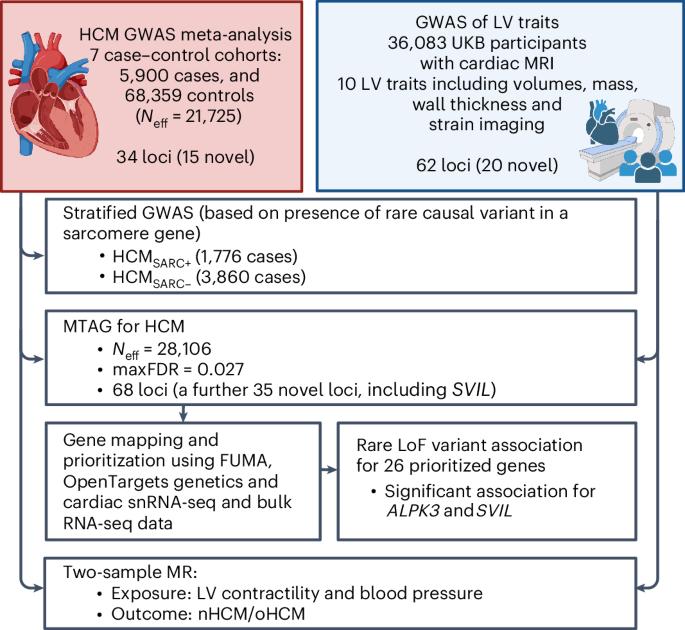
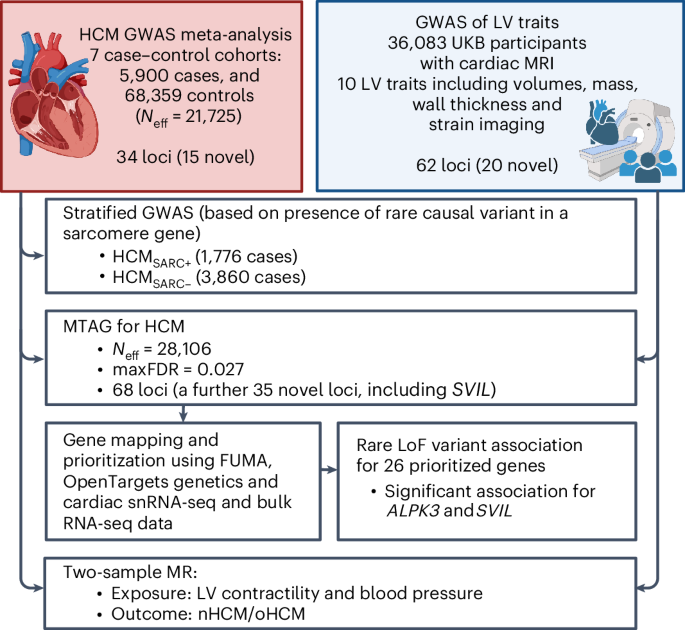
Hypertrophic cardiomyopathy (HCM) is an important cause of morbidity and mortality with both monogenic and polygenic components. Here, we report results from a large genome-wide association study and multitrait analysis including 5,900 HCM cases, 68,359 controls and 36,083 UK Biobank participants with cardiac magnetic resonance imaging. We identified 70 loci (50 novel) associated with HCM and 62 loci (20 novel) associated with relevant left ventricular traits. Among the prioritized genes in the HCM loci, we identify a novel HCM disease gene, SVIL, which encodes the actin-binding protein supervillin, showing that rare truncating SVIL variants confer a roughly tenfold increased risk of HCM. Mendelian randomization analyses support a causal role of increased left ventricular contractility in both obstructive and nonobstructive forms of HCM, suggesting common disease mechanisms and anticipating shared response to therapy. Taken together, these findings increase our understanding of the genetic basis of HCM, with potential implications for disease management. Genome-wide and multitrait analyses identify novel loci associated with hypertrophic cardiomyopathy and relevant left ventricular traits. Gene-level burden analyses show that rare truncating SVIL variants are associated with high risk of hypertrophic cardiomyopathy.
期刊介绍:
Nature Genetics publishes the very highest quality research in genetics. It encompasses genetic and functional genomic studies on human and plant traits and on other model organisms. Current emphasis is on the genetic basis for common and complex diseases and on the functional mechanism, architecture and evolution of gene networks, studied by experimental perturbation.
Integrative genetic topics comprise, but are not limited to:
-Genes in the pathology of human disease
-Molecular analysis of simple and complex genetic traits
-Cancer genetics
-Agricultural genomics
-Developmental genetics
-Regulatory variation in gene expression
-Strategies and technologies for extracting function from genomic data
-Pharmacological genomics
-Genome evolution




 京公网安备 11010802042870号
京ICP备2023020795号-1
京公网安备 11010802042870号
京ICP备2023020795号-1

 分享
分享
 求助内容:
求助内容: 应助结果提醒方式:
 扫码关注我们
