Continuous Conjugated Polymer Network in Elastomer Matrix Arising from Solution-State Aggregation and Film-Forming Dynamics Favoring Mechanical and Electrical Properties
Jiaming Zuo, Tianya Jin, Hongxiang Li, Junhang Li, Xinyu Liu, Xinhong Yu, Yang Han, Yanchun Han
{"title":"Continuous Conjugated Polymer Network in Elastomer Matrix Arising from Solution-State Aggregation and Film-Forming Dynamics Favoring Mechanical and Electrical Properties","authors":"Jiaming Zuo, Tianya Jin, Hongxiang Li, Junhang Li, Xinyu Liu, Xinhong Yu, Yang Han, Yanchun Han","doi":"10.1002/adfm.202424785","DOIUrl":null,"url":null,"abstract":"<p>The continuous conjugated polymer network structure in an elastomer matrix is significant for carrier transport. However, high-mobility conjugated polymers tend to form island-like phase separation. Here, a strategy is proposed to achieve a continuous conjugated polymer network structure via weakening the intermolecular interaction between the conjugated polymer chains and fast aggregation between conjugated polymer backbones during the film-forming process. This is enabled by hot spin-coating poly(2,5-bis(4-hexyldodecyl)-2,5-dihydro-3,6-di-2-thienyl-pyrrolo[3,4-c]pyrrole-1,4-dione-alt-thiophene) (PDPPT3) and polystyrene-<i>block</i>-poly(ethylene-ran-butylene)-<i>block</i>-polystyrene (SEBS) blend hot solution at 130 °C. In the solution state, PDPPT3 is observed to form small aggregates at 130 °C due to the decreased intermolecular interaction. In the film-forming process, these small aggregates grow rapidly and form a continuous network due to the enhanced polymer chain motion. In the meantime, the large-scale phase separation is suppressed by the short film formation time. Eventually, a sandwich-like vertical phase separation is generated, comprising a PDPPT3-enriched continuous network at both the top and bottom surfaces. Under strain, this small-scale phase separation PDPPT3 network can rotate freely and maintain sufficient connections for carrier transport. Finally, the optimized films exhibit 177% fracture strain and high average mobility of 0.99 cm<sup>2</sup> V<sup>−1</sup> s<sup>−1</sup> over 500 stretch-release cycles. This study offers a valuable approach for controlling morphology in blend systems.</p>","PeriodicalId":112,"journal":{"name":"Advanced Functional Materials","volume":"35 28","pages":""},"PeriodicalIF":19.0000,"publicationDate":"2025-02-17","publicationTypes":"Journal Article","fieldsOfStudy":null,"isOpenAccess":false,"openAccessPdf":"","citationCount":"0","resultStr":null,"platform":"Semanticscholar","paperid":null,"PeriodicalName":"Advanced Functional Materials","FirstCategoryId":"88","ListUrlMain":"https://advanced.onlinelibrary.wiley.com/doi/10.1002/adfm.202424785","RegionNum":1,"RegionCategory":"材料科学","ArticlePicture":[],"TitleCN":null,"AbstractTextCN":null,"PMCID":null,"EPubDate":"","PubModel":"","JCR":"Q1","JCRName":"CHEMISTRY, MULTIDISCIPLINARY","Score":null,"Total":0}
引用次数: 0
Abstract
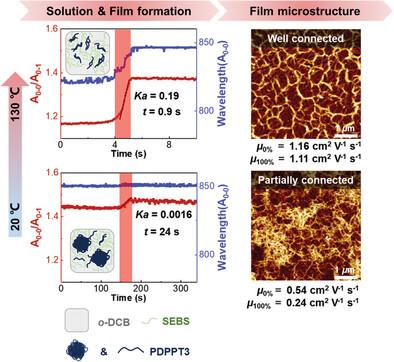
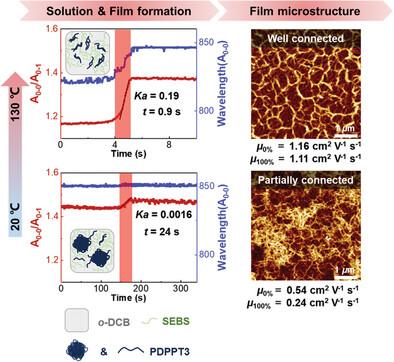
The continuous conjugated polymer network structure in an elastomer matrix is significant for carrier transport. However, high-mobility conjugated polymers tend to form island-like phase separation. Here, a strategy is proposed to achieve a continuous conjugated polymer network structure via weakening the intermolecular interaction between the conjugated polymer chains and fast aggregation between conjugated polymer backbones during the film-forming process. This is enabled by hot spin-coating poly(2,5-bis(4-hexyldodecyl)-2,5-dihydro-3,6-di-2-thienyl-pyrrolo[3,4-c]pyrrole-1,4-dione-alt-thiophene) (PDPPT3) and polystyrene-block-poly(ethylene-ran-butylene)-block-polystyrene (SEBS) blend hot solution at 130 °C. In the solution state, PDPPT3 is observed to form small aggregates at 130 °C due to the decreased intermolecular interaction. In the film-forming process, these small aggregates grow rapidly and form a continuous network due to the enhanced polymer chain motion. In the meantime, the large-scale phase separation is suppressed by the short film formation time. Eventually, a sandwich-like vertical phase separation is generated, comprising a PDPPT3-enriched continuous network at both the top and bottom surfaces. Under strain, this small-scale phase separation PDPPT3 network can rotate freely and maintain sufficient connections for carrier transport. Finally, the optimized films exhibit 177% fracture strain and high average mobility of 0.99 cm2 V−1 s−1 over 500 stretch-release cycles. This study offers a valuable approach for controlling morphology in blend systems.
期刊介绍:
Firmly established as a top-tier materials science journal, Advanced Functional Materials reports breakthrough research in all aspects of materials science, including nanotechnology, chemistry, physics, and biology every week.
Advanced Functional Materials is known for its rapid and fair peer review, quality content, and high impact, making it the first choice of the international materials science community.






 京公网安备 11010802042870号
京ICP备2023020795号-1
京公网安备 11010802042870号
京ICP备2023020795号-1

 分享
分享
 求助内容:
求助内容: 应助结果提醒方式:
 扫码关注我们
