Chenghao Qian , Shengsi Wang , Que Huang , Zhen Tian , Changcheng Liu , Yuelei Pan , Xingguo Qi , Yanjun Chen
{"title":"Aqueous multifunctional binder boosting high energy and thermal safety of Na3V2(PO4)3","authors":"Chenghao Qian , Shengsi Wang , Que Huang , Zhen Tian , Changcheng Liu , Yuelei Pan , Xingguo Qi , Yanjun Chen","doi":"10.1016/j.jechem.2024.12.060","DOIUrl":null,"url":null,"abstract":"<div><div>The conventional cathode processing utilizes a polyvinylidene fluoride/N-methyl-2-pyrrolidone (PVDF/NMP) binder system, which is afflicted by its toxic and mutagenic characteristics, as well as inadequate binding strength. Furthermore, the protracted drying rate of NMP results in uneven accumulation and gradient distribution of cathode materials throughout the extended drying process, thereby adversely impacting electron and ion transport as well as the integrity of the interface structure. This study introduces polyethyleneimine (PEI) as an aqueous multifunctional binder, which enhances the adhesion between electrode materials, improves mechanical stability, and reduces material detachment and damage, thereby extending the lifespan of Na<sub>3</sub>V<sub>2</sub>(PO<sub>4</sub>)<sub>3</sub> (NVP). Concurrently, PEI can regulate the particle distribution and structure of electrodes, optimize the porosity and charge transport pathways, and improve the energy density and cycling stability of NVP. Furthermore, PEI exhibits superior thermal stability at elevated temperatures, enhancing the reliability of battery performance in high-temperature environments. Leveraging these advantages, the application of PEI as a binder in this study has the potential to augment the energy density, cycle life, and safety of batteries, thereby offering a novel approach for optimizing sodium-ion batteries (SIBs) and advancing the development of battery technology.</div></div>","PeriodicalId":15728,"journal":{"name":"Journal of Energy Chemistry","volume":"104 ","pages":"Pages 773-788"},"PeriodicalIF":14.9000,"publicationDate":"2025-05-01","publicationTypes":"Journal Article","fieldsOfStudy":null,"isOpenAccess":false,"openAccessPdf":"","citationCount":"0","resultStr":null,"platform":"Semanticscholar","paperid":null,"PeriodicalName":"Journal of Energy Chemistry","FirstCategoryId":"92","ListUrlMain":"https://www.sciencedirect.com/science/article/pii/S2095495625000348","RegionNum":1,"RegionCategory":"化学","ArticlePicture":[],"TitleCN":null,"AbstractTextCN":null,"PMCID":null,"EPubDate":"2025/1/16 0:00:00","PubModel":"Epub","JCR":"Q1","JCRName":"Energy","Score":null,"Total":0}
引用次数: 0
Abstract
The conventional cathode processing utilizes a polyvinylidene fluoride/N-methyl-2-pyrrolidone (PVDF/NMP) binder system, which is afflicted by its toxic and mutagenic characteristics, as well as inadequate binding strength. Furthermore, the protracted drying rate of NMP results in uneven accumulation and gradient distribution of cathode materials throughout the extended drying process, thereby adversely impacting electron and ion transport as well as the integrity of the interface structure. This study introduces polyethyleneimine (PEI) as an aqueous multifunctional binder, which enhances the adhesion between electrode materials, improves mechanical stability, and reduces material detachment and damage, thereby extending the lifespan of Na3V2(PO4)3 (NVP). Concurrently, PEI can regulate the particle distribution and structure of electrodes, optimize the porosity and charge transport pathways, and improve the energy density and cycling stability of NVP. Furthermore, PEI exhibits superior thermal stability at elevated temperatures, enhancing the reliability of battery performance in high-temperature environments. Leveraging these advantages, the application of PEI as a binder in this study has the potential to augment the energy density, cycle life, and safety of batteries, thereby offering a novel approach for optimizing sodium-ion batteries (SIBs) and advancing the development of battery technology.
传统的阴极加工采用聚偏氟乙烯/ n -甲基-2-吡咯烷酮(PVDF/NMP)粘结体系,其毒性和诱变特性以及结合强度不足。此外,NMP干燥速率的延长导致正极材料在整个干燥过程中积累和梯度分布不均匀,从而对电子和离子的输运以及界面结构的完整性产生不利影响。本研究引入聚乙烯亚胺(PEI)作为水性多功能粘结剂,增强了电极材料之间的粘附性,提高了机械稳定性,减少了材料的脱落和损伤,从而延长了Na3V2(PO4)3 (NVP)的寿命。同时,PEI可以调节电极的颗粒分布和结构,优化孔隙率和电荷输运途径,提高NVP的能量密度和循环稳定性。此外,PEI在高温下表现出优异的热稳定性,增强了高温环境下电池性能的可靠性。利用这些优势,PEI作为粘合剂在本研究中的应用有可能增加电池的能量密度、循环寿命和安全性,从而为优化钠离子电池(sib)和推进电池技术的发展提供了一种新的方法。
期刊介绍:
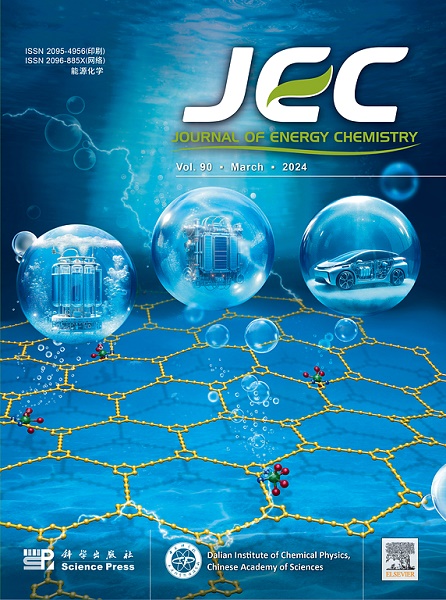
The Journal of Energy Chemistry, the official publication of Science Press and the Dalian Institute of Chemical Physics, Chinese Academy of Sciences, serves as a platform for reporting creative research and innovative applications in energy chemistry. It mainly reports on creative researches and innovative applications of chemical conversions of fossil energy, carbon dioxide, electrochemical energy and hydrogen energy, as well as the conversions of biomass and solar energy related with chemical issues to promote academic exchanges in the field of energy chemistry and to accelerate the exploration, research and development of energy science and technologies.
This journal focuses on original research papers covering various topics within energy chemistry worldwide, including:
Optimized utilization of fossil energy
Hydrogen energy
Conversion and storage of electrochemical energy
Capture, storage, and chemical conversion of carbon dioxide
Materials and nanotechnologies for energy conversion and storage
Chemistry in biomass conversion
Chemistry in the utilization of solar energy




 京公网安备 11010802042870号
京ICP备2023020795号-1
京公网安备 11010802042870号
京ICP备2023020795号-1

 分享
分享
 求助内容:
求助内容: 应助结果提醒方式:
 扫码关注我们
