J. Hong , H.S. Kim , S. Adams , J. Scaria , R. Patterson , T.A. Woyengo
{"title":"Growth performance and gut health of nursery pigs fed diet containing sodium butyrate or enzymatically hydrolyzed yeast product","authors":"J. Hong , H.S. Kim , S. Adams , J. Scaria , R. Patterson , T.A. Woyengo","doi":"10.1016/j.animal.2025.101448","DOIUrl":null,"url":null,"abstract":"<div><div>Weaned pigs are highly susceptible to gut infections, underscoring the need to develop feeding strategies to manage gut health. A study was conducted to determine the effects of lipid−coated sodium butyrate (<strong>NaB</strong>) and enzymatically hydrolyzed yeast cell wall product (<strong>EYP</strong>) on growth performance and indicators of intestinal structure and function in nursery pigs. A total of 96 weaned pigs (initial BW = 6.60 ± 0.88 kg) housed in 24 pens (four pigs/pen) were fed three diets in a randomized complete block design. The diets were corn-soybean meal-based without (<strong>CON</strong>) or with 0.05% NaB or 0.1% EYP. Growth performance and fecal score were determined by the feeding phase. During days 10–13, one pig from each pen was euthanized for measuring organ weights, blood immune response, histology and permeability of small intestine, electrophysiological parameters of jejunum mounted in Ussing chambers, and gut microbiome. Dietary NaB, but not EYP, increased (<em>P</em> < 0.05) overall gain−to−feed ratio by 16%. In comparison to CON, dietary EYP increased (<em>P</em> < 0.05) the cecum weight by 36%, and dietary NaB or EYP tended to increase (<em>P</em> < 0.10) the villous height to crypt depth ratio in duodenum by 12%. Dietary NaB or EYP had no influence on the serum concentrations of immunoglobulins A, G, M, and tumor-necrosis factor-α. Dietary NaB decreased (<em>P</em> < 0.05) the jejunal flux of fluorescein isothiocyanate-dextran flux by 32%, whereas dietary EYP tended to reduce (<em>P</em> = 0.10) it by 21% compared to CON. Also, dietary Nab and EYP decreased (<em>P</em> < 0.05) jejunal short circuit current by 52 and 50%, respectively, compared to CON. Dietary EYP increased (<em>P</em> < 0.05) the relative abundance of <em>Sporobacter</em> and <em>Desulfovibrio</em> genera in the cecum. Dietary EYP increased (<em>P</em> < 0.05) the relative abundance of Verrucomicrobia phylum and <em>Odoribacter, Enterococcus</em>, and <em>YRC22</em> genera in feces. In conclusion, dietary NaB improved feed efficiency and reduced jejunal permeability to fluorescein isothiocyanate-dextran 4 kDa, implying that it improved intestinal integrity in nursery pigs. Thus, NaB product fed in the current study can be included in diets for weaned pigs to improve their performance through improved gut integrity. Dietary EYP increased cecum weight, implying that dietary EYP improved cecal fermentation capacity. It also modified cecal and fecal microbial composition. Thus, the EYP product fed in the current study can be added in diets for weaned pigs to improve the fermentation of feed in the hindgut.</div></div>","PeriodicalId":50789,"journal":{"name":"Animal","volume":"19 3","pages":"Article 101448"},"PeriodicalIF":4.2000,"publicationDate":"2025-03-01","publicationTypes":"Journal Article","fieldsOfStudy":null,"isOpenAccess":false,"openAccessPdf":"","citationCount":"0","resultStr":null,"platform":"Semanticscholar","paperid":null,"PeriodicalName":"Animal","FirstCategoryId":"97","ListUrlMain":"https://www.sciencedirect.com/science/article/pii/S175173112500031X","RegionNum":2,"RegionCategory":"农林科学","ArticlePicture":[],"TitleCN":null,"AbstractTextCN":null,"PMCID":null,"EPubDate":"2025/1/28 0:00:00","PubModel":"Epub","JCR":"Q1","JCRName":"AGRICULTURE, DAIRY & ANIMAL SCIENCE","Score":null,"Total":0}
引用次数: 0
Abstract
Weaned pigs are highly susceptible to gut infections, underscoring the need to develop feeding strategies to manage gut health. A study was conducted to determine the effects of lipid−coated sodium butyrate (NaB) and enzymatically hydrolyzed yeast cell wall product (EYP) on growth performance and indicators of intestinal structure and function in nursery pigs. A total of 96 weaned pigs (initial BW = 6.60 ± 0.88 kg) housed in 24 pens (four pigs/pen) were fed three diets in a randomized complete block design. The diets were corn-soybean meal-based without (CON) or with 0.05% NaB or 0.1% EYP. Growth performance and fecal score were determined by the feeding phase. During days 10–13, one pig from each pen was euthanized for measuring organ weights, blood immune response, histology and permeability of small intestine, electrophysiological parameters of jejunum mounted in Ussing chambers, and gut microbiome. Dietary NaB, but not EYP, increased (P < 0.05) overall gain−to−feed ratio by 16%. In comparison to CON, dietary EYP increased (P < 0.05) the cecum weight by 36%, and dietary NaB or EYP tended to increase (P < 0.10) the villous height to crypt depth ratio in duodenum by 12%. Dietary NaB or EYP had no influence on the serum concentrations of immunoglobulins A, G, M, and tumor-necrosis factor-α. Dietary NaB decreased (P < 0.05) the jejunal flux of fluorescein isothiocyanate-dextran flux by 32%, whereas dietary EYP tended to reduce (P = 0.10) it by 21% compared to CON. Also, dietary Nab and EYP decreased (P < 0.05) jejunal short circuit current by 52 and 50%, respectively, compared to CON. Dietary EYP increased (P < 0.05) the relative abundance of Sporobacter and Desulfovibrio genera in the cecum. Dietary EYP increased (P < 0.05) the relative abundance of Verrucomicrobia phylum and Odoribacter, Enterococcus, and YRC22 genera in feces. In conclusion, dietary NaB improved feed efficiency and reduced jejunal permeability to fluorescein isothiocyanate-dextran 4 kDa, implying that it improved intestinal integrity in nursery pigs. Thus, NaB product fed in the current study can be included in diets for weaned pigs to improve their performance through improved gut integrity. Dietary EYP increased cecum weight, implying that dietary EYP improved cecal fermentation capacity. It also modified cecal and fecal microbial composition. Thus, the EYP product fed in the current study can be added in diets for weaned pigs to improve the fermentation of feed in the hindgut.
期刊介绍:
Editorial board
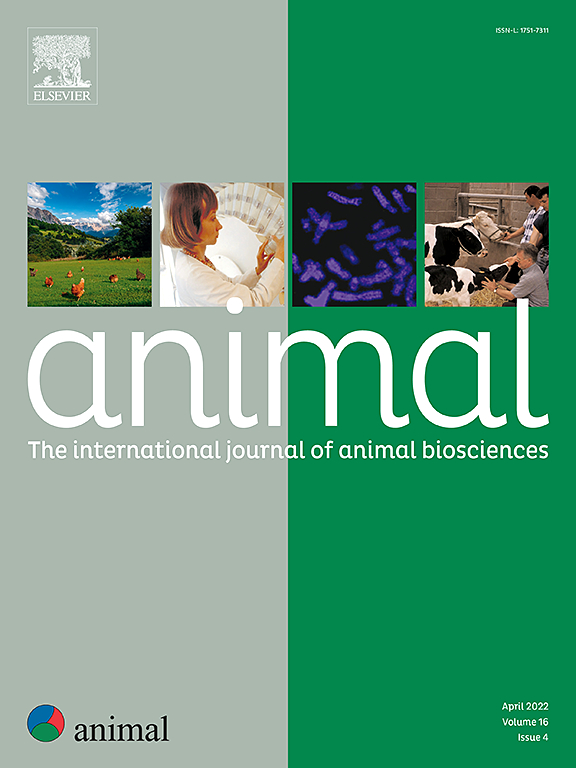
animal attracts the best research in animal biology and animal systems from across the spectrum of the agricultural, biomedical, and environmental sciences. It is the central element in an exciting collaboration between the British Society of Animal Science (BSAS), Institut National de la Recherche Agronomique (INRA) and the European Federation of Animal Science (EAAP) and represents a merging of three scientific journals: Animal Science; Animal Research; Reproduction, Nutrition, Development. animal publishes original cutting-edge research, ''hot'' topics and horizon-scanning reviews on animal-related aspects of the life sciences at the molecular, cellular, organ, whole animal and production system levels. The main subject areas include: breeding and genetics; nutrition; physiology and functional biology of systems; behaviour, health and welfare; farming systems, environmental impact and climate change; product quality, human health and well-being. Animal models and papers dealing with the integration of research between these topics and their impact on the environment and people are particularly welcome.




 京公网安备 11010802042870号
京ICP备2023020795号-1
京公网安备 11010802042870号
京ICP备2023020795号-1

 分享
分享
 求助内容:
求助内容: 应助结果提醒方式:
 扫码关注我们
