Improved differentiation of prostate cancer using advanced diffusion models: a comparative study of mono-exponential, fractional-order-calculus, and multi-compartment models
Yongsheng He, Xuan Qi, Min-Xiong Zhou, Mengxiao Liu, Hongkai Yang, Wuling Wang, Bing Du, Shengdong Nie, Xu Yan
{"title":"Improved differentiation of prostate cancer using advanced diffusion models: a comparative study of mono-exponential, fractional-order-calculus, and multi-compartment models","authors":"Yongsheng He, Xuan Qi, Min-Xiong Zhou, Mengxiao Liu, Hongkai Yang, Wuling Wang, Bing Du, Shengdong Nie, Xu Yan","doi":"10.1007/s00261-024-04684-z","DOIUrl":null,"url":null,"abstract":"<div><h3>Purpose</h3><p>This study aims to compare the performance of mono-exponential (Mono), fractional-order-calculus (FROC), and multi-compartment (MC) diffusion models in differentiating prostate lesions, including benign prostatic hyperplasia (BPH) and prostate cancer (PCa), as well as classifying PCa by clinical significance and risk levels.</p><h3>Methods</h3><p>\\A prospective study was conducted with 224 men (aged 50–80) undergoing 3 T MR imaging. Regions of interest (ROIs) analyses were performed on quantitative parameters from Mono, FROC, and MC models. These parameters were evaluated for their ability to distinguish BPH from PCa, clinically significant (CS) from clinically insignificant (CInS) PCa, and among PCa risk levels. Group differences were assessed using the Mann–Whitney U test and Kruskal–Wallis test, followed by post-hoc Dunn’s test. ROC curves were plotted, and AUC was calculated. Logistic regression was used for parameter combinations, and performance was evaluated via 1000 bootstrap samples. The correlation between parameter pairs was analyzed. The image quality and PCa detection capability were also evaluated visually.</p><h3>Results</h3><p>In distinguishing PCa from BPH, the F1, ADC, and D parameters from the three models achieved high AUCs of 0.92, 0.91, and 0.91, respectively. For differentiating CS-PCa from CInS-PCa, the F2 parameter and the combination of C1 + F2 from the MC model showed the highest AUCs (0.75 and 0.76). In assessing PCa risk levels, F2 and C1 + F2 from the MC model showed the highest AUCs (0.73 and 0.74) for low vs. intermediate-risk PCa. For intermediate vs. high-risk PCa, F1, F1F2, and β + F1F2 from MC and FROC models had the highest AUCs (0.66, 0.66, and 0.71). In addition, ADC was strongly or moderately correlated to D, μ, F1, F1F2, F3, C1 and C3, and not correlated to β and F2. ADC and C1 demonstrated high image quality and strong PCa detection capability.</p><h3>Conclusion</h3><p>Advanced diffusion models, particularly the MC model, demonstrated a significant improvement over ADC in differentiating prostate lesions, especially between low and intermediate-risk PCa, between intermediate and high-risk PCa, and between clinically significant and insignificant PCa. Comparable performance was observed in distinguishing BPH from PCa among three models. Moreover, the combination of MC and FROC models further enhanced differentiation accuracy, particularly in the more challenging classifications between intermediate and high-risk PCa, where ADC alone proved inadequate. These results highlight the potential clinical value of MC model and combining MC and FROC models for more precise PCa risk stratification.</p><h3>Graphical abstract</h3>\n<div><figure><div><div><picture><source><img></source></picture></div></div></figure></div></div>","PeriodicalId":7126,"journal":{"name":"Abdominal Radiology","volume":"50 9","pages":"4235 - 4248"},"PeriodicalIF":2.2000,"publicationDate":"2025-02-18","publicationTypes":"Journal Article","fieldsOfStudy":null,"isOpenAccess":false,"openAccessPdf":"https://www.ncbi.nlm.nih.gov/pmc/articles/PMC12331773/pdf/","citationCount":"0","resultStr":null,"platform":"Semanticscholar","paperid":null,"PeriodicalName":"Abdominal Radiology","FirstCategoryId":"3","ListUrlMain":"https://link.springer.com/article/10.1007/s00261-024-04684-z","RegionNum":3,"RegionCategory":"医学","ArticlePicture":[],"TitleCN":null,"AbstractTextCN":null,"PMCID":null,"EPubDate":"","PubModel":"","JCR":"Q2","JCRName":"RADIOLOGY, NUCLEAR MEDICINE & MEDICAL IMAGING","Score":null,"Total":0}
引用次数: 0
Abstract
Purpose
This study aims to compare the performance of mono-exponential (Mono), fractional-order-calculus (FROC), and multi-compartment (MC) diffusion models in differentiating prostate lesions, including benign prostatic hyperplasia (BPH) and prostate cancer (PCa), as well as classifying PCa by clinical significance and risk levels.
Methods
\A prospective study was conducted with 224 men (aged 50–80) undergoing 3 T MR imaging. Regions of interest (ROIs) analyses were performed on quantitative parameters from Mono, FROC, and MC models. These parameters were evaluated for their ability to distinguish BPH from PCa, clinically significant (CS) from clinically insignificant (CInS) PCa, and among PCa risk levels. Group differences were assessed using the Mann–Whitney U test and Kruskal–Wallis test, followed by post-hoc Dunn’s test. ROC curves were plotted, and AUC was calculated. Logistic regression was used for parameter combinations, and performance was evaluated via 1000 bootstrap samples. The correlation between parameter pairs was analyzed. The image quality and PCa detection capability were also evaluated visually.
Results
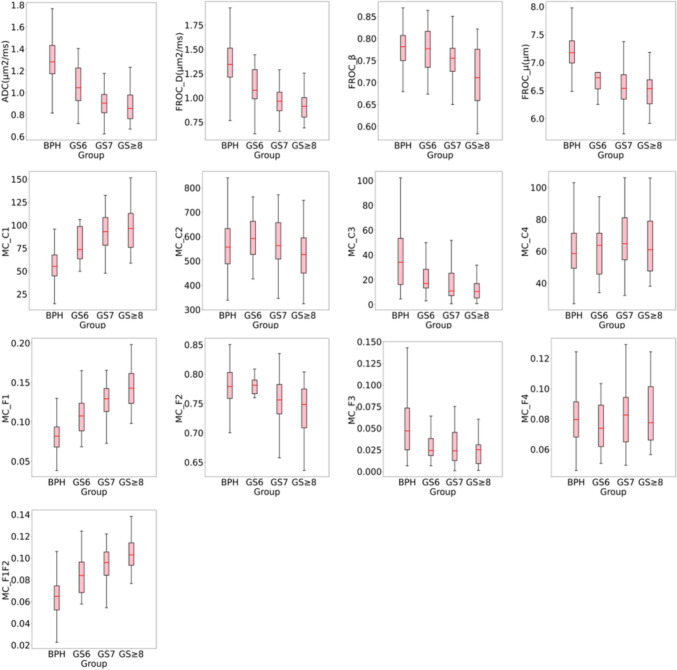
In distinguishing PCa from BPH, the F1, ADC, and D parameters from the three models achieved high AUCs of 0.92, 0.91, and 0.91, respectively. For differentiating CS-PCa from CInS-PCa, the F2 parameter and the combination of C1 + F2 from the MC model showed the highest AUCs (0.75 and 0.76). In assessing PCa risk levels, F2 and C1 + F2 from the MC model showed the highest AUCs (0.73 and 0.74) for low vs. intermediate-risk PCa. For intermediate vs. high-risk PCa, F1, F1F2, and β + F1F2 from MC and FROC models had the highest AUCs (0.66, 0.66, and 0.71). In addition, ADC was strongly or moderately correlated to D, μ, F1, F1F2, F3, C1 and C3, and not correlated to β and F2. ADC and C1 demonstrated high image quality and strong PCa detection capability.
Conclusion
Advanced diffusion models, particularly the MC model, demonstrated a significant improvement over ADC in differentiating prostate lesions, especially between low and intermediate-risk PCa, between intermediate and high-risk PCa, and between clinically significant and insignificant PCa. Comparable performance was observed in distinguishing BPH from PCa among three models. Moreover, the combination of MC and FROC models further enhanced differentiation accuracy, particularly in the more challenging classifications between intermediate and high-risk PCa, where ADC alone proved inadequate. These results highlight the potential clinical value of MC model and combining MC and FROC models for more precise PCa risk stratification.
期刊介绍:
Abdominal Radiology seeks to meet the professional needs of the abdominal radiologist by publishing clinically pertinent original, review and practice related articles on the gastrointestinal and genitourinary tracts and abdominal interventional and radiologic procedures. Case reports are generally not accepted unless they are the first report of a new disease or condition, or part of a special solicited section.
Reasons to Publish Your Article in Abdominal Radiology:
· Official journal of the Society of Abdominal Radiology (SAR)
· Published in Cooperation with:
European Society of Gastrointestinal and Abdominal Radiology (ESGAR)
European Society of Urogenital Radiology (ESUR)
Asian Society of Abdominal Radiology (ASAR)
· Efficient handling and Expeditious review
· Author feedback is provided in a mentoring style
· Global readership
· Readers can earn CME credits





 京公网安备 11010802042870号
京ICP备2023020795号-1
京公网安备 11010802042870号
京ICP备2023020795号-1

 分享
分享
 求助内容:
求助内容: 应助结果提醒方式:
 扫码关注我们
