Mahsa Torkaman, Skander Jemaa, Jill Fredrickson, Alexandre Fernandez Coimbra, Alex De Crespigny, Richard A D Carano
{"title":"Comparative analysis of intestinal tumor segmentation in PET CT scans using organ based and whole body deep learning.","authors":"Mahsa Torkaman, Skander Jemaa, Jill Fredrickson, Alexandre Fernandez Coimbra, Alex De Crespigny, Richard A D Carano","doi":"10.1186/s12880-025-01587-3","DOIUrl":null,"url":null,"abstract":"<p><strong>Background: </strong>18-Fluoro-deoxyglucose positron emission tomography/computed tomography (FDG-PET/CT) is a valuable imaging tool widely used in the management of cancer patients. Deep learning models excel at segmenting highly metabolic tumors but face challenges in regions with complex anatomy and normal cell uptake, such as the gastro-intestinal tract. Despite these challenges, it remains important to achieve accurate segmentation of gastro-intestinal tumors.</p><p><strong>Methods: </strong>Here, we present an international multicenter comparative study between a novel organ-focused approach and a whole-body training method to evaluate the effectiveness of training data homogeneity in accurately identifying gastro-intestinal tumors. In the organ-focused method, the training data is limited to cases with intestinal tumors which makes the network trained with more homogeneous data and with stronger presence of intestinal tumor signals. The whole body approach extracts the intestinal tumors from the results of a model trained on the whole-body scans. Both approaches were trained using diffuse large B cell (DLBCL) patients from a large multi-center clinical trial (NCT01287741).</p><p><strong>Results: </strong>We report an improved mean(±std) Dice score of 0.78(±0.21) for the organ-based approach on the hold-out set, compared to 0.63(±0.30) for the whole-body approach, with the p-value of less than 0.0001. At the lesion level, the proposed organ-based approach also shows increased precision, recall, and F1-score. An independent trial was used to evaluate the generalizability of the proposed method to non-Hodgkin's lymphoma (NHL) patients with follicular lymphoma (FL).</p><p><strong>Conclusion: </strong>Given the variability in structure and metabolism across tissues in the body, our quantitative findings suggest organ-focused training enhances intestinal tumor segmentation by leveraging tissue homogeneity in the training data, contrasting with the whole-body training approach, which, by its very nature, is a more heterogeneous data set.</p>","PeriodicalId":9020,"journal":{"name":"BMC Medical Imaging","volume":"25 1","pages":"52"},"PeriodicalIF":3.2000,"publicationDate":"2025-02-17","publicationTypes":"Journal Article","fieldsOfStudy":null,"isOpenAccess":false,"openAccessPdf":"https://www.ncbi.nlm.nih.gov/pmc/articles/PMC11834234/pdf/","citationCount":"0","resultStr":null,"platform":"Semanticscholar","paperid":null,"PeriodicalName":"BMC Medical Imaging","FirstCategoryId":"3","ListUrlMain":"https://doi.org/10.1186/s12880-025-01587-3","RegionNum":3,"RegionCategory":"医学","ArticlePicture":[],"TitleCN":null,"AbstractTextCN":null,"PMCID":null,"EPubDate":"","PubModel":"","JCR":"Q2","JCRName":"RADIOLOGY, NUCLEAR MEDICINE & MEDICAL IMAGING","Score":null,"Total":0}
引用次数: 0
Abstract
Background: 18-Fluoro-deoxyglucose positron emission tomography/computed tomography (FDG-PET/CT) is a valuable imaging tool widely used in the management of cancer patients. Deep learning models excel at segmenting highly metabolic tumors but face challenges in regions with complex anatomy and normal cell uptake, such as the gastro-intestinal tract. Despite these challenges, it remains important to achieve accurate segmentation of gastro-intestinal tumors.
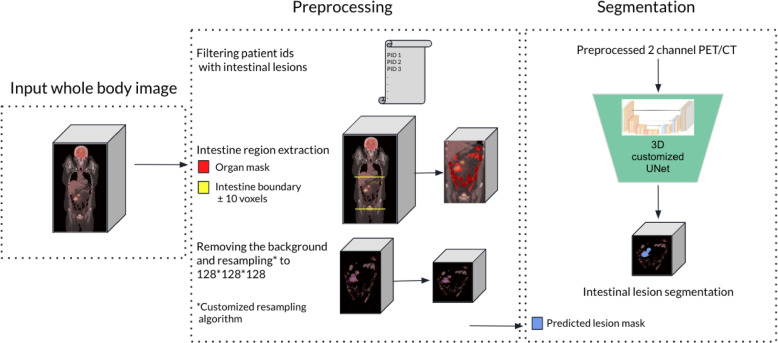
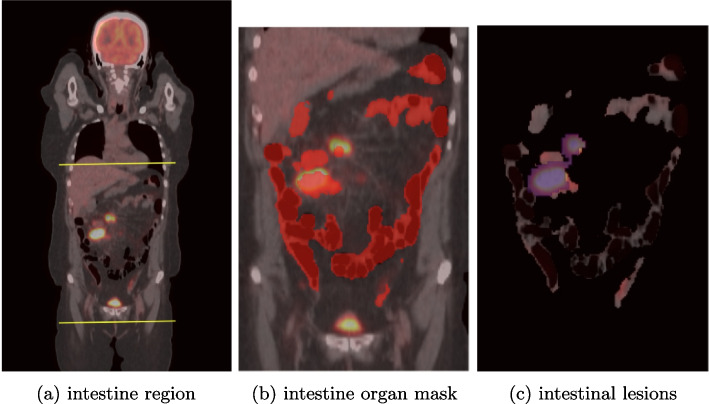
Methods: Here, we present an international multicenter comparative study between a novel organ-focused approach and a whole-body training method to evaluate the effectiveness of training data homogeneity in accurately identifying gastro-intestinal tumors. In the organ-focused method, the training data is limited to cases with intestinal tumors which makes the network trained with more homogeneous data and with stronger presence of intestinal tumor signals. The whole body approach extracts the intestinal tumors from the results of a model trained on the whole-body scans. Both approaches were trained using diffuse large B cell (DLBCL) patients from a large multi-center clinical trial (NCT01287741).
Results: We report an improved mean(±std) Dice score of 0.78(±0.21) for the organ-based approach on the hold-out set, compared to 0.63(±0.30) for the whole-body approach, with the p-value of less than 0.0001. At the lesion level, the proposed organ-based approach also shows increased precision, recall, and F1-score. An independent trial was used to evaluate the generalizability of the proposed method to non-Hodgkin's lymphoma (NHL) patients with follicular lymphoma (FL).
Conclusion: Given the variability in structure and metabolism across tissues in the body, our quantitative findings suggest organ-focused training enhances intestinal tumor segmentation by leveraging tissue homogeneity in the training data, contrasting with the whole-body training approach, which, by its very nature, is a more heterogeneous data set.
期刊介绍:
BMC Medical Imaging is an open access journal publishing original peer-reviewed research articles in the development, evaluation, and use of imaging techniques and image processing tools to diagnose and manage disease.




 京公网安备 11010802042870号
京ICP备2023020795号-1
京公网安备 11010802042870号
京ICP备2023020795号-1

 分享
分享
 求助内容:
求助内容: 应助结果提醒方式:
 扫码关注我们
