{"title":"Effects of migrant workers' health capital on their returning home intentions: evidence from China.","authors":"Haitao Li, Haibo Li, Hao Xiang","doi":"10.3389/fpubh.2025.1473435","DOIUrl":null,"url":null,"abstract":"<p><strong>Background: </strong>The health problems and migration problems of China's huge migrant workers are related to the implementation effect of new-type urbanization and rural revitalization strategy. A thorough examination of the effect of migrant workers' health on their returning home intentions and its mechanism is imperative.</p><p><strong>Objectives: </strong>This study aims to understand the influence of migrant workers' health capital (HC) in their returning home intentions (RHI). For this, using capital theory, this study developed an empirical model to probe the impact of Chinese migrant workers' health on their RHI and analyze the paths that this influence may follow to form the RHI of migrant workers.</p><p><strong>Methods: </strong>A theoretical model was established from the perspective of capital to study the relationship between health and migrant workers' migration. A probit model was used to probe the impact of Chinese migrant workers' HC on their RHI, and propensity score matching (PSM), replacing the explained variable (REV), and transforming the model (TM) were used for the robustness test. Stepwise coefficient test (SCT) and Sobel test (ST) were used to analyze the mediating effects of economic capital (EC) and social capital (SC) in the relationship of HC affecting RHI. Data were collected from a sample of 810 migrant workers from three provinces located in eastern, central, and western China using a survey questionnaire.</p><p><strong>Results: </strong>Migrant workers' HC had a significant and negative impact on their RHI, and mental health (MH) had a greater impact on migrant workers' RHI than physical health (PH). There is regional heterogeneity in the effect of HC on the RHI of migrant workers in China. In addition, economic capital (EC) mediated indirectly the relationship between HC and RHI, while the mediating role of social capital in the relationship between HC and RHI was not significant.</p><p><strong>Conclusion: </strong>Migrant workers' HC is an important factor affecting the formation of their RHI, in which EC plays an intermediary role. This study extends and deepens our understanding of HC and helps to understand the role of health in shaping RHI from the perspective of capital, and the finding confirms the validity of the \"salmon bias effect\" hypothesis in the Chinese context. These findings can also help local government pay more attention to returning migrant workers' HC.</p>","PeriodicalId":12548,"journal":{"name":"Frontiers in Public Health","volume":"13 ","pages":"1473435"},"PeriodicalIF":3.4000,"publicationDate":"2025-02-03","publicationTypes":"Journal Article","fieldsOfStudy":null,"isOpenAccess":false,"openAccessPdf":"https://www.ncbi.nlm.nih.gov/pmc/articles/PMC11830710/pdf/","citationCount":"0","resultStr":null,"platform":"Semanticscholar","paperid":null,"PeriodicalName":"Frontiers in Public Health","FirstCategoryId":"3","ListUrlMain":"https://doi.org/10.3389/fpubh.2025.1473435","RegionNum":3,"RegionCategory":"医学","ArticlePicture":[],"TitleCN":null,"AbstractTextCN":null,"PMCID":null,"EPubDate":"2025/1/1 0:00:00","PubModel":"eCollection","JCR":"Q2","JCRName":"PUBLIC, ENVIRONMENTAL & OCCUPATIONAL HEALTH","Score":null,"Total":0}
引用次数: 0
Abstract
Background: The health problems and migration problems of China's huge migrant workers are related to the implementation effect of new-type urbanization and rural revitalization strategy. A thorough examination of the effect of migrant workers' health on their returning home intentions and its mechanism is imperative.
Objectives: This study aims to understand the influence of migrant workers' health capital (HC) in their returning home intentions (RHI). For this, using capital theory, this study developed an empirical model to probe the impact of Chinese migrant workers' health on their RHI and analyze the paths that this influence may follow to form the RHI of migrant workers.
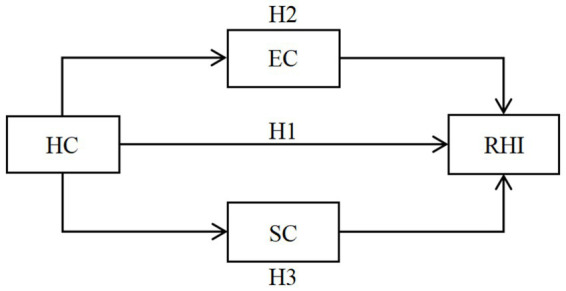
Methods: A theoretical model was established from the perspective of capital to study the relationship between health and migrant workers' migration. A probit model was used to probe the impact of Chinese migrant workers' HC on their RHI, and propensity score matching (PSM), replacing the explained variable (REV), and transforming the model (TM) were used for the robustness test. Stepwise coefficient test (SCT) and Sobel test (ST) were used to analyze the mediating effects of economic capital (EC) and social capital (SC) in the relationship of HC affecting RHI. Data were collected from a sample of 810 migrant workers from three provinces located in eastern, central, and western China using a survey questionnaire.
Results: Migrant workers' HC had a significant and negative impact on their RHI, and mental health (MH) had a greater impact on migrant workers' RHI than physical health (PH). There is regional heterogeneity in the effect of HC on the RHI of migrant workers in China. In addition, economic capital (EC) mediated indirectly the relationship between HC and RHI, while the mediating role of social capital in the relationship between HC and RHI was not significant.
Conclusion: Migrant workers' HC is an important factor affecting the formation of their RHI, in which EC plays an intermediary role. This study extends and deepens our understanding of HC and helps to understand the role of health in shaping RHI from the perspective of capital, and the finding confirms the validity of the "salmon bias effect" hypothesis in the Chinese context. These findings can also help local government pay more attention to returning migrant workers' HC.
期刊介绍:
Frontiers in Public Health is a multidisciplinary open-access journal which publishes rigorously peer-reviewed research and is at the forefront of disseminating and communicating scientific knowledge and impactful discoveries to researchers, academics, clinicians, policy makers and the public worldwide. The journal aims at overcoming current fragmentation in research and publication, promoting consistency in pursuing relevant scientific themes, and supporting finding dissemination and translation into practice.
Frontiers in Public Health is organized into Specialty Sections that cover different areas of research in the field. Please refer to the author guidelines for details on article types and the submission process.




 京公网安备 11010802042870号
京ICP备2023020795号-1
京公网安备 11010802042870号
京ICP备2023020795号-1

 分享
分享
 求助内容:
求助内容: 应助结果提醒方式:
 扫码关注我们
