{"title":"Physicians' Collective Actions in Response to Government Health Policies: A Scoping Review.","authors":"Hyo-Sun You, Kyung Hye Park, HyeRin Roh","doi":"10.3346/jkms.2025.40.e90","DOIUrl":null,"url":null,"abstract":"<p><p>Collective actions by physicians have occurred frequently worldwide, including in Korea. The literature primarily focuses on justifying industrial actions or assessing their impact on clinical outcomes. However, few studies have examined physicians' actions in response to government health policies. A comprehensive review of this literature could provide valuable insights into how physicians can effectively address and resolve conflicts with governments. This study aimed to investigate the existing literature on physicians' collective actions against government health policies and identify research gaps. A scoping review was conducted based on the methodology proposed by Arksey and O'Malley. We searched for terms related to physicians (e.g., doctors, trainees) and strikes (e.g., protests, walkouts) in PubMed, Embase, Scopus, Web of Science, KMbase, and RISS on March 25, 2024. A total of 5,248 articles published between 1974 and 2023 were screened, and 26 articles were selected for analysis. The authors of these studies were predominantly from the fields of social sciences, history, jurisprudence, and public health administration. Physician collective actions were documented in 16 countries across various levels of development. Physicians engaged in collective action for five main reasons: 1) Opposition to socialized medicine policies, 2) Opposition to healthcare privatization policies, 3) Dissatisfaction with poor or stagnant public healthcare systems and infrastructure, 4) Resistance to unreasonable medical reforms, and 5) Protests against inequitable health workforce policies. Government responses to physician strikes followed four main strategies: 1) Unilateral policy enforcement, 2) Instigation of conflicts, 3) Suppression of physicians through unwarranted use of governmental power, and 4) Use of mediators to negotiate resolutions. These strategies were employed regardless of whether the government was authoritarian or democratic. Physicians' strategies against government policies were categorized as 1) Strengthening physician organizations, 2) Improving public relations, 3) Disrupting government policy implementation, and 4) Reducing the available medical workforce. In conclusion, this study highlights the need for more theory-based research and greater integration of social sciences into physicians' education. We recommend that Korean physicians reflect on the strategies used by both governments and physicians in other countries and prepare for potential conflicts.</p>","PeriodicalId":16249,"journal":{"name":"Journal of Korean Medical Science","volume":"40 6","pages":"e90"},"PeriodicalIF":2.3000,"publicationDate":"2025-02-17","publicationTypes":"Journal Article","fieldsOfStudy":null,"isOpenAccess":false,"openAccessPdf":"https://www.ncbi.nlm.nih.gov/pmc/articles/PMC11832886/pdf/","citationCount":"0","resultStr":null,"platform":"Semanticscholar","paperid":null,"PeriodicalName":"Journal of Korean Medical Science","FirstCategoryId":"3","ListUrlMain":"https://doi.org/10.3346/jkms.2025.40.e90","RegionNum":3,"RegionCategory":"医学","ArticlePicture":[],"TitleCN":null,"AbstractTextCN":null,"PMCID":null,"EPubDate":"","PubModel":"","JCR":"Q1","JCRName":"MEDICINE, GENERAL & INTERNAL","Score":null,"Total":0}
引用次数: 0
Abstract
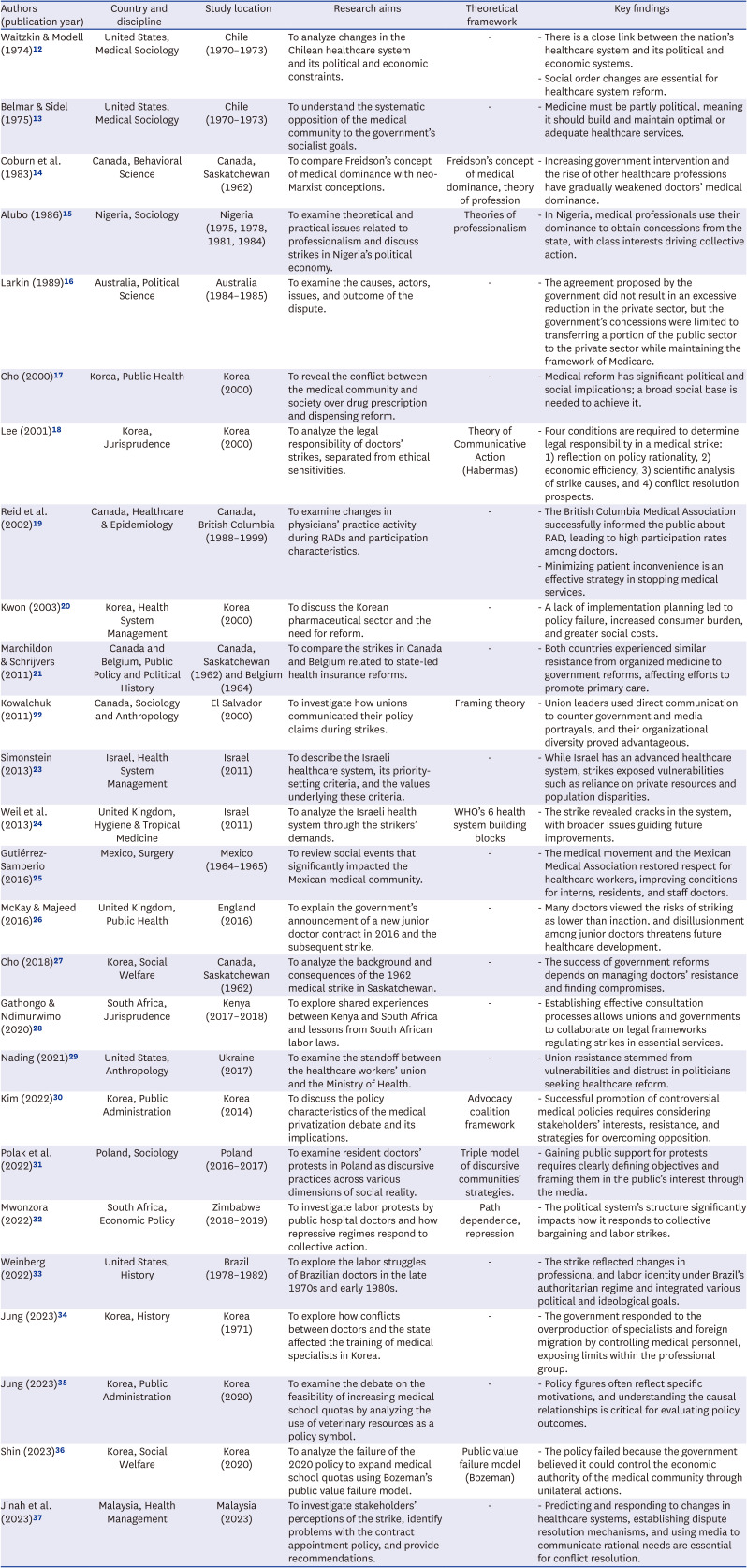
Collective actions by physicians have occurred frequently worldwide, including in Korea. The literature primarily focuses on justifying industrial actions or assessing their impact on clinical outcomes. However, few studies have examined physicians' actions in response to government health policies. A comprehensive review of this literature could provide valuable insights into how physicians can effectively address and resolve conflicts with governments. This study aimed to investigate the existing literature on physicians' collective actions against government health policies and identify research gaps. A scoping review was conducted based on the methodology proposed by Arksey and O'Malley. We searched for terms related to physicians (e.g., doctors, trainees) and strikes (e.g., protests, walkouts) in PubMed, Embase, Scopus, Web of Science, KMbase, and RISS on March 25, 2024. A total of 5,248 articles published between 1974 and 2023 were screened, and 26 articles were selected for analysis. The authors of these studies were predominantly from the fields of social sciences, history, jurisprudence, and public health administration. Physician collective actions were documented in 16 countries across various levels of development. Physicians engaged in collective action for five main reasons: 1) Opposition to socialized medicine policies, 2) Opposition to healthcare privatization policies, 3) Dissatisfaction with poor or stagnant public healthcare systems and infrastructure, 4) Resistance to unreasonable medical reforms, and 5) Protests against inequitable health workforce policies. Government responses to physician strikes followed four main strategies: 1) Unilateral policy enforcement, 2) Instigation of conflicts, 3) Suppression of physicians through unwarranted use of governmental power, and 4) Use of mediators to negotiate resolutions. These strategies were employed regardless of whether the government was authoritarian or democratic. Physicians' strategies against government policies were categorized as 1) Strengthening physician organizations, 2) Improving public relations, 3) Disrupting government policy implementation, and 4) Reducing the available medical workforce. In conclusion, this study highlights the need for more theory-based research and greater integration of social sciences into physicians' education. We recommend that Korean physicians reflect on the strategies used by both governments and physicians in other countries and prepare for potential conflicts.
包括韩国在内,世界各地的医生集体行动时有发生。文献主要集中在证明工业行动或评估其对临床结果的影响。然而,很少有研究调查医生对政府卫生政策的反应。对这些文献的全面回顾可以为医生如何有效地处理和解决与政府的冲突提供有价值的见解。本研究旨在调查现有关于医师集体行动反对政府卫生政策的文献,并找出研究空白。根据Arksey和O'Malley提出的方法进行了范围审查。我们于2024年3月25日在PubMed, Embase, Scopus, Web of Science, KMbase和RISS中搜索与医生(例如,医生,实习生)和罢工(例如,抗议,罢工)相关的术语。共筛选了1974 - 2023年间发表的5248篇文章,选取了26篇进行分析。这些研究的作者主要来自社会科学、历史、法学和公共卫生管理领域。16个不同发展水平的国家记录了医生的集体行动。医生参与集体行动有五个主要原因:1)反对社会化医疗政策,2)反对医疗私有化政策,3)不满贫穷或停滞的公共医疗系统和基础设施,4)抵制不合理的医疗改革,5)抗议不公平的卫生人力政策。政府对医生罢工的回应遵循四个主要策略:1)单方面执行政策;2)煽动冲突;3)通过无端使用政府权力镇压医生;4)使用调解人谈判解决方案。无论政府是专制还是民主,这些策略都被采用。医生对抗政府政策的策略分为:1)加强医师组织;2)改善公共关系;3)干扰政府政策的执行;4)减少可用的医疗人力。总之,本研究强调需要更多基于理论的研究,并将社会科学更大程度地整合到医生教育中。我们建议韩国医生反思其他国家政府和医生使用的策略,并为潜在的冲突做好准备。
期刊介绍:
The Journal of Korean Medical Science (JKMS) is an international, peer-reviewed Open Access journal of medicine published weekly in English. The Journal’s publisher is the Korean Academy of Medical Sciences (KAMS), Korean Medical Association (KMA). JKMS aims to publish evidence-based, scientific research articles from various disciplines of the medical sciences. The Journal welcomes articles of general interest to medical researchers especially when they contain original information. Articles on the clinical evaluation of drugs and other therapies, epidemiologic studies of the general population, studies on pathogenic organisms and toxic materials, and the toxicities and adverse effects of therapeutics are welcome.





 京公网安备 11010802042870号
京ICP备2023020795号-1
京公网安备 11010802042870号
京ICP备2023020795号-1

 分享
分享
 求助内容:
求助内容: 应助结果提醒方式:
 扫码关注我们
