{"title":"Physiological responses of the monocled cobra (<i>Naja kaouthia</i> Lesson, 1831) including venom production, to high ambient temperature exposure.","authors":"Taksa Vasaruchapong, Narongsak Chaiyabutr, Thanida Nampimoon, Sumpun Thammacharoen","doi":"10.1590/1678-9199-JVATITD-2024-0058","DOIUrl":null,"url":null,"abstract":"<p><strong>Background: </strong>Temperature regulation is essentially important for survival of poikilotherms such as snakes. Body temperature is regulated by snakes through behavioral and physiological responses. The global-warming crisis, combined with the need to house large population of snakes in limited spaces, increases the likelihood of exposing snakes to high ambient temperature (HTa), requiring it reliance on physiological responses. This study aimed to study the effect of HTa exposure on physiological responses and venom production, which have rarely been studied.</p><p><strong>Methods: </strong>Eleven adult monocled cobras (<i>Naja kaouthia</i> Lesson, 1831) were divided into two groups. The concurrent control group was housed in a temperature-controlled room, and the heat exposed group was housed in the same room with gradually increasing temperatures (25°C-35°C) for 4 h on four consecutive days. Data were collected 3 days before the experiment as the baseline and then compared with day 1 and day 4 after HTa exposure data representing immediate and prolonged effects. Body temperature, body weight, water intake, heart rate, hematology, plasma biochemistry, body-fluid compartments, hormonal response, heat shock protein expression and venom production were measured.</p><p><strong>Results: </strong>In response to HTa exposure, body temperature and heart rate increased, plasma volume significantly decreased, but water intake increased. Hematocrit and plasma protein progressively decreased in the latter stages of experimentation, but HTa diminished this effect. HTa only increased plasma corticosterone on day 1. Exposure to HTa increased venom protein concentration on day 4 and diminished the decreased proportion effect of frequent venom collection on phospholipase A<sub>2</sub> component.</p><p><strong>Conclusion: </strong>Increased heart rate and fluid shift from the intravascular compartment appeared to be the underlying mechanism for heat dissipation during HTa exposure. Under the study condition, HTa caused heat stress, but the snake could adapt after continued exposure. Additionally, HTa increased venom protein concentration in <i>N. kaouthia</i>, particularly phospholipase A<sub>2</sub> component.</p>","PeriodicalId":17565,"journal":{"name":"Journal of Venomous Animals and Toxins Including Tropical Diseases","volume":"31 ","pages":"e20240058"},"PeriodicalIF":1.8000,"publicationDate":"2025-02-14","publicationTypes":"Journal Article","fieldsOfStudy":null,"isOpenAccess":false,"openAccessPdf":"https://www.ncbi.nlm.nih.gov/pmc/articles/PMC11832193/pdf/","citationCount":"0","resultStr":null,"platform":"Semanticscholar","paperid":null,"PeriodicalName":"Journal of Venomous Animals and Toxins Including Tropical Diseases","FirstCategoryId":"3","ListUrlMain":"https://doi.org/10.1590/1678-9199-JVATITD-2024-0058","RegionNum":3,"RegionCategory":"医学","ArticlePicture":[],"TitleCN":null,"AbstractTextCN":null,"PMCID":null,"EPubDate":"2025/1/1 0:00:00","PubModel":"eCollection","JCR":"Q4","JCRName":"TOXICOLOGY","Score":null,"Total":0}
引用次数: 0
Abstract
Background: Temperature regulation is essentially important for survival of poikilotherms such as snakes. Body temperature is regulated by snakes through behavioral and physiological responses. The global-warming crisis, combined with the need to house large population of snakes in limited spaces, increases the likelihood of exposing snakes to high ambient temperature (HTa), requiring it reliance on physiological responses. This study aimed to study the effect of HTa exposure on physiological responses and venom production, which have rarely been studied.
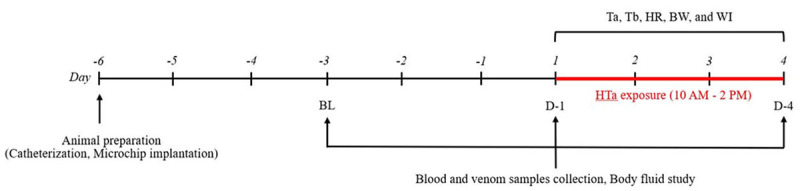
Methods: Eleven adult monocled cobras (Naja kaouthia Lesson, 1831) were divided into two groups. The concurrent control group was housed in a temperature-controlled room, and the heat exposed group was housed in the same room with gradually increasing temperatures (25°C-35°C) for 4 h on four consecutive days. Data were collected 3 days before the experiment as the baseline and then compared with day 1 and day 4 after HTa exposure data representing immediate and prolonged effects. Body temperature, body weight, water intake, heart rate, hematology, plasma biochemistry, body-fluid compartments, hormonal response, heat shock protein expression and venom production were measured.
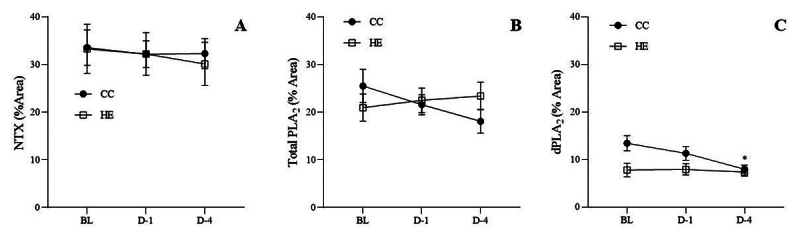
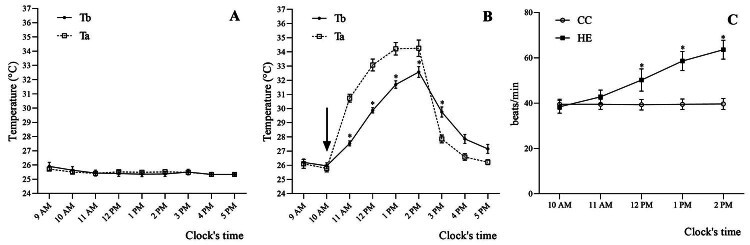
Results: In response to HTa exposure, body temperature and heart rate increased, plasma volume significantly decreased, but water intake increased. Hematocrit and plasma protein progressively decreased in the latter stages of experimentation, but HTa diminished this effect. HTa only increased plasma corticosterone on day 1. Exposure to HTa increased venom protein concentration on day 4 and diminished the decreased proportion effect of frequent venom collection on phospholipase A2 component.
Conclusion: Increased heart rate and fluid shift from the intravascular compartment appeared to be the underlying mechanism for heat dissipation during HTa exposure. Under the study condition, HTa caused heat stress, but the snake could adapt after continued exposure. Additionally, HTa increased venom protein concentration in N. kaouthia, particularly phospholipase A2 component.
期刊介绍:
Journal of Venomous Animals and Toxins including Tropical Diseases (JVATiTD) is a non-commercial academic open access publication dedicated to research on all aspects of toxinology, venomous animals and tropical diseases. Its interdisciplinary content includes original scientific articles covering research on toxins derived from animals, plants and microorganisms. Topics of interest include, but are not limited to:systematics and morphology of venomous animals;physiology, biochemistry, pharmacology and immunology of toxins;epidemiology, clinical aspects and treatment of envenoming by different animals, plants and microorganisms;development and evaluation of antivenoms and toxin-derivative products;epidemiology, clinical aspects and treatment of tropical diseases (caused by virus, bacteria, algae, fungi and parasites) including the neglected tropical diseases (NTDs) defined by the World Health Organization.



 京公网安备 11010802042870号
京ICP备2023020795号-1
京公网安备 11010802042870号
京ICP备2023020795号-1

 分享
分享
 求助内容:
求助内容: 应助结果提醒方式:
 扫码关注我们
