{"title":"Interpreting and comparing neural activity across systems by geometric deep learning","authors":"","doi":"10.1038/s41592-024-02581-3","DOIUrl":null,"url":null,"abstract":"The MARBLE method addresses a critical challenge in neural population recordings: inferring expressive and interpretable latent representations that are comparable across experiments and animals. It achieves this by explicitly leveraging the low-dimensional structure of neural states through geometric deep learning to learn the dynamical flow fields in neural activity.","PeriodicalId":18981,"journal":{"name":"Nature Methods","volume":"22 3","pages":"467-468"},"PeriodicalIF":32.1000,"publicationDate":"2025-02-17","publicationTypes":"Journal Article","fieldsOfStudy":null,"isOpenAccess":false,"openAccessPdf":"","citationCount":"0","resultStr":null,"platform":"Semanticscholar","paperid":null,"PeriodicalName":"Nature Methods","FirstCategoryId":"99","ListUrlMain":"https://www.nature.com/articles/s41592-024-02581-3","RegionNum":1,"RegionCategory":"生物学","ArticlePicture":[],"TitleCN":null,"AbstractTextCN":null,"PMCID":null,"EPubDate":"","PubModel":"","JCR":"Q1","JCRName":"BIOCHEMICAL RESEARCH METHODS","Score":null,"Total":0}
引用次数: 0
Abstract
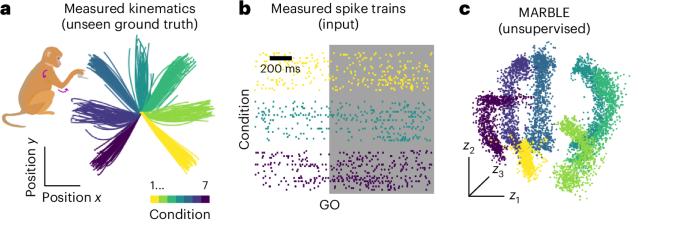
The MARBLE method addresses a critical challenge in neural population recordings: inferring expressive and interpretable latent representations that are comparable across experiments and animals. It achieves this by explicitly leveraging the low-dimensional structure of neural states through geometric deep learning to learn the dynamical flow fields in neural activity.
期刊介绍:
Nature Methods is a monthly journal that focuses on publishing innovative methods and substantial enhancements to fundamental life sciences research techniques. Geared towards a diverse, interdisciplinary readership of researchers in academia and industry engaged in laboratory work, the journal offers new tools for research and emphasizes the immediate practical significance of the featured work. It publishes primary research papers and reviews recent technical and methodological advancements, with a particular interest in primary methods papers relevant to the biological and biomedical sciences. This includes methods rooted in chemistry with practical applications for studying biological problems.




 京公网安备 11010802042870号
京ICP备2023020795号-1
京公网安备 11010802042870号
京ICP备2023020795号-1

 分享
分享
 求助内容:
求助内容: 应助结果提醒方式:
 扫码关注我们
