Adam Gosztolai, Robert L. Peach, Alexis Arnaudon, Mauricio Barahona, Pierre Vandergheynst
{"title":"MARBLE: interpretable representations of neural population dynamics using geometric deep learning","authors":"Adam Gosztolai, Robert L. Peach, Alexis Arnaudon, Mauricio Barahona, Pierre Vandergheynst","doi":"10.1038/s41592-024-02582-2","DOIUrl":null,"url":null,"abstract":"The dynamics of neuron populations commonly evolve on low-dimensional manifolds. Thus, we need methods that learn the dynamical processes over neural manifolds to infer interpretable and consistent latent representations. We introduce a representation learning method, MARBLE, which decomposes on-manifold dynamics into local flow fields and maps them into a common latent space using unsupervised geometric deep learning. In simulated nonlinear dynamical systems, recurrent neural networks and experimental single-neuron recordings from primates and rodents, we discover emergent low-dimensional latent representations that parametrize high-dimensional neural dynamics during gain modulation, decision-making and changes in the internal state. These representations are consistent across neural networks and animals, enabling the robust comparison of cognitive computations. Extensive benchmarking demonstrates state-of-the-art within- and across-animal decoding accuracy of MARBLE compared to current representation learning approaches, with minimal user input. Our results suggest that a manifold structure provides a powerful inductive bias to develop decoding algorithms and assimilate data across experiments. MARBLE uses geometric deep learning to map dynamics such as neural activity into a latent representation, which can then be used to decode the neural activity or compare it across systems.","PeriodicalId":18981,"journal":{"name":"Nature Methods","volume":"22 3","pages":"612-620"},"PeriodicalIF":32.1000,"publicationDate":"2025-02-17","publicationTypes":"Journal Article","fieldsOfStudy":null,"isOpenAccess":false,"openAccessPdf":"https://www.nature.com/articles/s41592-024-02582-2.pdf","citationCount":"0","resultStr":null,"platform":"Semanticscholar","paperid":null,"PeriodicalName":"Nature Methods","FirstCategoryId":"99","ListUrlMain":"https://www.nature.com/articles/s41592-024-02582-2","RegionNum":1,"RegionCategory":"生物学","ArticlePicture":[],"TitleCN":null,"AbstractTextCN":null,"PMCID":null,"EPubDate":"","PubModel":"","JCR":"Q1","JCRName":"BIOCHEMICAL RESEARCH METHODS","Score":null,"Total":0}
引用次数: 0
Abstract
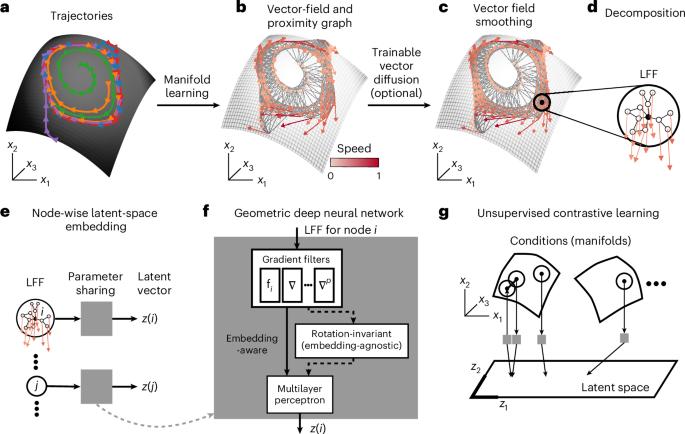
The dynamics of neuron populations commonly evolve on low-dimensional manifolds. Thus, we need methods that learn the dynamical processes over neural manifolds to infer interpretable and consistent latent representations. We introduce a representation learning method, MARBLE, which decomposes on-manifold dynamics into local flow fields and maps them into a common latent space using unsupervised geometric deep learning. In simulated nonlinear dynamical systems, recurrent neural networks and experimental single-neuron recordings from primates and rodents, we discover emergent low-dimensional latent representations that parametrize high-dimensional neural dynamics during gain modulation, decision-making and changes in the internal state. These representations are consistent across neural networks and animals, enabling the robust comparison of cognitive computations. Extensive benchmarking demonstrates state-of-the-art within- and across-animal decoding accuracy of MARBLE compared to current representation learning approaches, with minimal user input. Our results suggest that a manifold structure provides a powerful inductive bias to develop decoding algorithms and assimilate data across experiments. MARBLE uses geometric deep learning to map dynamics such as neural activity into a latent representation, which can then be used to decode the neural activity or compare it across systems.
期刊介绍:
Nature Methods is a monthly journal that focuses on publishing innovative methods and substantial enhancements to fundamental life sciences research techniques. Geared towards a diverse, interdisciplinary readership of researchers in academia and industry engaged in laboratory work, the journal offers new tools for research and emphasizes the immediate practical significance of the featured work. It publishes primary research papers and reviews recent technical and methodological advancements, with a particular interest in primary methods papers relevant to the biological and biomedical sciences. This includes methods rooted in chemistry with practical applications for studying biological problems.



 京公网安备 11010802042870号
京ICP备2023020795号-1
京公网安备 11010802042870号
京ICP备2023020795号-1

 分享
分享
 求助内容:
求助内容: 应助结果提醒方式:
 扫码关注我们
