Yao Liao, Yuheng Liu, Dinghao Li, Shiqi Luo, Yun Huang, Junwei Wu, Jin Su, Yi Yang, Ji Wu, Zifeng Zhu, Mengxi Yanglan, Haiyi Deng, Xinyi Wu, Junhao Xu, Feiyang Cao, Chunmei Cai, Zhen Li, Ruibing Yang, Xiaoyan Deng, Jie Wei, Lifu Wang
{"title":"COVID-19 patient serum-derived extracellular vesicles deliver miR-20b-5p induces neutrophil extracellular traps.","authors":"Yao Liao, Yuheng Liu, Dinghao Li, Shiqi Luo, Yun Huang, Junwei Wu, Jin Su, Yi Yang, Ji Wu, Zifeng Zhu, Mengxi Yanglan, Haiyi Deng, Xinyi Wu, Junhao Xu, Feiyang Cao, Chunmei Cai, Zhen Li, Ruibing Yang, Xiaoyan Deng, Jie Wei, Lifu Wang","doi":"10.1186/s12964-025-02095-1","DOIUrl":null,"url":null,"abstract":"<p><strong>Background: </strong>Severe cases of COVID-19 are characterized by an excessive presence of neutrophils. Neutrophil extracellular traps (NETs), released by activated neutrophils due to SARS-CoV-2 infection, contribute to lung epithelial cell death and are key drivers in COVID-19-associated immunothrombosis. However, the mechanism underlying NET formation in COVID-19 remain unclear.</p><p><strong>Methods: </strong>Extracellular vesicles (EVs) were isolated from the serum of COVID-19 patients and healthy volunteers, while neutrophils were isolated from blood samples of healthy volunteers. Neutrophils were treated with EVs, and the formation of NETs was observed. To identify the components responsible for the COVID-19-EVs-induced NET formation, we analyzed the expression profiles of microRNA (miRNAs) in COVID-19-EVs. We identified eight highly expressed miRNAs in COVID-19-EVs and explored their potential roles in COVID-19-EVs-mediated NET formation. Additionally, we explored the role of miR-20b-5p in COVID-19-EVs-induced NET formation.</p><p><strong>Results: </strong>In this study, we demonstrate that patients with COVID-19 have a higher concentration of serum EVs (COVID-19-EVs) than healthy controls (Normal-EVs). We also found that COVID-19-EVs are internalized by neutrophils to induced NET formation. Through comprehensive miRNA profiling of COVID-19-EVs versus Normal-EVs, we identified 78 differentially expressed miRNAs, with 27 of these being upregulated and 51 being downregulated. Subsequently, we discovered that COVID-19-EVs that were highly abundant with certain miRNAs promote NET formation. Specifically, miR-20b-5p was found to be the strongest inducer of NET formation of the identified miRNAs. Inhibition of miR-20b-5p resulted in a significant decrease in COVID-19-EVs-mediated induction of NET formation.</p><p><strong>Conclusion: </strong>Herein, we reveal a previously unknown role of COVID-19-EVs in NET formation, which contributes to COVID-19 progression. This study suggests that miR-20b-5p may serve as a potential therapeutic target for COVID-19 treatment.</p>","PeriodicalId":55268,"journal":{"name":"Cell Communication and Signaling","volume":"23 1","pages":"93"},"PeriodicalIF":8.2000,"publicationDate":"2025-02-17","publicationTypes":"Journal Article","fieldsOfStudy":null,"isOpenAccess":false,"openAccessPdf":"https://www.ncbi.nlm.nih.gov/pmc/articles/PMC11834185/pdf/","citationCount":"0","resultStr":null,"platform":"Semanticscholar","paperid":null,"PeriodicalName":"Cell Communication and Signaling","FirstCategoryId":"99","ListUrlMain":"https://doi.org/10.1186/s12964-025-02095-1","RegionNum":2,"RegionCategory":"生物学","ArticlePicture":[],"TitleCN":null,"AbstractTextCN":null,"PMCID":null,"EPubDate":"","PubModel":"","JCR":"Q1","JCRName":"CELL BIOLOGY","Score":null,"Total":0}
引用次数: 0
Abstract
Background: Severe cases of COVID-19 are characterized by an excessive presence of neutrophils. Neutrophil extracellular traps (NETs), released by activated neutrophils due to SARS-CoV-2 infection, contribute to lung epithelial cell death and are key drivers in COVID-19-associated immunothrombosis. However, the mechanism underlying NET formation in COVID-19 remain unclear.
Methods: Extracellular vesicles (EVs) were isolated from the serum of COVID-19 patients and healthy volunteers, while neutrophils were isolated from blood samples of healthy volunteers. Neutrophils were treated with EVs, and the formation of NETs was observed. To identify the components responsible for the COVID-19-EVs-induced NET formation, we analyzed the expression profiles of microRNA (miRNAs) in COVID-19-EVs. We identified eight highly expressed miRNAs in COVID-19-EVs and explored their potential roles in COVID-19-EVs-mediated NET formation. Additionally, we explored the role of miR-20b-5p in COVID-19-EVs-induced NET formation.
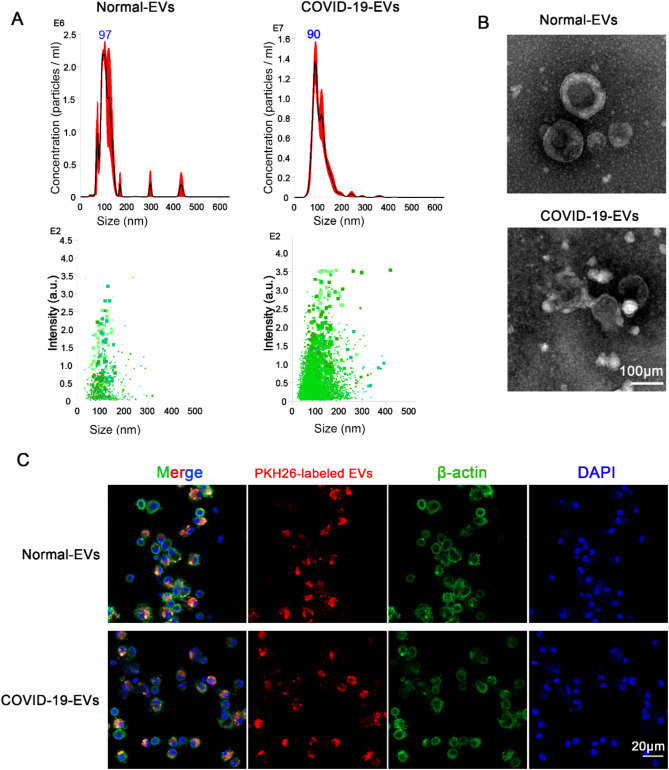
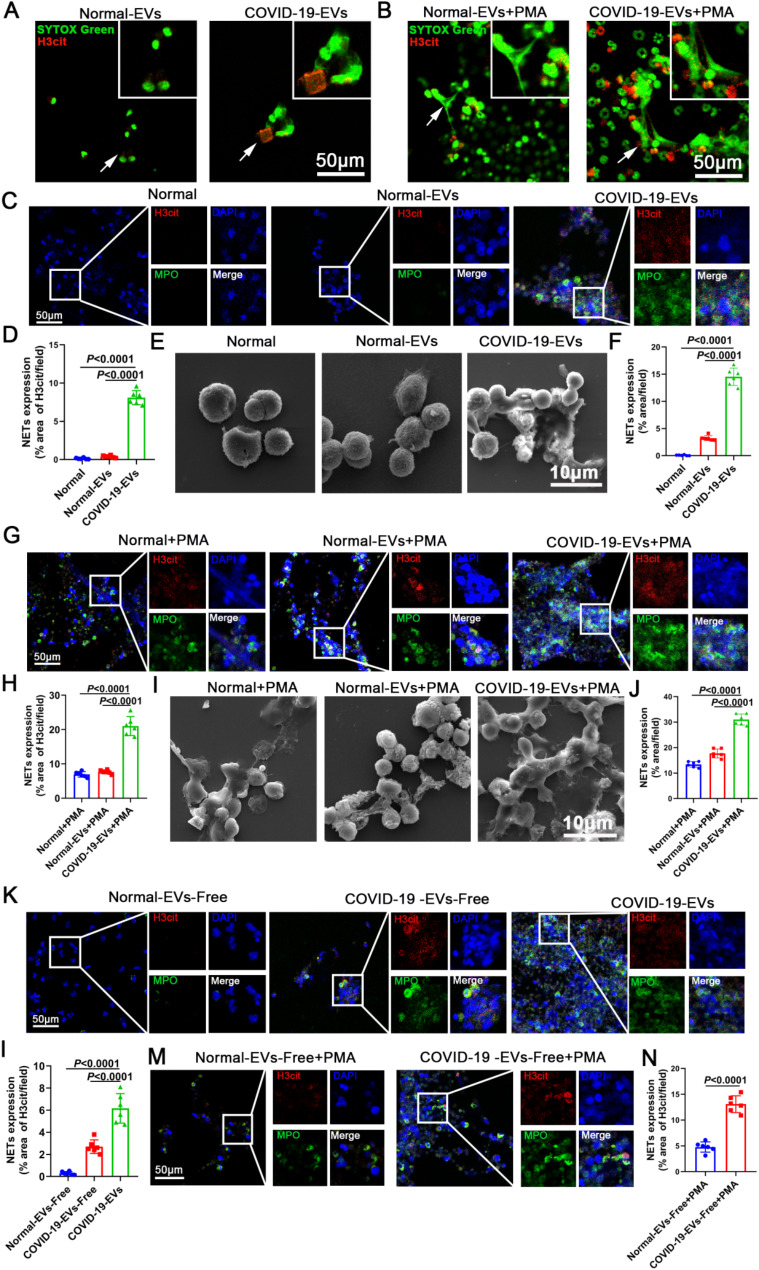
Results: In this study, we demonstrate that patients with COVID-19 have a higher concentration of serum EVs (COVID-19-EVs) than healthy controls (Normal-EVs). We also found that COVID-19-EVs are internalized by neutrophils to induced NET formation. Through comprehensive miRNA profiling of COVID-19-EVs versus Normal-EVs, we identified 78 differentially expressed miRNAs, with 27 of these being upregulated and 51 being downregulated. Subsequently, we discovered that COVID-19-EVs that were highly abundant with certain miRNAs promote NET formation. Specifically, miR-20b-5p was found to be the strongest inducer of NET formation of the identified miRNAs. Inhibition of miR-20b-5p resulted in a significant decrease in COVID-19-EVs-mediated induction of NET formation.
Conclusion: Herein, we reveal a previously unknown role of COVID-19-EVs in NET formation, which contributes to COVID-19 progression. This study suggests that miR-20b-5p may serve as a potential therapeutic target for COVID-19 treatment.
期刊介绍:
Cell Communication and Signaling (CCS) is a peer-reviewed, open-access scientific journal that focuses on cellular signaling pathways in both normal and pathological conditions. It publishes original research, reviews, and commentaries, welcoming studies that utilize molecular, morphological, biochemical, structural, and cell biology approaches. CCS also encourages interdisciplinary work and innovative models, including in silico, in vitro, and in vivo approaches, to facilitate investigations of cell signaling pathways, networks, and behavior.
Starting from January 2019, CCS is proud to announce its affiliation with the International Cell Death Society. The journal now encourages submissions covering all aspects of cell death, including apoptotic and non-apoptotic mechanisms, cell death in model systems, autophagy, clearance of dying cells, and the immunological and pathological consequences of dying cells in the tissue microenvironment.




 京公网安备 11010802042870号
京ICP备2023020795号-1
京公网安备 11010802042870号
京ICP备2023020795号-1

 分享
分享
 求助内容:
求助内容: 应助结果提醒方式:
 扫码关注我们
