Ana P. Millán, Hanlin Sun, Lorenzo Giambagli, Riccardo Muolo, Timoteo Carletti, Joaquín J. Torres, Filippo Radicchi, Jürgen Kurths, Ginestra Bianconi
{"title":"Topology shapes dynamics of higher-order networks","authors":"Ana P. Millán, Hanlin Sun, Lorenzo Giambagli, Riccardo Muolo, Timoteo Carletti, Joaquín J. Torres, Filippo Radicchi, Jürgen Kurths, Ginestra Bianconi","doi":"10.1038/s41567-024-02757-w","DOIUrl":null,"url":null,"abstract":"Higher-order networks capture the many-body interactions present in complex systems, shedding light on the interplay between topology and dynamics. The theory of higher-order topological dynamics, which combines higher-order interactions with discrete topology and nonlinear dynamics, has the potential to enhance our understanding of complex systems, such as the brain and the climate, and to advance the development of next-generation AI algorithms. This theoretical framework, which goes beyond traditional node-centric descriptions, encodes the dynamics of a network through topological signals—variables assigned not only to nodes but also to edges, triangles and other higher-order cells. Recent findings show that topological signals lead to the emergence of distinct types of dynamical state and collective phenomena, including topological and Dirac synchronization, pattern formation and triadic percolation. These results offer insights into how topology shapes dynamics, how dynamics learns topology and how topology evolves dynamically. This Perspective primarily aims to guide physicists, mathematicians, computer scientists and network scientists through the emerging field of higher-order topological dynamics, while also outlining future research challenges. Higher-order interactions reveal new aspects of the interplay between topology and dynamics in complex systems. This Perspective describes the emerging field of higher-order topological dynamics and discusses the open research questions in the area.","PeriodicalId":19100,"journal":{"name":"Nature Physics","volume":"21 3","pages":"353-361"},"PeriodicalIF":18.4000,"publicationDate":"2025-02-19","publicationTypes":"Journal Article","fieldsOfStudy":null,"isOpenAccess":false,"openAccessPdf":"","citationCount":"0","resultStr":null,"platform":"Semanticscholar","paperid":null,"PeriodicalName":"Nature Physics","FirstCategoryId":"101","ListUrlMain":"https://www.nature.com/articles/s41567-024-02757-w","RegionNum":1,"RegionCategory":"物理与天体物理","ArticlePicture":[],"TitleCN":null,"AbstractTextCN":null,"PMCID":null,"EPubDate":"","PubModel":"","JCR":"Q1","JCRName":"PHYSICS, MULTIDISCIPLINARY","Score":null,"Total":0}
引用次数: 0
Abstract
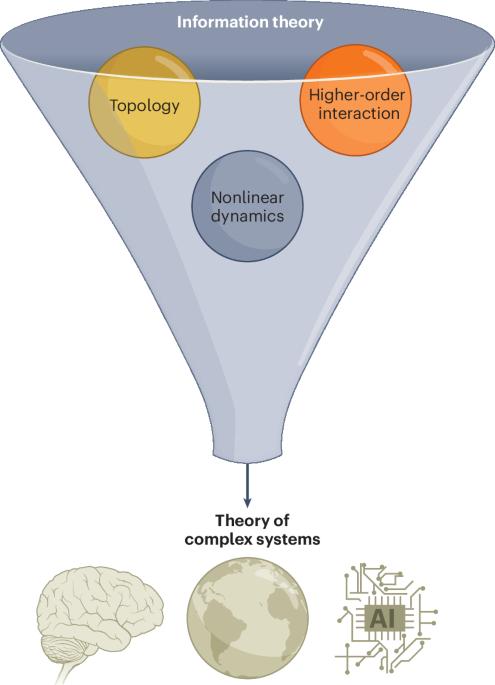
Higher-order networks capture the many-body interactions present in complex systems, shedding light on the interplay between topology and dynamics. The theory of higher-order topological dynamics, which combines higher-order interactions with discrete topology and nonlinear dynamics, has the potential to enhance our understanding of complex systems, such as the brain and the climate, and to advance the development of next-generation AI algorithms. This theoretical framework, which goes beyond traditional node-centric descriptions, encodes the dynamics of a network through topological signals—variables assigned not only to nodes but also to edges, triangles and other higher-order cells. Recent findings show that topological signals lead to the emergence of distinct types of dynamical state and collective phenomena, including topological and Dirac synchronization, pattern formation and triadic percolation. These results offer insights into how topology shapes dynamics, how dynamics learns topology and how topology evolves dynamically. This Perspective primarily aims to guide physicists, mathematicians, computer scientists and network scientists through the emerging field of higher-order topological dynamics, while also outlining future research challenges. Higher-order interactions reveal new aspects of the interplay between topology and dynamics in complex systems. This Perspective describes the emerging field of higher-order topological dynamics and discusses the open research questions in the area.
期刊介绍:
Nature Physics is dedicated to publishing top-tier original research in physics with a fair and rigorous review process. It provides high visibility and access to a broad readership, maintaining high standards in copy editing and production, ensuring rapid publication, and maintaining independence from academic societies and other vested interests.
The journal presents two main research paper formats: Letters and Articles. Alongside primary research, Nature Physics serves as a central source for valuable information within the physics community through Review Articles, News & Views, Research Highlights covering crucial developments across the physics literature, Commentaries, Book Reviews, and Correspondence.



 京公网安备 11010802042870号
京ICP备2023020795号-1
京公网安备 11010802042870号
京ICP备2023020795号-1

 分享
分享
 求助内容:
求助内容: 应助结果提醒方式:
 扫码关注我们
