{"title":"MYC in cancer: from undruggable target to clinical trials","authors":"Jonathan R. Whitfield, Laura Soucek","doi":"10.1038/s41573-025-01143-2","DOIUrl":null,"url":null,"abstract":"MYC is among the most infamous oncogenes in cancer. A notable feature that distinguishes it from other common oncogenes is that its deregulation is not usually due to direct mutation, but instead to its relentless activation by other oncogenic lesions. These signalling pathways funnel through MYC to execute the transcriptional programmes that eventually lead to the uncontrolled proliferation of cancer cells. Indeed, deregulated MYC activity may be linked to most — if not all — human cancers. Despite this unquestionable role of MYC in tumour development and maintenance, no MYC inhibitor has yet been approved for clinical use. The main reason is that MYC has long fallen into the category of ‘undruggable’ or ‘difficult-to-drug’ targets, mainly because of its intrinsically disordered structure, which is not amenable to traditional drug development strategies. However, in recent years, attempts to develop MYC inhibitors have multiplied, and the first clinical trials have been testing their efficacy in patients. We are finally reaching the point at which its inhibition seems clinically viable. This Review provides an overview of the various strategies to inhibit MYC, focusing on the most recently described inhibitors and those that have reached clinical trials. Oncogene MYC has been considered ‘undruggable’ for many decades. This Review provides an overview of the various strategies to inhibit MYC, focusing on the most recently described inhibitors and those that have reached clinical trials.","PeriodicalId":19068,"journal":{"name":"Nature Reviews. Drug Discovery","volume":"24 6","pages":"445-457"},"PeriodicalIF":101.8000,"publicationDate":"2025-02-19","publicationTypes":"Journal Article","fieldsOfStudy":null,"isOpenAccess":false,"openAccessPdf":"","citationCount":"0","resultStr":null,"platform":"Semanticscholar","paperid":null,"PeriodicalName":"Nature Reviews. Drug Discovery","FirstCategoryId":"3","ListUrlMain":"https://www.nature.com/articles/s41573-025-01143-2","RegionNum":1,"RegionCategory":"医学","ArticlePicture":[],"TitleCN":null,"AbstractTextCN":null,"PMCID":null,"EPubDate":"","PubModel":"","JCR":"Q1","JCRName":"BIOTECHNOLOGY & APPLIED MICROBIOLOGY","Score":null,"Total":0}
引用次数: 0
Abstract
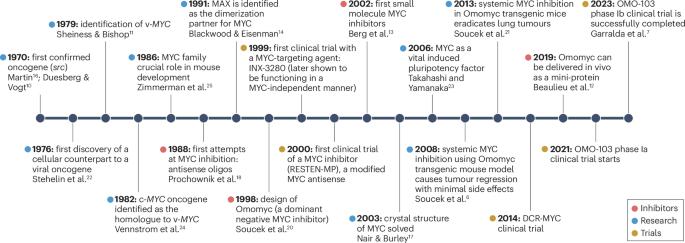
MYC is among the most infamous oncogenes in cancer. A notable feature that distinguishes it from other common oncogenes is that its deregulation is not usually due to direct mutation, but instead to its relentless activation by other oncogenic lesions. These signalling pathways funnel through MYC to execute the transcriptional programmes that eventually lead to the uncontrolled proliferation of cancer cells. Indeed, deregulated MYC activity may be linked to most — if not all — human cancers. Despite this unquestionable role of MYC in tumour development and maintenance, no MYC inhibitor has yet been approved for clinical use. The main reason is that MYC has long fallen into the category of ‘undruggable’ or ‘difficult-to-drug’ targets, mainly because of its intrinsically disordered structure, which is not amenable to traditional drug development strategies. However, in recent years, attempts to develop MYC inhibitors have multiplied, and the first clinical trials have been testing their efficacy in patients. We are finally reaching the point at which its inhibition seems clinically viable. This Review provides an overview of the various strategies to inhibit MYC, focusing on the most recently described inhibitors and those that have reached clinical trials. Oncogene MYC has been considered ‘undruggable’ for many decades. This Review provides an overview of the various strategies to inhibit MYC, focusing on the most recently described inhibitors and those that have reached clinical trials.
期刊介绍:
Nature Reviews Drug Discovery is a monthly journal aimed at everyone working in the drug discovery and development arena.
Each issue includes:
Highest-quality reviews and perspectives covering a broad scope.
News stories investigating the hottest topics in drug discovery.
Timely summaries of key primary research papers.
Concise updates on the latest advances in areas such as new drug approvals, patent law, and emerging industry trends and strategies.




 京公网安备 11010802042870号
京ICP备2023020795号-1
京公网安备 11010802042870号
京ICP备2023020795号-1

 分享
分享
 求助内容:
求助内容: 应助结果提醒方式:
 扫码关注我们
