M. Austin Argentieri, Najaf Amin, Alejo J. Nevado-Holgado, William Sproviero, Jennifer A. Collister, Sarai M. Keestra, Midas M. Kuilman, Bigina N. R. Ginos, Mohsen Ghanbari, Aiden Doherty, David J. Hunter, Alexandra Alvergne, Cornelia M. van Duijn
{"title":"Integrating the environmental and genetic architectures of aging and mortality","authors":"M. Austin Argentieri, Najaf Amin, Alejo J. Nevado-Holgado, William Sproviero, Jennifer A. Collister, Sarai M. Keestra, Midas M. Kuilman, Bigina N. R. Ginos, Mohsen Ghanbari, Aiden Doherty, David J. Hunter, Alexandra Alvergne, Cornelia M. van Duijn","doi":"10.1038/s41591-024-03483-9","DOIUrl":null,"url":null,"abstract":"Both environmental exposures and genetics are known to play important roles in shaping human aging. Here we aimed to quantify the relative contributions of environment (referred to as the exposome) and genetics to aging and premature mortality. To systematically identify environmental exposures associated with aging in the UK Biobank, we first conducted an exposome-wide analysis of all-cause mortality (n = 492,567) and then assessed the associations of these exposures with a proteomic age clock (n = 45,441), identifying 25 independent exposures associated with mortality and proteomic aging. These exposures were also associated with incident age-related multimorbidity, aging biomarkers and major disease risk factors. Compared with information on age and sex, polygenic risk scores for 22 major diseases explained less than 2 percentage points of additional mortality variation, whereas the exposome explained an additional 17 percentage points. Polygenic risk explained a greater proportion of variation (10.3–26.2%) compared with the exposome for incidence of dementias and breast, prostate and colorectal cancers, whereas the exposome explained a greater proportion of variation (5.5–49.4%) compared with polygenic risk for incidence of diseases of the lung, heart and liver. Our findings provide a comprehensive map of the contributions of environment and genetics to mortality and incidence of common age-related diseases, suggesting that the exposome shapes distinct patterns of disease and mortality risk, irrespective of polygenic disease risk. Based on a systematic analysis of environmental exposures associated with aging and mortality in the UK Biobank, the relative contributions of such exposures and genetic risk for mortality and a range of age-related diseases were compared, highlighting the potential beneficial effects of environment-focused interventions.","PeriodicalId":19037,"journal":{"name":"Nature Medicine","volume":"31 3","pages":"1016-1025"},"PeriodicalIF":50.0000,"publicationDate":"2025-02-19","publicationTypes":"Journal Article","fieldsOfStudy":null,"isOpenAccess":false,"openAccessPdf":"https://www.nature.com/articles/s41591-024-03483-9.pdf","citationCount":"0","resultStr":null,"platform":"Semanticscholar","paperid":null,"PeriodicalName":"Nature Medicine","FirstCategoryId":"3","ListUrlMain":"https://www.nature.com/articles/s41591-024-03483-9","RegionNum":1,"RegionCategory":"医学","ArticlePicture":[],"TitleCN":null,"AbstractTextCN":null,"PMCID":null,"EPubDate":"","PubModel":"","JCR":"Q1","JCRName":"BIOCHEMISTRY & MOLECULAR BIOLOGY","Score":null,"Total":0}
引用次数: 0
Abstract
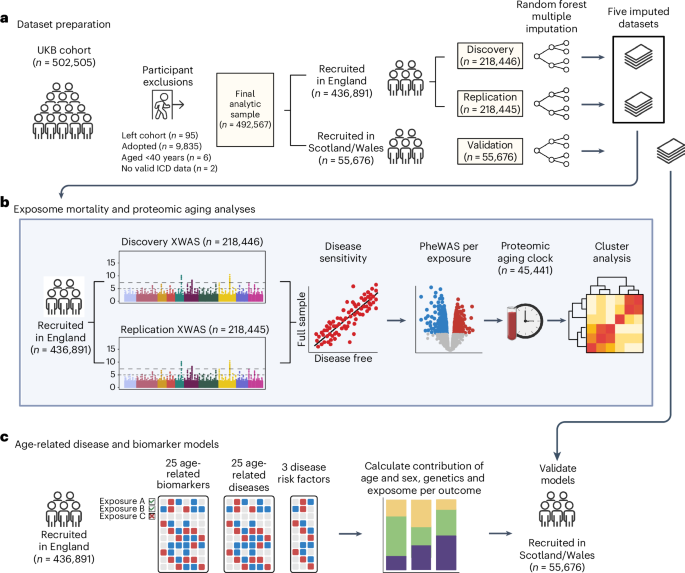
Both environmental exposures and genetics are known to play important roles in shaping human aging. Here we aimed to quantify the relative contributions of environment (referred to as the exposome) and genetics to aging and premature mortality. To systematically identify environmental exposures associated with aging in the UK Biobank, we first conducted an exposome-wide analysis of all-cause mortality (n = 492,567) and then assessed the associations of these exposures with a proteomic age clock (n = 45,441), identifying 25 independent exposures associated with mortality and proteomic aging. These exposures were also associated with incident age-related multimorbidity, aging biomarkers and major disease risk factors. Compared with information on age and sex, polygenic risk scores for 22 major diseases explained less than 2 percentage points of additional mortality variation, whereas the exposome explained an additional 17 percentage points. Polygenic risk explained a greater proportion of variation (10.3–26.2%) compared with the exposome for incidence of dementias and breast, prostate and colorectal cancers, whereas the exposome explained a greater proportion of variation (5.5–49.4%) compared with polygenic risk for incidence of diseases of the lung, heart and liver. Our findings provide a comprehensive map of the contributions of environment and genetics to mortality and incidence of common age-related diseases, suggesting that the exposome shapes distinct patterns of disease and mortality risk, irrespective of polygenic disease risk. Based on a systematic analysis of environmental exposures associated with aging and mortality in the UK Biobank, the relative contributions of such exposures and genetic risk for mortality and a range of age-related diseases were compared, highlighting the potential beneficial effects of environment-focused interventions.
期刊介绍:
Nature Medicine is a monthly journal publishing original peer-reviewed research in all areas of medicine. The publication focuses on originality, timeliness, interdisciplinary interest, and the impact on improving human health. In addition to research articles, Nature Medicine also publishes commissioned content such as News, Reviews, and Perspectives. This content aims to provide context for the latest advances in translational and clinical research, reaching a wide audience of M.D. and Ph.D. readers. All editorial decisions for the journal are made by a team of full-time professional editors.
Nature Medicine consider all types of clinical research, including:
-Case-reports and small case series
-Clinical trials, whether phase 1, 2, 3 or 4
-Observational studies
-Meta-analyses
-Biomarker studies
-Public and global health studies
Nature Medicine is also committed to facilitating communication between translational and clinical researchers. As such, we consider “hybrid” studies with preclinical and translational findings reported alongside data from clinical studies.




 京公网安备 11010802042870号
京ICP备2023020795号-1
京公网安备 11010802042870号
京ICP备2023020795号-1

 分享
分享
 求助内容:
求助内容: 应助结果提醒方式:
 扫码关注我们
