{"title":"The effects of disruptive technologies on accountability in fintech industry: Using bibliometric analysis to develop a research agenda","authors":"Silvana Secinaro , Federico Lanzalonga , Michele Oppioli , Elbano de Nuccio","doi":"10.1016/j.ribaf.2025.102816","DOIUrl":null,"url":null,"abstract":"<div><div>The fintech industry has fundamentally reshaped the financial landscape, driven by disruptive technologies such as blockchain and artificial intelligence, which have revolutionized big data analysis. These advancements empower users to bypass traditional intermediaries, achieving cost reductions and fostering safer, more efficient information and verification processes. However, the rapid evolution of fintech demands a deeper understanding of how accountability can be integrated into this transformative ecosystem. This research employs bibliometric analysis to synthesize existing knowledge on fintech and accountability-enabling technologies, exploring associated risks and opportunities. The study focuses on critical dimensions such as sustainability, governance, and innovative accounting approaches, illustrating how these technologies foster transparency and trust in financial systems. It also examines the interplay between fintech, ethical finance, and predictive technologies, emphasizing their role in forecasting financial, environmental, and social impacts. The findings highlight the importance of aligning disruptive technologies with global sustainability goals, including the Paris Climate Agreement and the SDGs, while addressing regulatory challenges. This research contributes by advancing theoretical insights into fintech’s accountability and providing practical recommendations for decision-makers and policymakers. By proposing strategies for regulatory frameworks and governance, this study underscores fintech’s transformative potential in enhancing transparency, trust, and accountability across the financial sector and beyond.</div></div>","PeriodicalId":51430,"journal":{"name":"Research in International Business and Finance","volume":"76 ","pages":"Article 102816"},"PeriodicalIF":6.9000,"publicationDate":"2025-04-01","publicationTypes":"Journal Article","fieldsOfStudy":null,"isOpenAccess":false,"openAccessPdf":"","citationCount":"0","resultStr":null,"platform":"Semanticscholar","paperid":null,"PeriodicalName":"Research in International Business and Finance","FirstCategoryId":"96","ListUrlMain":"https://www.sciencedirect.com/science/article/pii/S0275531925000728","RegionNum":2,"RegionCategory":"经济学","ArticlePicture":[],"TitleCN":null,"AbstractTextCN":null,"PMCID":null,"EPubDate":"2025/2/18 0:00:00","PubModel":"Epub","JCR":"Q1","JCRName":"BUSINESS, FINANCE","Score":null,"Total":0}
引用次数: 0
Abstract
The fintech industry has fundamentally reshaped the financial landscape, driven by disruptive technologies such as blockchain and artificial intelligence, which have revolutionized big data analysis. These advancements empower users to bypass traditional intermediaries, achieving cost reductions and fostering safer, more efficient information and verification processes. However, the rapid evolution of fintech demands a deeper understanding of how accountability can be integrated into this transformative ecosystem. This research employs bibliometric analysis to synthesize existing knowledge on fintech and accountability-enabling technologies, exploring associated risks and opportunities. The study focuses on critical dimensions such as sustainability, governance, and innovative accounting approaches, illustrating how these technologies foster transparency and trust in financial systems. It also examines the interplay between fintech, ethical finance, and predictive technologies, emphasizing their role in forecasting financial, environmental, and social impacts. The findings highlight the importance of aligning disruptive technologies with global sustainability goals, including the Paris Climate Agreement and the SDGs, while addressing regulatory challenges. This research contributes by advancing theoretical insights into fintech’s accountability and providing practical recommendations for decision-makers and policymakers. By proposing strategies for regulatory frameworks and governance, this study underscores fintech’s transformative potential in enhancing transparency, trust, and accountability across the financial sector and beyond.
期刊介绍:
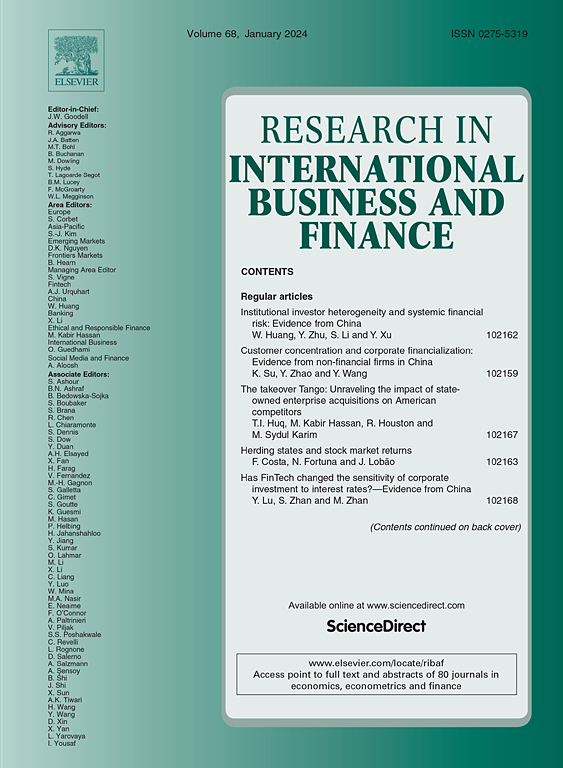
Research in International Business and Finance (RIBAF) seeks to consolidate its position as a premier scholarly vehicle of academic finance. The Journal publishes high quality, insightful, well-written papers that explore current and new issues in international finance. Papers that foster dialogue, innovation, and intellectual risk-taking in financial studies; as well as shed light on the interaction between finance and broader societal concerns are particularly appreciated. The Journal welcomes submissions that seek to expand the boundaries of academic finance and otherwise challenge the discipline. Papers studying finance using a variety of methodologies; as well as interdisciplinary studies will be considered for publication. Papers that examine topical issues using extensive international data sets are welcome. Single-country studies can also be considered for publication provided that they develop novel methodological and theoretical approaches or fall within the Journal''s priority themes. It is especially important that single-country studies communicate to the reader why the particular chosen country is especially relevant to the issue being investigated. [...] The scope of topics that are most interesting to RIBAF readers include the following: -Financial markets and institutions -Financial practices and sustainability -The impact of national culture on finance -The impact of formal and informal institutions on finance -Privatizations, public financing, and nonprofit issues in finance -Interdisciplinary financial studies -Finance and international development -International financial crises and regulation -Financialization studies -International financial integration and architecture -Behavioral aspects in finance -Consumer finance -Methodologies and conceptualization issues related to finance



 京公网安备 11010802042870号
京ICP备2023020795号-1
京公网安备 11010802042870号
京ICP备2023020795号-1

 分享
分享
 求助内容:
求助内容: 应助结果提醒方式:
 扫码关注我们
