{"title":"Exploring the Potential of Quantum Dot-Sensitized Solar Cells: Innovation and Insights","authors":"Jyoti Singh, Rakhi Thareja, Pragati Malik","doi":"10.1002/cphc.202400800","DOIUrl":null,"url":null,"abstract":"<p>Photovoltaic technologies have garnered significant attention towards generating renewable and clean energy from solar power. Quantum-dot-sensitized solar cells represent a promising third-generation photovoltaic technology that offers alternatives to conventional silicon-based solar cells due to their unique properties, their favourable optoelectronic properties for photovoltaic applications including simplified manufacturing, lower processing temperatures, enhanced flexibility, semi-transparent design, and a theoretical efficiency up to 44 %. The unique characteristic of tailoring the size and composition of quantum dots makes them valuable absorber materials capable of efficiently harnessing a broader range of the solar spectrum. The potential of quantum dot-sensitized solar cells to revolutionize the field of photovoltaic technology is a cause for optimism. However, the major limitation of the overall power conversion efficiency lies in their inability to absorb ultraviolet and near-infrared. Therefore, a photovoltaic technology that can effectively harness the entire solar spectrum becomes imperative. This review discusses the synthesis and light conversion mechanisms of these solar cells. Additionally, it offers an overview of the various advancements made in quantum dot-sensitized solar cells for enhancement in the efficiency of energy conversion. It focuses on the light-absorbing materials used, their efficiency, and the advantages and drawbacks of quantum dot solar cell technology.</p>","PeriodicalId":9819,"journal":{"name":"Chemphyschem","volume":"26 10","pages":""},"PeriodicalIF":2.2000,"publicationDate":"2025-02-18","publicationTypes":"Journal Article","fieldsOfStudy":null,"isOpenAccess":false,"openAccessPdf":"","citationCount":"0","resultStr":null,"platform":"Semanticscholar","paperid":null,"PeriodicalName":"Chemphyschem","FirstCategoryId":"92","ListUrlMain":"https://chemistry-europe.onlinelibrary.wiley.com/doi/10.1002/cphc.202400800","RegionNum":3,"RegionCategory":"化学","ArticlePicture":[],"TitleCN":null,"AbstractTextCN":null,"PMCID":null,"EPubDate":"","PubModel":"","JCR":"Q3","JCRName":"CHEMISTRY, PHYSICAL","Score":null,"Total":0}
引用次数: 0
Abstract
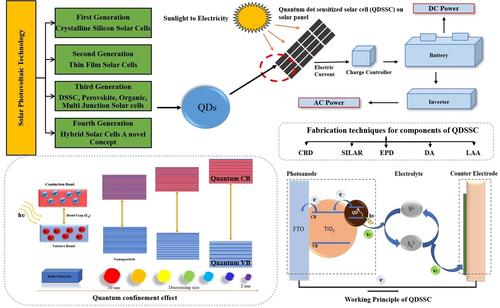
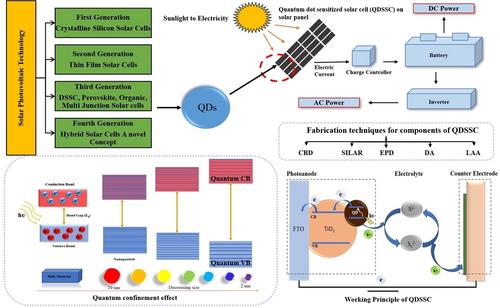
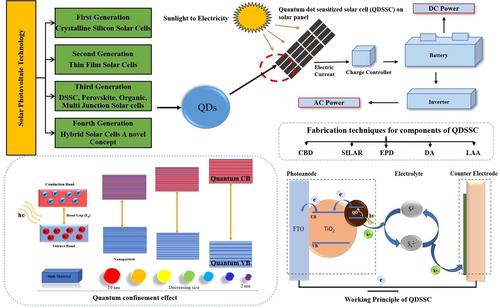
Photovoltaic technologies have garnered significant attention towards generating renewable and clean energy from solar power. Quantum-dot-sensitized solar cells represent a promising third-generation photovoltaic technology that offers alternatives to conventional silicon-based solar cells due to their unique properties, their favourable optoelectronic properties for photovoltaic applications including simplified manufacturing, lower processing temperatures, enhanced flexibility, semi-transparent design, and a theoretical efficiency up to 44 %. The unique characteristic of tailoring the size and composition of quantum dots makes them valuable absorber materials capable of efficiently harnessing a broader range of the solar spectrum. The potential of quantum dot-sensitized solar cells to revolutionize the field of photovoltaic technology is a cause for optimism. However, the major limitation of the overall power conversion efficiency lies in their inability to absorb ultraviolet and near-infrared. Therefore, a photovoltaic technology that can effectively harness the entire solar spectrum becomes imperative. This review discusses the synthesis and light conversion mechanisms of these solar cells. Additionally, it offers an overview of the various advancements made in quantum dot-sensitized solar cells for enhancement in the efficiency of energy conversion. It focuses on the light-absorbing materials used, their efficiency, and the advantages and drawbacks of quantum dot solar cell technology.
期刊介绍:
ChemPhysChem is one of the leading chemistry/physics interdisciplinary journals (ISI Impact Factor 2018: 3.077) for physical chemistry and chemical physics. It is published on behalf of Chemistry Europe, an association of 16 European chemical societies.
ChemPhysChem is an international source for important primary and critical secondary information across the whole field of physical chemistry and chemical physics. It integrates this wide and flourishing field ranging from Solid State and Soft-Matter Research, Electro- and Photochemistry, Femtochemistry and Nanotechnology, Complex Systems, Single-Molecule Research, Clusters and Colloids, Catalysis and Surface Science, Biophysics and Physical Biochemistry, Atmospheric and Environmental Chemistry, and many more topics. ChemPhysChem is peer-reviewed.




 京公网安备 11010802042870号
京ICP备2023020795号-1
京公网安备 11010802042870号
京ICP备2023020795号-1

 分享
分享
 求助内容:
求助内容: 应助结果提醒方式:
 扫码关注我们
