Significance of whole-blood EBV DNA status in T/NK-cell lymphoma-associated hemophagocytic lymphohistiocytosis: a single-center retrospective analysis.
Mengqi Xiong, Li Li, Lulu Wang, Lixia Zhu, Rongrong Chen, Jingsong He, Xiujin Ye
{"title":"Significance of whole-blood EBV DNA status in T/NK-cell lymphoma-associated hemophagocytic lymphohistiocytosis: a single-center retrospective analysis.","authors":"Mengqi Xiong, Li Li, Lulu Wang, Lixia Zhu, Rongrong Chen, Jingsong He, Xiujin Ye","doi":"10.1177/20406207251319604","DOIUrl":null,"url":null,"abstract":"<p><strong>Background: </strong>Hemophagocytic lymphohistiocytosis (HLH) is a severe hyperinflammatory condition often triggered by malignancies, especially T/NK-cell lymphoma-associated HLH (T/NK-LAHLH). Epstein-Barr virus (EBV) infection is strongly linked to T/NK-LAHLH and worsens prognosis. However, the prognostic value of whole-blood EBV DNA levels in T/NK-LAHLH remains unclear, necessitating further investigation to improve risk assessment and treatment strategies.</p><p><strong>Objective: </strong>To investigate the clinical characteristics and prognostic significance of whole-blood EBV DNA status in patients with T/NK-LAHLH.</p><p><strong>Design: </strong>A single-center, retrospective study was conducted, including 85 patients diagnosed with T/NK-LAHLH between January 2017 and August 2022. Patients were categorized based on EBV DNA status, and clinical outcomes were compared.</p><p><strong>Methods: </strong>EBV DNA levels were quantified using polymerase chain reaction (PCR) assays. Kaplan-Meier survival and Cox regression models to assess overall survival (OS) and identify independent prognostic factors.</p><p><strong>Results: </strong>A total of 85 T/NK-LAHLH patients were included, with a median age of 52 years (range: 18-81 years) and 60% male. The OS rates at 1, 3, 6, and 12 months were 66.6%, 49.8%, 33.8%, and 28.4%, respectively. Among these patients, 67 (78.8%) were EBV DNA-positive, while 18 (21.2%) were EBV DNA negative. EBV DNA-positive patients exhibited significantly lower platelet and globulin levels, higher IL-10 levels, and prolonged activated partial thromboplastin time compared to EBV DNA-negative patients (<i>p</i> < 0.05). The 6-month OS rate was significantly lower in EBV DNA-positive patients compared to EBV DNA-negative patients (22.5% vs 75.1%, <i>p</i> < 0.001). Multivariate analysis identified EBV DNA positivity as an independent risk factor for shorter 6-month OS (hazard ratio (HR): 4.715; 95% CI: 1.662-13.377; <i>p</i> = 0.004). Among the four patients who underwent allogeneic hematopoietic stem cell transplantation, all achieved complete remission and remained alive at the last follow-up.</p><p><strong>Conclusion: </strong>Whole-blood EBV DNA positivity is a significant prognostic factor for poor outcomes in T/NK-LAHLH patients. These findings highlight the need for incorporating EBV DNA monitoring into clinical management and further research to refine therapeutic strategies.</p>","PeriodicalId":23048,"journal":{"name":"Therapeutic Advances in Hematology","volume":"16 ","pages":"20406207251319604"},"PeriodicalIF":3.1000,"publicationDate":"2025-02-17","publicationTypes":"Journal Article","fieldsOfStudy":null,"isOpenAccess":false,"openAccessPdf":"https://www.ncbi.nlm.nih.gov/pmc/articles/PMC11833809/pdf/","citationCount":"0","resultStr":null,"platform":"Semanticscholar","paperid":null,"PeriodicalName":"Therapeutic Advances in Hematology","FirstCategoryId":"3","ListUrlMain":"https://doi.org/10.1177/20406207251319604","RegionNum":3,"RegionCategory":"医学","ArticlePicture":[],"TitleCN":null,"AbstractTextCN":null,"PMCID":null,"EPubDate":"2025/1/1 0:00:00","PubModel":"eCollection","JCR":"Q2","JCRName":"HEMATOLOGY","Score":null,"Total":0}
引用次数: 0
Abstract
Background: Hemophagocytic lymphohistiocytosis (HLH) is a severe hyperinflammatory condition often triggered by malignancies, especially T/NK-cell lymphoma-associated HLH (T/NK-LAHLH). Epstein-Barr virus (EBV) infection is strongly linked to T/NK-LAHLH and worsens prognosis. However, the prognostic value of whole-blood EBV DNA levels in T/NK-LAHLH remains unclear, necessitating further investigation to improve risk assessment and treatment strategies.
Objective: To investigate the clinical characteristics and prognostic significance of whole-blood EBV DNA status in patients with T/NK-LAHLH.
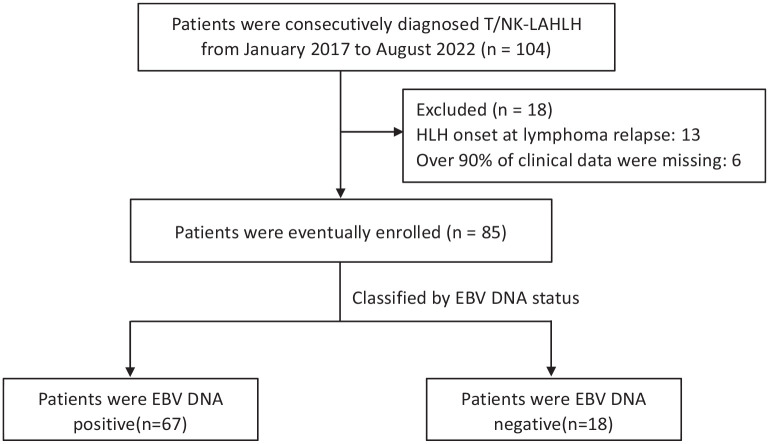
Design: A single-center, retrospective study was conducted, including 85 patients diagnosed with T/NK-LAHLH between January 2017 and August 2022. Patients were categorized based on EBV DNA status, and clinical outcomes were compared.
Methods: EBV DNA levels were quantified using polymerase chain reaction (PCR) assays. Kaplan-Meier survival and Cox regression models to assess overall survival (OS) and identify independent prognostic factors.
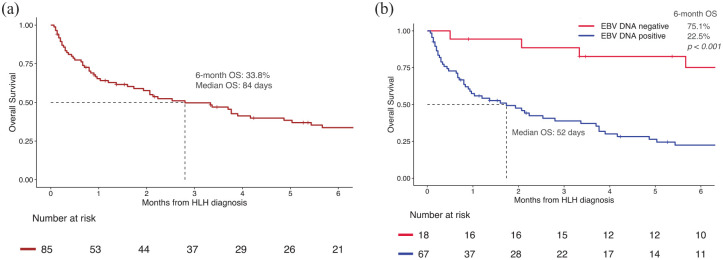
Results: A total of 85 T/NK-LAHLH patients were included, with a median age of 52 years (range: 18-81 years) and 60% male. The OS rates at 1, 3, 6, and 12 months were 66.6%, 49.8%, 33.8%, and 28.4%, respectively. Among these patients, 67 (78.8%) were EBV DNA-positive, while 18 (21.2%) were EBV DNA negative. EBV DNA-positive patients exhibited significantly lower platelet and globulin levels, higher IL-10 levels, and prolonged activated partial thromboplastin time compared to EBV DNA-negative patients (p < 0.05). The 6-month OS rate was significantly lower in EBV DNA-positive patients compared to EBV DNA-negative patients (22.5% vs 75.1%, p < 0.001). Multivariate analysis identified EBV DNA positivity as an independent risk factor for shorter 6-month OS (hazard ratio (HR): 4.715; 95% CI: 1.662-13.377; p = 0.004). Among the four patients who underwent allogeneic hematopoietic stem cell transplantation, all achieved complete remission and remained alive at the last follow-up.
Conclusion: Whole-blood EBV DNA positivity is a significant prognostic factor for poor outcomes in T/NK-LAHLH patients. These findings highlight the need for incorporating EBV DNA monitoring into clinical management and further research to refine therapeutic strategies.
期刊介绍:
Therapeutic Advances in Hematology delivers the highest quality peer-reviewed articles, reviews, and scholarly comment on pioneering efforts and innovative studies across all areas of hematology. The journal has a strong clinical and pharmacological focus and is aimed at clinicians and researchers in hematology, providing a forum in print and online for publishing the highest quality articles in this area.




 京公网安备 11010802042870号
京ICP备2023020795号-1
京公网安备 11010802042870号
京ICP备2023020795号-1

 分享
分享
 求助内容:
求助内容: 应助结果提醒方式:
 扫码关注我们
