Y B Liu, W W Du, Q Y Cao, H J Wang, C Su, Y N He, J G Ji, J Li, X F Jia
{"title":"[Association between dietary choline intake trajectories and cognitive function in middle-aged and older population].","authors":"Y B Liu, W W Du, Q Y Cao, H J Wang, C Su, Y N He, J G Ji, J Li, X F Jia","doi":"10.3760/cma.j.cn112338-20240906-00559","DOIUrl":null,"url":null,"abstract":"<p><p><b>Objective:</b> To identify the trajectories of dietary choline intake in middle-aged and older population, and to analyze its longitudinal association with cognitive function. <b>Methods:</b> Subjects aged 55 to 79 years with at least two rounds of completed population economics, lifestyle, disease history, cognitive function, dietary assessments and physical measurements in 1997-2018 and those with at least three rounds of dietary measures in 1991-2015 were selected from the China Health and Nutrition Survey. Dietary survey was conducted using three consecutive 24-hour dietary recalls combined with a weighing inventory at the household level. Cognitive assessment was performed using part of the Telephone Interview for Cognitive Status Scale. Group-based univariate trajectory modeling was used to identify trajectory of choline intake, and three-level linear mixed-effects models or three-level logistic mixed-effects models was employed to analyze the relationship between trajectory groups and cognitive function. Subgroup analyses were conducted by gender and age at baseline. <b>Results:</b> Four trajectories of dietary choline intake were identified in the whole population, named as low-intake-stable group (61.0%), medium-intake-stable group (23.9%), medium-intake-slowly-declined group (11.2%), and high-intake-stable group (3.9%). Three trajectories were identified for each subgroup. Low-intake-stable group accounted for more than 60% in total population as well as each subgroup, especially in women and 55-59 years group. After adjusting for covariates, global cognitive scores were 0.54 (95%<i>CI</i>: 0.26-0.82), 0.77 (95%<i>CI</i>: 0.36-1.18), and 0.85 (95%<i>CI</i>: 0.21-1.48) points higher in medium-intake-stable, medium-intake- slowly-declined and high-intake-stable groups in the whole population, respectively, compared with the low-intake-stable group. The likelihoods of cognitive decline were 18.4% (<i>OR</i>=0.816,95%<i>CI</i>: 0.709-0.939), 17.6% (<i>OR</i>=0.824, 95%<i>CI</i>: 0.680-0.998), 24.4% (<i>OR</i>=0.756, 95%<i>CI</i>: 0.589-0.970) and 22.4% (<i>OR</i>=0.776,95%<i>CI</i>: 0.623-0.968) lower in medium-intake-stable group of dietary choline in the whole population, medium-intake-stable group in males, medium-intake-slightly-increased group in females and medium-intake-slowly-increased group in 55-59 years at baseline than in low-intake-stable group, respectively. <b>Conclusions:</b> Dietary choline intake is generally lower in the Chinese population aged 55-79 years. Long-term lower choline intake has a negative impact on cognitive function in middle-aged and older adults and may increase the risk of cognitive decline. The increment in the consumption of choline-enriched foods should be recommended.</p>","PeriodicalId":23968,"journal":{"name":"中华流行病学杂志","volume":"46 2","pages":"210-217"},"PeriodicalIF":0.0000,"publicationDate":"2025-02-10","publicationTypes":"Journal Article","fieldsOfStudy":null,"isOpenAccess":false,"openAccessPdf":"","citationCount":"0","resultStr":null,"platform":"Semanticscholar","paperid":null,"PeriodicalName":"中华流行病学杂志","FirstCategoryId":"3","ListUrlMain":"https://doi.org/10.3760/cma.j.cn112338-20240906-00559","RegionNum":0,"RegionCategory":null,"ArticlePicture":[],"TitleCN":null,"AbstractTextCN":null,"PMCID":null,"EPubDate":"","PubModel":"","JCR":"Q1","JCRName":"Medicine","Score":null,"Total":0}
引用次数: 0
Abstract
Objective: To identify the trajectories of dietary choline intake in middle-aged and older population, and to analyze its longitudinal association with cognitive function. Methods: Subjects aged 55 to 79 years with at least two rounds of completed population economics, lifestyle, disease history, cognitive function, dietary assessments and physical measurements in 1997-2018 and those with at least three rounds of dietary measures in 1991-2015 were selected from the China Health and Nutrition Survey. Dietary survey was conducted using three consecutive 24-hour dietary recalls combined with a weighing inventory at the household level. Cognitive assessment was performed using part of the Telephone Interview for Cognitive Status Scale. Group-based univariate trajectory modeling was used to identify trajectory of choline intake, and three-level linear mixed-effects models or three-level logistic mixed-effects models was employed to analyze the relationship between trajectory groups and cognitive function. Subgroup analyses were conducted by gender and age at baseline. Results: Four trajectories of dietary choline intake were identified in the whole population, named as low-intake-stable group (61.0%), medium-intake-stable group (23.9%), medium-intake-slowly-declined group (11.2%), and high-intake-stable group (3.9%). Three trajectories were identified for each subgroup. Low-intake-stable group accounted for more than 60% in total population as well as each subgroup, especially in women and 55-59 years group. After adjusting for covariates, global cognitive scores were 0.54 (95%CI: 0.26-0.82), 0.77 (95%CI: 0.36-1.18), and 0.85 (95%CI: 0.21-1.48) points higher in medium-intake-stable, medium-intake- slowly-declined and high-intake-stable groups in the whole population, respectively, compared with the low-intake-stable group. The likelihoods of cognitive decline were 18.4% (OR=0.816,95%CI: 0.709-0.939), 17.6% (OR=0.824, 95%CI: 0.680-0.998), 24.4% (OR=0.756, 95%CI: 0.589-0.970) and 22.4% (OR=0.776,95%CI: 0.623-0.968) lower in medium-intake-stable group of dietary choline in the whole population, medium-intake-stable group in males, medium-intake-slightly-increased group in females and medium-intake-slowly-increased group in 55-59 years at baseline than in low-intake-stable group, respectively. Conclusions: Dietary choline intake is generally lower in the Chinese population aged 55-79 years. Long-term lower choline intake has a negative impact on cognitive function in middle-aged and older adults and may increase the risk of cognitive decline. The increment in the consumption of choline-enriched foods should be recommended.
期刊介绍:
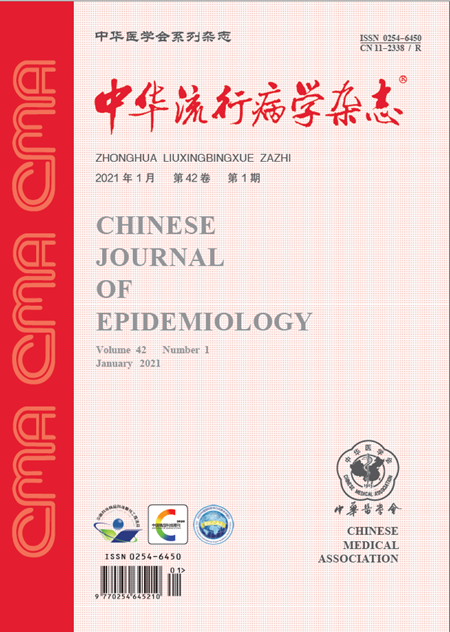
Chinese Journal of Epidemiology, established in 1981, is an advanced academic periodical in epidemiology and related disciplines in China, which, according to the principle of integrating theory with practice, mainly reports the major progress in epidemiological research. The columns of the journal include commentary, expert forum, original article, field investigation, disease surveillance, laboratory research, clinical epidemiology, basic theory or method and review, etc.
The journal is included by more than ten major biomedical databases and index systems worldwide, such as been indexed in Scopus, PubMed/MEDLINE, PubMed Central (PMC), Europe PubMed Central, Embase, Chemical Abstract, Chinese Science and Technology Paper and Citation Database (CSTPCD), Chinese core journal essentials overview, Chinese Science Citation Database (CSCD) core database, Chinese Biological Medical Disc (CBMdisc), and Chinese Medical Citation Index (CMCI), etc. It is one of the core academic journals and carefully selected core journals in preventive and basic medicine in China.



 京公网安备 11010802042870号
京ICP备2023020795号-1
京公网安备 11010802042870号
京ICP备2023020795号-1

 分享
分享
 求助内容:
求助内容: 应助结果提醒方式:
 扫码关注我们
