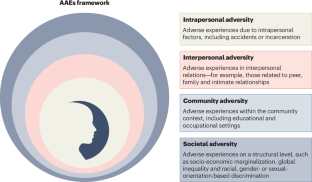
{"title":"A framework for understanding adverse adolescent experiences","authors":"A. Pollmann, K. E. Bates, D. Fuhrmann","doi":"10.1038/s41562-024-02098-x","DOIUrl":null,"url":null,"abstract":"Adolescence (ages 10–24) is characterized by cognitive, behavioural and social development. Childhood environments are typically centred on home and care settings, whereas adolescents increasingly engage with peer and community environments. These changing environments confer risks of experiencing specific adversities at different ages. Despite the unique characteristics of adversities in adolescence and potential associations with lifespan outcomes, few frameworks exist to systematize adversities in adolescents. Here we review current research and propose an approach specific to this developmental period: the adverse adolescent experiences (AAEs) framework. Building on existing models (for example, the adverse childhood experiences framework), the AAEs focus on potentially traumatizing experiences during adolescence. The framework builds on Bronfenbrenner’s ecological systems theory to conceptualize adversities at intrapersonal, interpersonal, community and societal levels. We argue that this approach can enhance our understanding of adolescent adversity, facilitate the study of its potential effects, and guide prevention and intervention efforts. Adolescence (ages 10–24) is characterized by cognitive, behavioural and social development. This Review proposes the adverse adolescent experiences (AAEs) framework to categorize and examine potentially traumatizing experiences during this developmental period.","PeriodicalId":19074,"journal":{"name":"Nature Human Behaviour","volume":"9 3","pages":"450-463"},"PeriodicalIF":15.9000,"publicationDate":"2025-02-20","publicationTypes":"Journal Article","fieldsOfStudy":null,"isOpenAccess":false,"openAccessPdf":"","citationCount":"0","resultStr":null,"platform":"Semanticscholar","paperid":null,"PeriodicalName":"Nature Human Behaviour","FirstCategoryId":"102","ListUrlMain":"https://www.nature.com/articles/s41562-024-02098-x","RegionNum":1,"RegionCategory":"心理学","ArticlePicture":[],"TitleCN":null,"AbstractTextCN":null,"PMCID":null,"EPubDate":"","PubModel":"","JCR":"Q1","JCRName":"MULTIDISCIPLINARY SCIENCES","Score":null,"Total":0}
引用次数: 0
Abstract
Adolescence (ages 10–24) is characterized by cognitive, behavioural and social development. Childhood environments are typically centred on home and care settings, whereas adolescents increasingly engage with peer and community environments. These changing environments confer risks of experiencing specific adversities at different ages. Despite the unique characteristics of adversities in adolescence and potential associations with lifespan outcomes, few frameworks exist to systematize adversities in adolescents. Here we review current research and propose an approach specific to this developmental period: the adverse adolescent experiences (AAEs) framework. Building on existing models (for example, the adverse childhood experiences framework), the AAEs focus on potentially traumatizing experiences during adolescence. The framework builds on Bronfenbrenner’s ecological systems theory to conceptualize adversities at intrapersonal, interpersonal, community and societal levels. We argue that this approach can enhance our understanding of adolescent adversity, facilitate the study of its potential effects, and guide prevention and intervention efforts. Adolescence (ages 10–24) is characterized by cognitive, behavioural and social development. This Review proposes the adverse adolescent experiences (AAEs) framework to categorize and examine potentially traumatizing experiences during this developmental period.
期刊介绍:
Nature Human Behaviour is a journal that focuses on publishing research of outstanding significance into any aspect of human behavior.The research can cover various areas such as psychological, biological, and social bases of human behavior.It also includes the study of origins, development, and disorders related to human behavior.The primary aim of the journal is to increase the visibility of research in the field and enhance its societal reach and impact.





 京公网安备 11010802042870号
京ICP备2023020795号-1
京公网安备 11010802042870号
京ICP备2023020795号-1

 分享
分享
 求助内容:
求助内容: 应助结果提醒方式:
 扫码关注我们
