{"title":"Cushion plants as soil engineers: the formation of islands of fertility differ between species in nival environments","authors":"Keyvan Dumas, Nicolas Bonfanti, Aurélien Grange, Annie Millery-Vigues, Christiane Gallet, Glenn Yannic, Jérome Poulenard, Sébastien Lavergne, Sébastien Ibanez","doi":"10.1007/s11104-025-07274-0","DOIUrl":null,"url":null,"abstract":"<h3 data-test=\"abstract-sub-heading\">Aims</h3><p>In extreme environments such as the nival vegetation belt, isolated cushion plants create islands of soil fertility within a mostly mineral environment. It, however, remains unknown whether different co-occurring cushion plant species engineer soils with contrasted properties, and to what extent plant functional traits mediate this process.</p><h3 data-test=\"abstract-sub-heading\">Methods</h3><p>We sampled 117 individual cushions from seven species, together with 26 bare soil controls from 2600 to 3200m of elevation. Soil property (carbon and nitrogen content, soil C:N and available phosphorus) were compared between species, and the role of cushion plant traits was assessed using Structural Equation Modelling (SEM).</p><h3 data-test=\"abstract-sub-heading\">Results</h3><p>The soils beneath cushion plants showed similar characteristics to those found 1000m below, where vegetation is continuously distributed. Isotopic signatures showed that the soil organic matter beneath cushions originated from the plant itself. Soil characteristics (C, N, C:N, P) differed among plant species. SEM revealed that soil characteristics were not driven by leaf C/N or phenolic content, but rather by cushion size and bedrock type.</p><h3 data-test=\"abstract-sub-heading\">Conclusions</h3><p>Providing a unique overview of soil formation in nival ecosystems, our study provides novel insights into the mechanisms of ecosystem engineering by foundation plants and shows how interspecific variability contributes to this process.</p>","PeriodicalId":20223,"journal":{"name":"Plant and Soil","volume":"81 1","pages":""},"PeriodicalIF":4.1000,"publicationDate":"2025-02-20","publicationTypes":"Journal Article","fieldsOfStudy":null,"isOpenAccess":false,"openAccessPdf":"","citationCount":"0","resultStr":null,"platform":"Semanticscholar","paperid":null,"PeriodicalName":"Plant and Soil","FirstCategoryId":"97","ListUrlMain":"https://doi.org/10.1007/s11104-025-07274-0","RegionNum":2,"RegionCategory":"农林科学","ArticlePicture":[],"TitleCN":null,"AbstractTextCN":null,"PMCID":null,"EPubDate":"","PubModel":"","JCR":"Q1","JCRName":"AGRONOMY","Score":null,"Total":0}
引用次数: 0
Abstract
Aims
In extreme environments such as the nival vegetation belt, isolated cushion plants create islands of soil fertility within a mostly mineral environment. It, however, remains unknown whether different co-occurring cushion plant species engineer soils with contrasted properties, and to what extent plant functional traits mediate this process.
Methods
We sampled 117 individual cushions from seven species, together with 26 bare soil controls from 2600 to 3200m of elevation. Soil property (carbon and nitrogen content, soil C:N and available phosphorus) were compared between species, and the role of cushion plant traits was assessed using Structural Equation Modelling (SEM).
Results
The soils beneath cushion plants showed similar characteristics to those found 1000m below, where vegetation is continuously distributed. Isotopic signatures showed that the soil organic matter beneath cushions originated from the plant itself. Soil characteristics (C, N, C:N, P) differed among plant species. SEM revealed that soil characteristics were not driven by leaf C/N or phenolic content, but rather by cushion size and bedrock type.
Conclusions
Providing a unique overview of soil formation in nival ecosystems, our study provides novel insights into the mechanisms of ecosystem engineering by foundation plants and shows how interspecific variability contributes to this process.
期刊介绍:
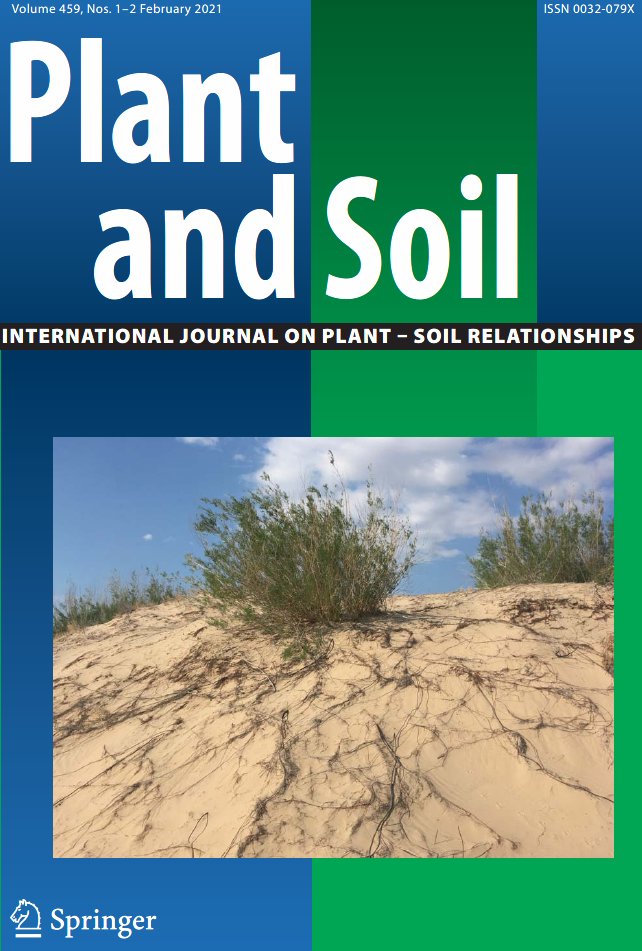
Plant and Soil publishes original papers and review articles exploring the interface of plant biology and soil sciences, and that enhance our mechanistic understanding of plant-soil interactions. We focus on the interface of plant biology and soil sciences, and seek those manuscripts with a strong mechanistic component which develop and test hypotheses aimed at understanding underlying mechanisms of plant-soil interactions. Manuscripts can include both fundamental and applied aspects of mineral nutrition, plant water relations, symbiotic and pathogenic plant-microbe interactions, root anatomy and morphology, soil biology, ecology, agrochemistry and agrophysics, as long as they are hypothesis-driven and enhance our mechanistic understanding. Articles including a major molecular or modelling component also fall within the scope of the journal. All contributions appear in the English language, with consistent spelling, using either American or British English.




 京公网安备 11010802042870号
京ICP备2023020795号-1
京公网安备 11010802042870号
京ICP备2023020795号-1

 分享
分享
 求助内容:
求助内容: 应助结果提醒方式:
 扫码关注我们
