{"title":"Community estimate of global glacier mass changes from 2000 to 2023","authors":"The GlaMBIE Team","doi":"10.1038/s41586-024-08545-z","DOIUrl":null,"url":null,"abstract":"Glaciers are indicators of ongoing anthropogenic climate change1. Their melting leads to increased local geohazards2, and impacts marine3 and terrestrial4,5 ecosystems, regional freshwater resources6, and both global water and energy cycles7,8. Together with the Greenland and Antarctic ice sheets, glaciers are essential drivers of present9,10 and future11–13 sea-level rise. Previous assessments of global glacier mass changes have been hampered by spatial and temporal limitations and the heterogeneity of existing data series14–16. Here we show in an intercomparison exercise that glaciers worldwide lost 273 ± 16 gigatonnes in mass annually from 2000 to 2023, with an increase of 36 ± 10% from the first (2000–2011) to the second (2012–2023) half of the period. Since 2000, glaciers have lost between 2% and 39% of their ice regionally and about 5% globally. Glacier mass loss is about 18% larger than the loss from the Greenland Ice Sheet and more than twice that from the Antarctic Ice Sheet17. Our results arise from a scientific community effort to collect, homogenize, combine and analyse glacier mass changes from in situ and remote-sensing observations. Although our estimates are in agreement with findings from previous assessments14–16 at a global scale, we found some large regional deviations owing to systematic differences among observation methods. Our results provide a refined baseline for better understanding observational differences and for calibrating model ensembles12,16,18, which will help to narrow projection uncertainty for the twenty-first century11,12,18. An intercomparison exercise reassesses mass loss from glaciers worldwide based on the main in situ and satellite methods from 2000 to 2023; the results are consistent with previous assessments and provide a refined and comprehensive observational baseline for future impact and modelling studies.","PeriodicalId":18787,"journal":{"name":"Nature","volume":"639 8054","pages":"382-388"},"PeriodicalIF":48.5000,"publicationDate":"2025-02-19","publicationTypes":"Journal Article","fieldsOfStudy":null,"isOpenAccess":false,"openAccessPdf":"https://www.nature.com/articles/s41586-024-08545-z.pdf","citationCount":"0","resultStr":null,"platform":"Semanticscholar","paperid":null,"PeriodicalName":"Nature","FirstCategoryId":"103","ListUrlMain":"https://www.nature.com/articles/s41586-024-08545-z","RegionNum":1,"RegionCategory":"综合性期刊","ArticlePicture":[],"TitleCN":null,"AbstractTextCN":null,"PMCID":null,"EPubDate":"","PubModel":"","JCR":"Q1","JCRName":"MULTIDISCIPLINARY SCIENCES","Score":null,"Total":0}
引用次数: 0
Abstract
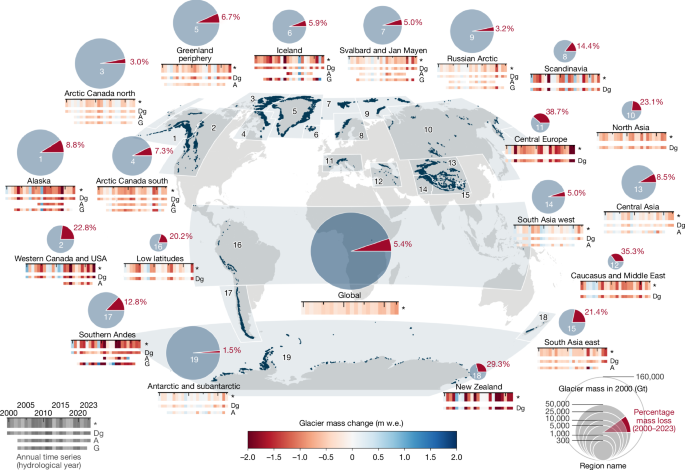
Glaciers are indicators of ongoing anthropogenic climate change1. Their melting leads to increased local geohazards2, and impacts marine3 and terrestrial4,5 ecosystems, regional freshwater resources6, and both global water and energy cycles7,8. Together with the Greenland and Antarctic ice sheets, glaciers are essential drivers of present9,10 and future11–13 sea-level rise. Previous assessments of global glacier mass changes have been hampered by spatial and temporal limitations and the heterogeneity of existing data series14–16. Here we show in an intercomparison exercise that glaciers worldwide lost 273 ± 16 gigatonnes in mass annually from 2000 to 2023, with an increase of 36 ± 10% from the first (2000–2011) to the second (2012–2023) half of the period. Since 2000, glaciers have lost between 2% and 39% of their ice regionally and about 5% globally. Glacier mass loss is about 18% larger than the loss from the Greenland Ice Sheet and more than twice that from the Antarctic Ice Sheet17. Our results arise from a scientific community effort to collect, homogenize, combine and analyse glacier mass changes from in situ and remote-sensing observations. Although our estimates are in agreement with findings from previous assessments14–16 at a global scale, we found some large regional deviations owing to systematic differences among observation methods. Our results provide a refined baseline for better understanding observational differences and for calibrating model ensembles12,16,18, which will help to narrow projection uncertainty for the twenty-first century11,12,18. An intercomparison exercise reassesses mass loss from glaciers worldwide based on the main in situ and satellite methods from 2000 to 2023; the results are consistent with previous assessments and provide a refined and comprehensive observational baseline for future impact and modelling studies.
期刊介绍:
Nature is a prestigious international journal that publishes peer-reviewed research in various scientific and technological fields. The selection of articles is based on criteria such as originality, importance, interdisciplinary relevance, timeliness, accessibility, elegance, and surprising conclusions. In addition to showcasing significant scientific advances, Nature delivers rapid, authoritative, insightful news, and interpretation of current and upcoming trends impacting science, scientists, and the broader public. The journal serves a dual purpose: firstly, to promptly share noteworthy scientific advances and foster discussions among scientists, and secondly, to ensure the swift dissemination of scientific results globally, emphasizing their significance for knowledge, culture, and daily life.




 京公网安备 11010802042870号
京ICP备2023020795号-1
京公网安备 11010802042870号
京ICP备2023020795号-1

 分享
分享
 求助内容:
求助内容: 应助结果提醒方式:
 扫码关注我们
