Laura Salazar-Remigio , Guadalupe Ponce-Vélez , Hugo F. Olivares-Rubio , Omar Amador-Muñoz , Antonio Z. Márquez-García , Jorge Feliciano Ontiveros-Cuadras
{"title":"Bisphenol and phthalate levels, sources, and hazard estimation in sediments from a reef system: First study in the southern Gulf of Mexico","authors":"Laura Salazar-Remigio , Guadalupe Ponce-Vélez , Hugo F. Olivares-Rubio , Omar Amador-Muñoz , Antonio Z. Márquez-García , Jorge Feliciano Ontiveros-Cuadras","doi":"10.1016/j.envpol.2025.125888","DOIUrl":null,"url":null,"abstract":"<div><div>Bisphenols (BPs) and phthalate acid esters (PAEs) are emerging pollutants (EPs) associated with plastic pollution, as they are used in manufacturing processes and easily separated from these msaterials, accumulating in the sediments of coastal and marine ecosystems. This is the first report of the concentrations of BPs and PAEs in surface and trap sediments from a Protected Natural Area (PNA) of great biological, tourist, and economic importance in the southern Gulf of Mexico (GoM), the Veracruz Reef System National Park (VRSNP). ΣBPs in surface sediments were between 7.0 × 10<sup>−2</sup> and 1.35 ng g<sup>−1</sup>, for ΣPAEs from 0.18 to 4.59 × 10<sup>3</sup> ng g<sup>−1</sup>, while in the trap sediments, the ΣPAEs were between 0.12 and 3.17 × 10<sup>3</sup> ng g<sup>−1</sup>. Plasticizer bisphenol A (BPA) showed the highest concentration (0.66 ng g<sup>−1</sup>), whereas di-butyl phthalate (DBP) for PAEs (2.58 × 10<sup>3</sup> ng g<sup>−1</sup>). PAEs were strongly associated with terrigenous sources, while BPs with urban and port activities. The ecotoxicological hazard was estimated from the sediments, where BPs had a low hazard level, and PAEs presented a moderate to high hazard level for the reef benthos, reflecting the enormous anthropogenic pressures on the VRSNP. This study contributes with the first scientifically and technically reliable records of EPs, necessary to influence the definition of effective strategies for coastal management and territorial planning of the basins that directly influence chemical pollution. These efforts are crucial for mitigating risk to biodiversity and ensuring the conservation of this PNA in the southern GoM.</div></div>","PeriodicalId":311,"journal":{"name":"Environmental Pollution","volume":"370 ","pages":"Article 125888"},"PeriodicalIF":7.3000,"publicationDate":"2025-04-01","publicationTypes":"Journal Article","fieldsOfStudy":null,"isOpenAccess":false,"openAccessPdf":"","citationCount":"0","resultStr":null,"platform":"Semanticscholar","paperid":null,"PeriodicalName":"Environmental Pollution","FirstCategoryId":"93","ListUrlMain":"https://www.sciencedirect.com/science/article/pii/S0269749125002611","RegionNum":2,"RegionCategory":"环境科学与生态学","ArticlePicture":[],"TitleCN":null,"AbstractTextCN":null,"PMCID":null,"EPubDate":"2025/2/20 0:00:00","PubModel":"Epub","JCR":"Q1","JCRName":"ENVIRONMENTAL SCIENCES","Score":null,"Total":0}
引用次数: 0
Abstract
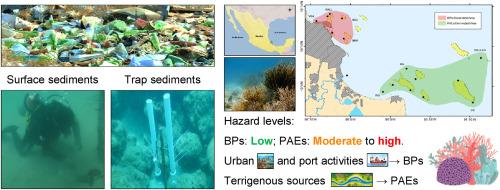
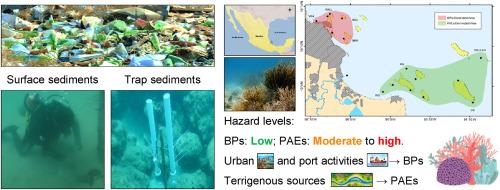
Bisphenols (BPs) and phthalate acid esters (PAEs) are emerging pollutants (EPs) associated with plastic pollution, as they are used in manufacturing processes and easily separated from these msaterials, accumulating in the sediments of coastal and marine ecosystems. This is the first report of the concentrations of BPs and PAEs in surface and trap sediments from a Protected Natural Area (PNA) of great biological, tourist, and economic importance in the southern Gulf of Mexico (GoM), the Veracruz Reef System National Park (VRSNP). ΣBPs in surface sediments were between 7.0 × 10⁻² and 1.35 ng g−1, for ΣPAEs from 0.18 to 4.59 × 10³ ng g−1, while in the trap sediments, the ΣPAEs were between 0.12 and 3.17 × 10³ ng g−1. Plasticizer bisphenol A (BPA) showed the highest concentration (0.66 ng g−1), whereas di-butyl phthalate (DBP) for PAEs (2.58 × 10³ ng g−1). PAEs were strongly associated with terrigenous sources, while BPs with urban and port activities. The ecotoxicological hazard was estimated from the sediments, where BPs had a low hazard level, and PAEs presented a moderate to high hazard level for the reef benthos, reflecting the enormous anthropogenic pressures on the VRSNP. This study contributes with the first scientifically and technically reliable records of EPs, necessary to influence the definition of effective strategies for coastal management and territorial planning of the basins that directly influence chemical pollution. These efforts are crucial for mitigating risk to biodiversity and ensuring the conservation of this PNA in the southern GoM.
双酚(bp)和邻苯二甲酸酯(PAEs)是与塑料污染相关的新兴污染物(EPs),因为它们在制造过程中被使用,很容易从这些物质中分离出来,积聚在沿海和海洋生态系统的沉积物中。这是关于墨西哥湾南部韦拉克鲁斯珊瑚礁系统国家公园(VRSNP)自然保护区(PNA)表层沉积物中bp和PAEs浓度的第一份报告,该保护区具有重要的生物、旅游和经济意义。表层沉积物中ΣBPs在7.0×10⁻² ~ 1.35 ng g-1之间,ΣPAEs在0.18 ~ 4.59×10³ ng g-1之间,圈闭沉积物中ΣPAEs在0.12 ~ 3.17×10³ ng g-1之间。增塑剂双酚A (BPA)浓度最高(0.66 ng g-1), PAEs中邻苯二甲酸二丁酯(DBP)浓度最高(2.58×10³ ng g-1)。PAEs与陆地来源密切相关,而bp与城市和港口活动密切相关。沉积物中bp对底栖生物的危害程度为低,PAEs对底栖生物的危害程度为中至高,反映了VRSNP受到的巨大人为压力。这项研究提供了第一个科学和技术上可靠的生态污染记录,这对于影响直接影响化学污染的沿海管理和流域领土规划的有效战略的定义是必要的。这些努力对于减轻生物多样性的风险和确保墨西哥湾南部这一PNA得到保护至关重要。
期刊介绍:
Environmental Pollution is an international peer-reviewed journal that publishes high-quality research papers and review articles covering all aspects of environmental pollution and its impacts on ecosystems and human health.
Subject areas include, but are not limited to:
• Sources and occurrences of pollutants that are clearly defined and measured in environmental compartments, food and food-related items, and human bodies;
• Interlinks between contaminant exposure and biological, ecological, and human health effects, including those of climate change;
• Contaminants of emerging concerns (including but not limited to antibiotic resistant microorganisms or genes, microplastics/nanoplastics, electronic wastes, light, and noise) and/or their biological, ecological, or human health effects;
• Laboratory and field studies on the remediation/mitigation of environmental pollution via new techniques and with clear links to biological, ecological, or human health effects;
• Modeling of pollution processes, patterns, or trends that is of clear environmental and/or human health interest;
• New techniques that measure and examine environmental occurrences, transport, behavior, and effects of pollutants within the environment or the laboratory, provided that they can be clearly used to address problems within regional or global environmental compartments.




 京公网安备 11010802042870号
京ICP备2023020795号-1
京公网安备 11010802042870号
京ICP备2023020795号-1

 分享
分享
 求助内容:
求助内容: 应助结果提醒方式:
 扫码关注我们
