{"title":"European Green Deal Index: A new composite tool for monitoring European Union's Green Deal strategy","authors":"Magdalena Olczyk, Marta Kuc-Czarnecka","doi":"10.1016/j.jclepro.2025.145077","DOIUrl":null,"url":null,"abstract":"<div><div>The European Union's growth strategy, called \"The European Green Deal,\" strives to create a competitive economy in which there are no net emissions of greenhouse gases in 2050 and growth is decoupled from resource use. This paper aims to develop a new composite indicator, the European Green Deal Index, to analyse the implementation of the European Green Deal in the Member States. This index is based on 26 indicators proposed by the European Commission, categorised under the three pillars of reducing climate impact, protecting our planet and our health, and enabling green and just transition. The new index makes possible to identify the leading and lagging countries as well as the convergence/divergence between European Union countries on their path towards a zero-emission and climate-neutral economy. We employ a sensitivity analysis to compute the European Green Deal Index. Our analysis shows that the high complexity of the European Green Deal strategy poses a major challenge for most European Union countries to achieve all Green Deal targets. According to the value of the European Green Deal Index, Estonia, Sweden, and Latvia, as well as Austria, are leading countries, suggesting that North European paths toward a green economy are the most suitable approach for implementing the European Green Deal. Our analysis revealed a slight upward divergence in European Green Deal values among Member States. When analysing the development of the paths to achieving the Green Deal targets, we find that France, the Netherlands, and Germany are among the frontrunners with an above-average paths.</div></div>","PeriodicalId":349,"journal":{"name":"Journal of Cleaner Production","volume":"495 ","pages":"Article 145077"},"PeriodicalIF":10.0000,"publicationDate":"2025-03-01","publicationTypes":"Journal Article","fieldsOfStudy":null,"isOpenAccess":false,"openAccessPdf":"","citationCount":"0","resultStr":null,"platform":"Semanticscholar","paperid":null,"PeriodicalName":"Journal of Cleaner Production","FirstCategoryId":"93","ListUrlMain":"https://www.sciencedirect.com/science/article/pii/S0959652625004275","RegionNum":1,"RegionCategory":"环境科学与生态学","ArticlePicture":[],"TitleCN":null,"AbstractTextCN":null,"PMCID":null,"EPubDate":"2025/2/20 0:00:00","PubModel":"Epub","JCR":"Q1","JCRName":"ENGINEERING, ENVIRONMENTAL","Score":null,"Total":0}
引用次数: 0
Abstract
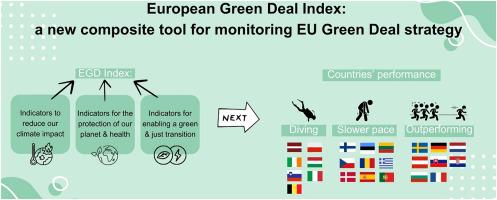
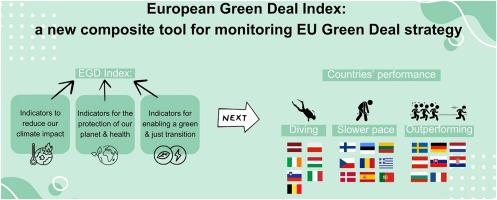
The European Union's growth strategy, called "The European Green Deal," strives to create a competitive economy in which there are no net emissions of greenhouse gases in 2050 and growth is decoupled from resource use. This paper aims to develop a new composite indicator, the European Green Deal Index, to analyse the implementation of the European Green Deal in the Member States. This index is based on 26 indicators proposed by the European Commission, categorised under the three pillars of reducing climate impact, protecting our planet and our health, and enabling green and just transition. The new index makes possible to identify the leading and lagging countries as well as the convergence/divergence between European Union countries on their path towards a zero-emission and climate-neutral economy. We employ a sensitivity analysis to compute the European Green Deal Index. Our analysis shows that the high complexity of the European Green Deal strategy poses a major challenge for most European Union countries to achieve all Green Deal targets. According to the value of the European Green Deal Index, Estonia, Sweden, and Latvia, as well as Austria, are leading countries, suggesting that North European paths toward a green economy are the most suitable approach for implementing the European Green Deal. Our analysis revealed a slight upward divergence in European Green Deal values among Member States. When analysing the development of the paths to achieving the Green Deal targets, we find that France, the Netherlands, and Germany are among the frontrunners with an above-average paths.
欧盟的增长战略被称为“欧洲绿色协议”(The European Green Deal),其目标是创造一个有竞争力的经济,在这个经济中,到2050年温室气体的净排放量为零,增长与资源使用脱钩。本文旨在开发一个新的综合指标,即欧洲绿色协议指数,以分析成员国对欧洲绿色协议的实施情况。该指数基于欧盟委员会提出的26项指标,分为减少气候影响、保护地球和人类健康、实现绿色公正转型三大支柱。新的指数可以确定领先和落后的国家,以及欧盟国家在实现零排放和气候中和经济的道路上的趋同/分歧。我们采用敏感性分析来计算欧洲绿色交易指数。我们的分析表明,欧洲绿色协议战略的高度复杂性对大多数欧盟国家实现所有绿色协议目标构成了重大挑战。根据欧洲绿色交易指数的价值,爱沙尼亚、瑞典、拉脱维亚以及奥地利是领先的国家,这表明北欧走向绿色经济的道路是实施欧洲绿色交易的最合适的途径。我们的分析显示,各成员国在欧洲绿色协议价值观上的差异略有上升。在分析实现《绿色协议》目标的路径发展时,我们发现法国、荷兰和德国的路径高于平均水平,处于领先地位。
期刊介绍:
The Journal of Cleaner Production is an international, transdisciplinary journal that addresses and discusses theoretical and practical Cleaner Production, Environmental, and Sustainability issues. It aims to help societies become more sustainable by focusing on the concept of 'Cleaner Production', which aims at preventing waste production and increasing efficiencies in energy, water, resources, and human capital use. The journal serves as a platform for corporations, governments, education institutions, regions, and societies to engage in discussions and research related to Cleaner Production, environmental, and sustainability practices.




 京公网安备 11010802042870号
京ICP备2023020795号-1
京公网安备 11010802042870号
京ICP备2023020795号-1

 分享
分享
 求助内容:
求助内容: 应助结果提醒方式:
 扫码关注我们
